Tuesday, May 28, 2019

OnePlus 7 Pro Nebula Blue colour variant to go on sale at 12 PM today: Price, specs and all you need to know

The OnePlus 7 Pro is going up for sale today and this time, in Nebula Blue colour variant. The smartphone has already been available but not in the Nebula Blue colour model. The handset will be available via Amazon and OnePlus.from 12 PM today in 256GB storage model, with an option to select from 8GB and 12GB RAM variants. The OnePlus 7 Pro sports an almost bezel-less display design, thanks to a pop-up camera. It has a 90Hz refresh rate for the display and a triple-rear camera setup, which consists of a 48MP sensor. 

OnePlus 7 Pro features and specifications

The OnePlus 7 Pro comes equipped with a 6.67-inch fluid AMOLED display with a QHD+ resolution. The handset’s display is HDR10+ certified and features a 90Hz refresh rate, which makes for smoother transition animations, navigation and supported video playback. It runs on the Qualcomm Snapdragon 855 SoC and is coupled with up to 12GB RAM and 256GB of storage. You can read our performance review of the phone here.  

In terms of optics, the OnePlus 7 Pro features a triple rear camera setup. It consists of a 48MP Sony IMX 586 sensor , which is paired with an f/1.6 aperture lens with a custom-made 7-element plastic lens. This sensor gets OIS and EIS supports, and is supplemented by an 8MP telephoto lens that offers 3X zoom. Finally, a 16MP ultra-wide lens is also present. The 8MP sensor is coupled with an f/2.4 aperture lens and it also gets OIS. On the other hand, the 16MP ultra-wide lens is paired with an f/2.2 aperture lens with a 117-degree field of view. Read our camera review and comparison of the smartphone here..

The OnePlus 7 Pro is backed by a 4000mAh battery that supports Warp Charge 30 at 5V/6A and the device also sports stereo speakers, which the company says were tuned by working closely with Dolby. It comes equipped with an in-display fingerprint sensor and also features improved haptic feedback, thanks to a new vibration motor. The handset runs on OxygenOS 9 on top of Android 9 Pie. 

OnePlus 7 Pro price, offers

The OnePlus 7 Pro starts at Rs 48,999 for the 6GB RAM + 128GB storage variant. However, the device’s Nebula Blue colour model is available only with 8GB and 12GB RAM, both of which are coupled with 256GB storage and are priced at Rs 52,999 and Rs 57,999 respectively. The handset will be available via Amazon, OnePlus.in, Reliance Digital, MyJio, OnePlus exclusive offline store, and Croma stores at 12 PM today. 

Sale offers on the phone includes benefits worth Rs 9,300 from Reliance Jio and up to 70 percent guaranteed exchange value from Servify. There’s also up to Rs 2,000 discount for SBI card holders.

http://bit.ly/30PFtTl

Oppo Reno, Reno 10x Zoom Edition to launch in India today: How to watch live stream, specs, expected price and more

Oppo will launch its Reno series of smartphones in India at an event today. The phone maker has already announced the Oppo Reno and Oppo Reno 10x Zoom smartphones in China and is all set to launch the phones in India. While the two phones share a similar design that consists of a shark fin popup camera module, Oppo Reno is a mid-range handset that runs on Snapdragon 710 SoC, while the Oppo Reno 10x Zoom Edition is a flagship device that is equipped with the Snapdragon 855. Additionally, the standard Oppo Reno features a dual rear camera setup while its bigger sibling sports a triple camera setup that consists of a 48MP main camera sensor. 

Oppo Reno, Reno 10x Zoom Edition: How to watch livestream

The launch event of the smartphones was slated to go live at 12 PM today but it seems like the company has rescheduled it for 1 PM. The launch event is being live streamed via the company’s social media channels but you can watch it directly from the video embedded below. Rest assured, Digit will update you with everything there is to know about the phones once they are announced. 

Oppo Reno, Oppo Reno 10x Zoom Edition specifications

As mentioned earlier, the Oppo Reno 10x Zoom Edition is the company’s flagship device that features a 6.6-inch AMOLED display and runs on the latest Snapdragon 855 SoC. It comes with up to 8GB RAM and up to 256GB of internal storage. It comes with three cameras on the back, which consist of a 48MP primary sensor, which is supplemented with a 13MP sensor with a periscope telephoto lens and an 8MP super wide-angle lens. On the front is a 16MP camera that is housed in the shark fin module. The handset is backed by a 4065mAh battery that supports VOOC 3.0 fast charging.

Coming to the standard Oppo Reno, it is a mid-range handset that is powered by the Snapdragon 710 SoC. It sports a 6.4-inch full-HD+ AMOLED display and comes with up to 8GB RAM and 256GB of internal storage. In the camera department, it sports dual sensors on the back. It features a 48MP primary camera sensor that is assisted by a 5MP secondary depth sensor with an f/2.4 aperture. On the front, it features a shark fin 16MP selfie pop-up camera with an f/2.0 aperture lens. The handset includes a 3765mAh battery with VOOC 3.0 fast charging.

Oppo Reno, Reno 10x Zoom Expected Price

In China, the Oppo Reno 10x Zoom comes in Fog Sea Green and Extreme Night Black colours. Its 6GB RAM + 128GB storage variant is priced at 3,999 Yuan (approx Rs 41,000), while the 6GB RAM + 256GB storage variant costs 4,499 Yuan (approx Rs 46,000). The 8GB RAM + 256GB storage variant is priced at 4,799 Yuan (approx Rs 49,500). 

The Oppo Reno standard edition was announced in Fog Sea Green, Extreme Night Black, Nebula Purple and Pink Mist colours in China. The 6GB + 128GB variant of the handset is priced at 2,999 Yuan (approx Rs 31,000), while its 6GB + 256GB version costs 3,299 Yuan (approx Rs 34,000). The phone’s 8GB RAM + 256GB storage variant was announced for 3,599 Yuan (approx Rs 37,000). 

While there’s no intimation about the phone’s pricing in India, we can expect the company to price the handset similarly or slightly lower over here.

http://bit.ly/2XcbQcG

Worlds deadliest laptop is being auctioned for over 12 million

Would you consider computer viruses as a work of art? A laptop loaded with six of the world’s deadliest viruses is being sold at an auction, hoping for someone to be brave enough to buy it. The viruses loaded in the laptop have reportedly caused over $100 million in damages worldwide. In fact, some of them can still be contracted from the internet. So would you call it a piece of art? Or the world’s most dangerous computer? It doesn’t help that the laptop is running on Windows XP, the popular but now phased-out operating system that Microsoft has completely stopped support for.

The ‘piece of art’ is titled “The Persistence of Chaos” and is nothing but a Samsung NC10-14GB 10.2-inch laptop, a 2008 model that’s running on Windows XP (Service Pack 3). The laptop is loaded with six deadly malware. The auction is being streamed live for everyone to see.

The project was conceived by a cybersecurity firm called Deep Instinct while the laptop has been created by the artist Guo O Dong. The bidding for the laptop has already crossed $1.2 million in a private auction, even though it’s open for anyone to bid online.

The laptop is presently being stored isolated in an air-gapped space so that these six viruses cannot escape from the computer into other machines. It will stay that way unless someone connects the laptop to Wi-Fi or plugs in a USB stick.

The six viruses include ILOVEYOU, MyDoom, SoBig, WannaCry, Dark Tequila, and BlackEnergy. The official listing of the deadly laptop states the auction is purely meant for ‘academic reasons’ as the sale of hardware malware for operational purposes is illegal. To recall, some of these viruses have wrecked quite a havoc worldwide. The WannaCry ransomware is credited to have crashed the UK’s National Health Service which caused about $100 million in damages. BlackEnergy, on the other hand, was used to create large-scale blackouts in Ukraine in 2015.

The bidding for the auction is still ongoing and you can see the laptop being live-streamed on the auction’s website. It’ll be interesting to see what’s the final price the laptop will fetch.

http://bit.ly/2X8VsKb

10 TV deals to enjoy the Cricket World Cup 2019

The TV is no longer an idiot box that sits in your living room for the occasional viewing experience. It is a window into alternate realities, immersive stories and in the case of sports, has the potential to put you in the centre of the playing field. If you are one looking to upgrade your TV viewing experience then this is the story for you. Here we will list deals on TVs that you can avail to enjoy an immersive World Cup experience. 

SHINCO Smart 124 cm (49 inch) 4K (Ultra HD) LED S50QHDR10 TV

The Shinco 50-inch TV is a 4K TV with support for HDR 10. The TV is available in 43-inch as well as 55-inch screen size options. For your connectivity needs, the TV has 3 HDMI ports and 2 USB ports. The remote control of the TV has controls on both sides. One side is a traditional remote control and the other is a QWERTY keypad for logging into services. The TV has 20W sound output and runs on Android 7 AOSP out of the box.Click here to buy.

CloudWalker 139 cm (55 inches) Cloud 55SU 4K LED Smart TV

The CloudWalker 55-inch TV is a 4K TV and is available in 43-inch screen size as well. For your connectivity needs, the TV has 3 HDMI ports and 2 USB ports. The TV has 20W sound output and runs on Android 4.4 AOSP out of the box. The TV has Bluetooth 4.0, 1GB RAM and 8GB storage for your apps. Click here to buy.

Kodak 140 cm (55 inches) UHD 55UHDXSMART 4K Ultra HD Smart LED TV 

The Kodak 55-inch TV is a 4K TV with support for HDR 10. The TV is available in 50-inch screen size as well. For your connectivity needs, the TV has 3 HDMI ports and 2 USB ports. The TV has 20W sound output and runs on Android AOSP out of the box. The TV supports WiFi, has 8GB storage and support for streaming services. Click here to buy.

TCL 138.71 cm (55 Inches) 4K UHD LED Smart Certified Android TV L55P2MUS 

The TCL 55-inch TV is a 4K TV with support for HDR Pro. For your connectivity needs, the TV has 4 HDMI ports and 2 USB ports. The TV has 16W sound output and runs on Android TV OS out of the box. The TV has 2.5GB RAM and 16GB storage. You also have access to the Google Play store for apps. The TV also features built-in Chromecast and comes with a voice-enabled remote control in the box. Click here to buy.

Mi LED TV 4 PRO 138.88 cm (55) Ultra HD Android TV

The Mi LED TV is one of the thinnest TVs you can get. It was also the first Xiaomi TV to launch in India. For your connectivity needs, the TV has 3 HDMI ports and 2 USB ports. The TV comes with a minimalistic remote control very reminiscent of the Apple TV remote control. The TV has its own PatchWall UI running on the Android OS.Click here to buy.

LG 125cm (49 Inch) 49UK6360PTE UHD Smart TV Al ThinQ

The LG 49-inch TV is a 4K TV with support for Active HDR. For your connectivity needs, the TV has 2 HDMI ports and 1 USB ports. The remote control of the TV is minimalistic and brings with it voice controls. The TV runs on LG’s webOS and also features the Google Assistant. The TV also supports 2 way Bluetooth.Click here to buy.

Panasonic 138 cm (55 Inches) 4K UHD LED Smart TV TH-55FX650D

The Panasonic 55-inch TV is a 4K TV with support for HDR 10. The TV is available in 43-inch as well as 49-inch screen size options. For your connectivity needs, the TV has 2 HDMI ports and 1 USB ports. The remote control of the TV has a traditional design. The TV has 20W sound output and supports 2 way Bluetooth2.Click here to buy.

Samsung 138 cm (55 inches) 55NU7090 4K (Ultra HD) LED Smart TV 

Samsung 55-inch TV is a 4K TV. For your connectivity needs, the TV has 2 HDMI ports and  USB port. The TV has 20W sound output and runs on Samsung own Tizen OS out of the box. Click here to buy.

Sony Bravia 138.8 cm (55 Inches) 4K UHD OLED Smart Android TV KD-55A8F

The Sony A8F is a flagship OLED TV from Sony. The TV has an OLED panel and runs on Android TV out of the box. The TV boasts of a 4K resolution along with support for HDR 10 and Dolby Vision. For your connectivity needs, the TV has 4 HDMI ports and 3 USB ports. The remote control of the TV is traditional and supports voice controls. The TV has 50W sound output.Click here to buy.

Samsung 163 cm (65 Inches) Q Series 4K UHD QLED Smart TV QA65Q8CNAK

The Samsung Q8C is a flagship QLED TV from Samsung. The TV has a QLED panel and runs on Samsung’s Tizen OS. The TV boasts of a 4K resolution along with support for HDR. For your connectivity needs, the TV has 4 HDMI ports and 3 USB ports. The remote control of the TV supports voice controls. The TV has 40W sound output.Click here to buy.

http://bit.ly/2HFylBy

Nvidia announces Studio laptops aimed at creators and Nvidia Quadro RTX GPUs for laptops

We were expecting a slew of announcements from Computex 2019 and we aren’t disappointed. A day ahead of the event, Nvidia has made a slew of announcements including a new Nvidia Studio platform, along with a full range of Turing architecture-based Quadro GPUs for mobile workstations. Nvidia Studio is a collection of company’s RTX GPUs, Stack of specialized SDKs and dedicated Studio Drivers. They are the company’s new software-hardware initiative aimed at creators that were introduced with 17 RTX Studio laptops at Computex from seven PC manufacturers. On the other hand, the new range of NVIDIA Quadro RTX-powered mobile workstations features Quadro RTX 5000, 4000 and 3000 GPUs.

Nvidia Studio

Nvidia is rebranding its existing Creator-Ready Drivers to Studio Drivers and the collection of SDKs and APIs under the branding is said to boost performance and efficiency in creative software. Along with GeForce RTX 2080, 2070 and 2060 GPUs, the laptops featuring RTX Studio branding will also come with the new Quadro RTX 5000, 4000 and 3000 GPUs. Comparing the performance of new laptops, Nvidia claims they speed up content creation with up to 7x than the MacBook Pro. Many of the laptops sport 4K precision displays and the company’s Max-Q technology. 

The company has also announced Nvidia Studio Stack, which is a set of software aimed at digital content creators. It consists of Nvidia Studio SDKs and APIs for app developers, along with NVIDIA Studio Drivers for creators. Nvidia says its Studio Drivers are testing against multi-app creator workflows and creative applications from developers such as Adobe, Autodesk, Avid, Blackmagic Design, Epic, Maxon and Unity. The company’s RTX Studio laptops will be available from June with a price starting at $1,599 (Rs 1.11 lakhs) but this can change based on partner designs, features and region.

Nvidia Quadro RTX powered laptops 

As mentioned, Nvidia has also announced new Quadro RTX 5000, 4000 and 3000 GPUs for laptops at Computex 2019. The GPUs are aimed at delivering AI acceleration, 8K video editing and VR with GPU memory of up to 16GB. The new lineup of mobile workstations also features Quadro T2000, T1000, P620 and P520 GPUs. 

Nvidia Quadro equipped systems will start shipping in the second half of 2019. Global OEMs such as Dell, HP, Lenovo and regional system builders including MSI will include the new GPUs in their offerings. 

http://bit.ly/2JNdRcz

Oppo Reno Z with Snapdragon 710 SoC, 64-inch AMOLED display launched in Europe

After launching the Reno, Reno 10x Zoom, and the Reno 5G smartphones, Oppo has now launched a mid-range device called the Reno Z for the European market. The phone is priced at 150 Euros, which translates to approximately Rs 11,500. The phone will be available in Ocean Green and Jet Black colors sometime in June. There is no information on when the handset will launched in other markets.

Oppo Reno Z specifications

The Oppo Reno Z sports a Full HD+ 6.4-inch display AMOLED display with a resolution of 2340 x 1080 pixels, and 19.5:9 aspect ratio. The display has a waterdrop notch thin bezels on all sides and sports an in-display fingerprint sensor. The smartphone has the Qualcomm Snapdragon 710 chipset, which is paired with 6GB of RAM and 128GB onboard storage. It packs a 3,950mAh battery and features a 20W VOOC 3.0 Flash Charge technology support.

In the camera department, the comes equipped with two cameras at the back. The dual-camera setup consists of a 48MP Sony IMX586 primary sensor, and a 5MP secondary depth sensor. The notch on the display houses a 32MP selfie shooter. Reportedly, the rear panel features an O-Dot ceramic paint for protecting the camera glass on the sensors when the device is laid flat on a surface. The phone sports a 3.5mm audio jack, and it runs Android 9 Pie-based ColorOS 6.0.

http://bit.ly/2EDWG94

Wolfenstein: Youngblood and Quake II get ray-tracing support

Ray-Tracing is the new buzzword when it comes to PC graphics and now it looks like those planning to get their hands on the new graphics cards will get something extra with their purchase. Nvidia and games publisher, Bethesda have announced that the next game in the Wolfenstein series, Wolfenstein: Youngblood will include support for real-time ray-tracing effects as well as Nvidia Adaptive Shading and more. Further, the two also announced that the classic 90s FPS game, Quake II, would get remastered with ray-tracing. The remaster is aptly called Quake II RTX.

As an added bonus, Nvidia has launched a ‘Born to Hunt’ bundle for GeForce RTX GPUs. For a limited time, those who purchase an eligible GeForce RTX 2080 Ti, 2080, 2070, or 2060 equipped graphics card, desktop PC or laptop will receive a copy of Wolfenstein: Youngblood. The game is scheduled to be released on July 26.

This isn’t the only freebie gamers can expect. The demo of Quake II RTX will be available for free for anyone who owns a GeForce RTX graphics card. The demo would include the first three levels of the game. However, if the user already owns a copy of Quake II, then the can enjoy the entire game, including the entire campaign and play against other players in multiplayer. The game will be released on June 6 and will be available on Steam and Nvidia’s website.

Nvidia also noted that the source code will be posted to GitHub. The aim is to enable other users to expand upon the game with improvements and enhancements or use it to ray trace Quake II mods and more. You can learn more about Quake II RTX here. 

http://bit.ly/2Xbo7hI

Google Files offering reward of up to Rs 1,000 for sharing files offline

People generally use Google's File manager to clean loads of junk from their phones as well as share files when there is no internet connection. Users can now use the app for another interesting purpose, that is, to earn some money. With an aim to encourage people to use its file manager, Google is offering a chance to earn up to Rs 1000, which can later be used to purchase items by using it as Google Pay credit.

After booting up the app, one will be greeted with a message, “Send a file to start earning rewards.” In case you have multiple accounts, choose the account to link with the app and proceed to the next page. A text will appear saying, “Get friends to try sharing with you and earn up to Rs 1000. You'll claim your reward in Google Pay.” We tried the same and won Rs 10 as a reward that can be claimed via Google Pay. Do note that only who gets the option to enrol in the reward program will get to earn money.

Reportedly, for every successful transfer, customers can earn a prize of up to Rs 100. The offer is limited to ten successful transfers, which essentially makes it Rs 1,000. The app passed more than 100 million downloads in January. Google rebranded its file management app Files Go to Files in November. The Files app was meant for low-end phones and as a means to share files in offline in areas with patchy internet connectivity like in countries such as India. In November, the app is also got a revamped user experience with a Material Theme design and the background colour theme has also changed to white.

The company had also improved the connection protocol and claimed that it would take an average of five seconds for connecting two devices. Google also added some security measures for secure connection establishment and encrypted transfers. The offline file sharing speed can use 5GHz Wi-Fi Direct for sharing files at speeds of up to 490Mbps.

http://bit.ly/2EzrjMQ

Computex 2019: Asus ZenBook Duo series, ZenBook and VivoBook series with ScreenPad, ROG series and more announced

A couple of days before Computex 2019, Asus unveiled everything it’s going to show at the popular annual trade fair in Taipei. We, at Digit.in, were one of the first few to get an exclusive sneak peek at its new products for this year. Here’s a list of everything the Taiwanese electronics manufacturer showed us ahead of Computex 2019. If there’s anything we can say for sure at the moment about these products, it’s that Asus is betting big on its ScreenPad innovation. You’ll remember that it was first seen on the Asus  ZenBook Pro 15 that we reviewed last year. It’s essentially a touchscreen display within the laptop’s touchpad—only this time around—Asus has made more and improved variants of it for this year’s models. Let’s take a closer look:

ZenBook Duo, ZenBook Pro Duo

This is it. This is Asus’ headline product for this year’s Computex event. The ZenBook Duo and ZenBook Pro Duo come with one and a half screens each in that there’s a regular display on the top fold of the laptop and another slim display just above the keyboard on the bottom half. It’s called the ScreenPad Plus. The keyboard and touchpad have moved further down the base panel, so there’s no space left to rest your palms. But that’s all right, Asus says, because the ZenBook Pro Duo comes with a bundled palm rest accessory. It also comes with an active stylus pen.

According to Asus, the smaller second display on the base panel can be used to boost productivity. A typical user could have up to three smaller pop-up apps open there to avoid distractions on the main display. For example, a user could have Spotify or YouTube running in a small window on the ScreenPad Plus display and use the main display for work. Asus’ proprietary software also helps the user create profiles for different window positions so they won’t have to keep dragging and dropping frequently used apps in the second display.

While the ZenBook Duo has a 14-inch Full HD display combined with a 12.6-inch Full HD ScreenPad Plus display, the ZenBook Pro Duo has a 15.6-inch 4K Ultra HD OLED touchscreen display combined with a 14-inch 4K ScreenPad Plus display. While the ZenBook Duo comes with an Intel 9th Gen Core i7 CPU and an NVIDIA GeForce MX250 graphics card, the ZenBook Pro Duo is powered by an Intel 9th Gen Core i9 CPU and an NVIDIA GeForce RTX 2060 graphics card. Expect to see this strange new device in the market sometime in  the third quarter of this year.

ZenBook 13/14/15 with ScreenPad

Asus’ ZenBook series, which was already available in 13-,  14-, and 15-inch sizes, now gets the ScreenPad treatment. ScreenPad 2.0 is now available on all three sizes of the ZenBook line-up. At first glance, it’s evident that  it looks significantly wider than the touchpad on the outgoing models. According to Asus, ScreenPad 2.0 will support Microsoft Store apps, like Spotify and Evernote. There’s nothing noticeably different about the new ZenBook series apart from the upgraded touchpad. Expect the series to come with Intel’s 9th Gen Core series CPUs.
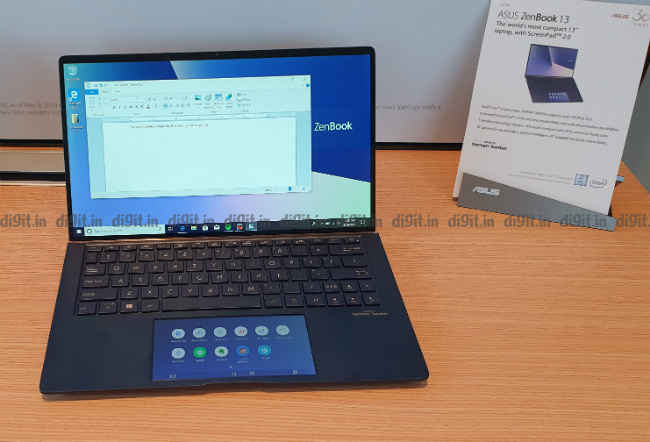
VivoBook S14/S15 with ScreenPad

Asus has equipped even some of its VivoBook laptops with a ScreenPad. Some VivoBook S14 and S15 models with ScreenPad 2.0. Like the ScreenPad on the ZenBook line-up, the ScreenPad on the VivoBook S14 and S15 supports Microsoft Store apps. It also comes with some inbuilt tools from Asus, such as document editor helper and a soft numpad. The document editor helper has common shortcuts for document processing apps like Microsoft Word. The new VivoBook S14 and S15 are expected to come with a new set of colours and body finishes.

ROG Strix XG17

The ROG Strix XG17 is a 17.3-inch portable gaming display. The IPS panel has a refresh rate of 240Hz and a response time of 3ms. It also comes with Adaptive Sync and a 3-hour battery life (at 240Hz refresh rate). It’s bundled with a case for easy carrying. The sides have a Micro HDMI port and a USB Type-C port. It can be hooked up to a PC or mobile phone for a better gaming experience.

TUF Gaming monitors

Asus has three new TUF Gaming monitors for gaming namely the TUF Gaming VG27AQ, TUF Gaming VG32VQ, and TUF Gaming VG27BQ. The first is a 27-inch IPS display with a WQHD resolution. The second is a 31.5-inch curved VA panel with a 144Hz refresh rate and WQHD resolution. The last one is a 27-inch TN panel with a 155Hz refresh rate and WQHD resolution. Asus recommends the last one for those seeking a very high refresh rate.

ROG Mothership GZ700

We’ve seen this one before at CES. The Asus Mothership GZ700 looks like a beefed-up Microsoft Surface Pro but is actually a gaming desktop replacement, at least, that’s what Asus says. It has a kickstand and a magnetically detachable keyboard unit similar to those on Microsoft’s popular device. The Intel 9th Gen Core i9 inside it is factory-overclocked and surrounded by a liquid metal compound. The large 17.3-inch 4K display covers 100 percent of the colours in the Adobe RGB colour space.

ROG Strix Scar III/Hero III

Asus is replacing the Strix Scar II and Hero II with the Scar III and Hero III respectively but admits that most of the changes to the new model are in the design department. The new models will be powered by Intel’s 9th Gen Core series octa-core CPUs and NVIDIA’s GeForce RTX series graphics. The display is now a 240Hz panel with a response time of 3ms. Asus has integrated a small digital key called Keystone in the two models. It allows the user to store their personal colour and lighting profiles in it, among other things. Both laptops have a light strip running around the base panel for that “floating” effect. We’ll know more about both models in the coming weeks and months.

ROG Strix G531/G731

Aiming to please eSports gaming enthusiasts, the new ROG Strix G531 and G731 come with features similar to those on the Strix Scar series. While the G531 is a 15.6-inch model, the G731 is a larger 17.3-inch model. Both models get wrap-around multi-colour lighting, like the Strix Scar series. Expect them to be launched with Intel’s 9th Gen Core series CPUs.

ROG Zephyrus G GA502

Expected to start at $1,199 (Rs 83,000 approx) in the US, the Zephyrus G GA502 is a slim gaming laptop with an AMD Ryzen 7 CPU and NVIDIA GeForce GTX 1660 Ti graphics card. On the inside it has 16GB of RAM and a 512GB PCIe NVMe solid-state drive. The styling on the Zephyrus is G can be best be termed convservative until we get a review unit in our hands.

ROG Zephyrus M GU502

The Zephyrus M GU502 comes with a Pantone-validated 240Hz IPS display with a 3ms response time. It also comes with an NVIDIA GeForce RTX 2060 graphics card to do what it’s built for. It measures 18.9mm in thickness and weighs 1.9 kilogrammes. Though it has a large power brick, it can be charged through a USB-C port. For storage, it has dual M.2 solid-state drives with RAID 0. The body is made of reinforced magnesium alloy and the base panel has a soft-touch finish.

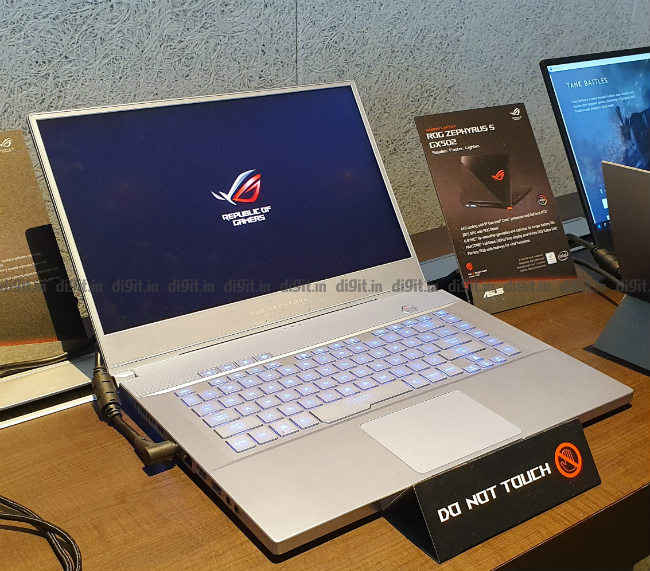
ROG Zephyrus S GX502

According to Asus, the ROG Zephyrus S GX502 is the “world’s first 240Hz/3ms IPS panel gaming laptop” for everyday use. Like its M counterpart, the Zephyrus S GX502 has a display with 240Hz refresh rate and a 3ms response time. The card pushing pixels to it is an NVIDIA GeForce RTX 2070. In addition, it uses a centered keyboard and an Active Aerodynamic System technology to keep temperatures in check.
ROG Theta Flagship Headphones

Asus has two new pairs of flagship gaming headphones under the Theta sub-brand. The ROG Theta sports 7.1-channel surround sound with a total of 8 large Essence drivers; the largest driver is 30mm. Bass is delivered through the same drivers virtually without any separate bass driver. According to Asus, it also has a USB-C port and AI-powered noise-cancelling microphone. The ROG Theta Electret, on  the other hand, is an analogue pair with an impedance of 32 ohms and silver-plated copper cables.

ExpertBook, ExpertPC, and others

Asus is rebranding its ASUSPRO PC models. The company’s range of PC models for commercial markets will be called ExperBook and ExpertPC. The ExpertBook line-up will consist of laptops designed specifically for use in large enterprises with security features, like TPM (Trusted Platform Module) and a physical shutter for the webcam. It will also get vPro variants of Intel’s Core series CPUs. Asus is also planning to launch a new range of Wi-Fi routers with support for Wi-FI 6.

http://bit.ly/30ND5N2

Redmi K20 spotted on Geekbench, K20 Pro appears in live images

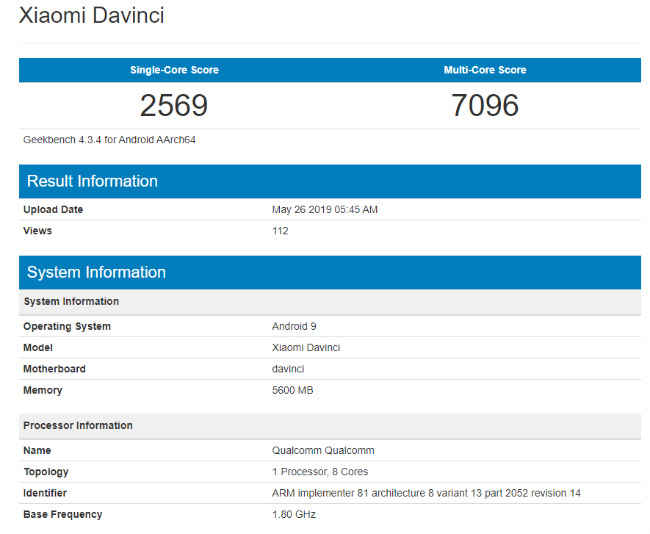
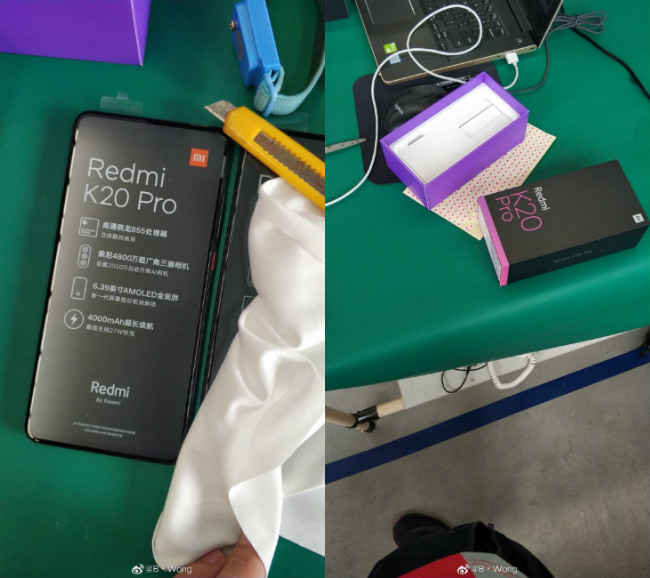
Redmi will launch the K20 smartphone in China, and just ahead of the on May 28 launch event, the phone has been spotted on Geekbench. Further, the reports about a Pro variant also seems to be true as the handset has appeared in live images. Both these developments now suggest that the Pro variant will have the Snapdragon 855 processor, and the Geekbench listing shows that the regular variant will ship with Snapdragon 730 SoC.

According to a listing on Geekbench, the Redmi K20 is codenamed as Da Vinci and will have 6GB of RAM. It scores 2,569 points in single-core, and 7,096 points multi-core benchmarking tests. It runs on the Android 9 Pie. Samsung Galaxy A80 is the other phone that has the Snapdragon 730 under the hood but we still don’t know its performance numbers yet. The phone is expected to launch in India in June.

Now coming to the Redmi K20 Series, live images of the rumoured K20 Pro have now surfaced on the internet. According to the images, the Pro variant will be a flagship device with top-end hardware. According to a recently leaked spec sheet, the Redmi K20, or Redmi K20 Pro features a 6.39-inch Super AMOLED screen, with a Full HD+ resolution (1080 x 2340 pixels), and Gorilla Glass 6 protection.

It is expected that the phone would get four variants: 6GB RAM + 64GB storage, 6GB RAM + 128GB storage, 8GB RAM + 128GB storage and 8GB RAM + 256GB storage. In the camera department, the phone will sport a triple-camera setup, with a 48MP main sensor with f/1.7 aperture lens, a 13MP wide-angle sensor, and an 8MP telephoto sensor. The pop-up selfie shooter is said to be a 20MP sensor. It could be powered by a 4000mAh battery.

http://bit.ly/2Ww1wPA

How to convert legacy software into stateful containers

Most container applications are stateless. The transition to stateful container apps requires a new approach. https://tek.io/2YRNZzk https://ift.tt/eA8V8J

Indian Army plans to use AI to take the fight to the next level

The army plans to use AI technology that can predict, for instance, when a tank would require its next servicing, its remaining life and potential failures. http://bit.ly/2QxYpS4 https://ift.tt/eA8V8J

Intel 10th Gen Core 'Ice Lake' 10nm CPUs Unveiled at Computex 2019

Intel's Computex 2019 keynote focused on products that deliver performance and responsiveness across PC categories. http://bit.ly/2wmIo86

TikTok Parent ByteDance Developing Its Own Smartphone: Report

ByteDance, the company that runs video sharing platform Tiktok, is reportedly working on a smartphone that will come with many of its apps and services pre-installed http://bit.ly/2HFypkH

All You Need to Know About X-Men: Dark Phoenix

X-Men: Dark Phoenix release date in India, cast, review, trailer 2 and 3, poster, timeline, and more - here's everything you need to know about the latest X-Men movie. http://bit.ly/2K7fiBP

Sources: private capital giant Apollo Global has shorted loans and rapidly cut exposure to the enterprise software sector in 2025 amid concerns over AI threat (Financial Times)

Financial Times : Sources: private capital giant Apollo Global has shorted loans and rapidly cut exposure to the enterprise software sect...