Wednesday, July 22, 2020

Singaporean startup Partipost gets $3.5 million to let anyone become an influencer

Partipost, a Singapore-based marketing startup that lets anyone with a social media profile sign up for influencer campaigns, has raised $3.5 million in new funding. The round was led by SPH Ventures, the investment arm of publisher Singapore Press Holdings, with participation from Quest Ventures and other investors.

The funding will be used to grow Partipost’s current operations in Singapore, Indonesia and Taiwan, and expand into Vietnam, the Philippines and Malaysia, other Southeast Asian markets with heavy social media usage. Since launching its mobile app in 2018, Partipost says it has added about 200,000 influencers to its platform, and that over the past 12 months, it has helped conduct 2,500 social media marketing campaigns for more than 850 brands, including Adidas, Arnott’s, Red Bull, Chope and Gojek.

According to benchmark report released in March by Influencer Marketing Hub, the influencer marketing industry is expected to be worth about $9.7 billion in 2020, with companies spending increasing amounts on social media campaigns and working with more “micro-influencers.” To serve them, the report said that more than 380 new influencer marketing agencies and platforms were launched last year, joining a roster of companies that already include AspireIQ, Upfluence, BuzzSumo, SparkToro and Inzpsire.me, to name just a few examples.

While most of these companies focus on helping brands identify the influencers with the widest social media reach, Partipost lets anyone sign up to take part in a campaign.

“Partipost’s main difference is that we believe that everyone can be an influencer,” founder and chief executive officer Jonathan Eg told TechCrunch. “Even if you have 200 followers, you can be one. We want to create a new market that we believe will be the future. Everyone can post on social media, write a review or give some feedback and be paid for it.”

“We want to empower everyone to monetize off their own data and influence and not just allow the big tech companies to do so,” he added.

Aspiring influencers browse brand campaigns on Partipost’s app and apply to take part by submitting a post draft. If the brand approves it, the user can then go ahead and post it on their social media profiles.

The amount of cash they earn is based on how much engagement each post receives. According to the company’s website, most campaigns require a minimum of 200 followers or more, and successful users can earn an average of $5 to $150 per campaign, depending on the brand’s payout structure.

One of Partipost’s selling points for brands is that it enables them to sign up thousands of influencers for a campaign in a single day, help them react quickly to online trends. Part of the funding will also be used to build data tools to help brands match campaigns with Partipost users more efficiently. The company says it expects to increase its base of aspiring influencers to one million within the next 18 months.

As part of the funding, SPH Ventures chief executive officer Chua Boon Ping will join Partipost’s board, while Quest Ventures partner Jeffrey Seah will become an observer.

In a media statement, Chua said, “Social influencer marketing is one of the fastest growing segments within Digital marketing. Hence, we are very excited to lead Partipost’s Series A round to further accelerate its growth. We are impressed by Partipost’s strong traction in Singapore, Indonesia and Taiwan as a young startup and look forward to partnering it to scale to new markets.”

NY legislature passes a bill pausing use of facial recognition and other biometric ID tech in schools until 2022, the first such regulation in the US if signed (Kyle Wiggers/VentureBeat)

Kyle Wiggers / VentureBeat:
NY legislature passes a bill pausing use of facial recognition and other biometric ID tech in schools until 2022, the first such regulation in the US if signed  —  The New York legislature today passed a moratorium banning the use of facial recognition and other forms of biometric identification in schools until 2022.


Shopify adds Affirm Inc. as a partner, working together to offer flexible payment plans to Shopify's US consumers; the plans are expected by the end of the year (Bloomberg)

Bloomberg:
Shopify adds Affirm Inc. as a partner, working together to offer flexible payment plans to Shopify's US consumers; the plans are expected by the end of the year  —  - Canadian e-commerce firm links with Affirm on payment plans  — Move aimed at luring shoppers who want to avoid credit cards


Propeller, a 3D mapping and data analytics company for construction, aggregates, mining, and waste management worksites, raises $18M Series B (Nick Greenhalgh/AmericanInno)

Nick Greenhalgh / AmericanInno:
Propeller, a 3D mapping and data analytics company for construction, aggregates, mining, and waste management worksites, raises $18M Series B  —  Denver's Propeller, a 3D mapping and worksite analytics company, announced today that it has raised $18 million in Series B funding to more rapidly scale its operations.


Tesla’s Megapack powers its small, but growing energy storage business

Tesla’s energy storage business picked up steam in the second quarter and even played a minor role in the company’s fourth consecutive quarter of profitability, according to earnings reported Wednesday.

Commercial and residential energy storage sales as well as solar are still mere slices of Tesla’s overall business, which is largely dominated by automotive. However, second-quarter results show some promise for energy storage, particularly Megapack, the utility-scale energy storage product that launched in 2019 and is modeled after the giant battery system it deployed in South Australia.

While Tesla does provide separate deployment stats for solar and energy storage, it combines the two when reporting revenue, making it impossible to fully measure the success of Megapack. However, Tesla made a point in its earnings statement to flag Megapack as a winner in the second quarter and noted that it turned a profit for the first time.

“There’s a lot of demand for the product and we’re growing the production rates as fast as we can,” Drew Baglino, senior vice president of powertrain and energy engineering, said during Wednesday’s earnings call.

For the past four years or so Tesla has been asking investors to view it as an energy company instead of just an automaker. Some analysts think that the real value in Tesla’s business will be when it actually achieves some level of parity between the two sides of the shop — a goal that Musk is also shooting for.

But energy storage and solar has remained in Tesla’s automotive shadow, despite assurances that these business products will eventually be equals. For now, energy storage remains a small, but growing, fraction of Tesla’s revenue.

CEO Elon Musk predicted its energy business would be roughly the same size at its automotive unit over the long term. He did not provide a timeline.

One product that Tesla is hoping will accelerate the growth of its energy storage business is Autobidder, the company’s machine-learning platform for automated energy trading.

Autobidder provides grid stabilization and ensures that things are “super smooth,” Musk said, adding that it is necessary in order to solve the sustainable energy problem

Overall, energy storage deployed was up 61% on a quarterly basis (from 260 megawatt hours to 419 megawatt hours) signs that the business is beginning to recover to levels before the COVID-19 pandemic hit. Energy storage deployments in the second quarter were still only 1% higher than the same period last year, illustrating that Tesla still has a ways to go before it hits numbers reached in the third and fourth quarters of 2019.

Meanwhile, Tesla’s solar deployments shrank.

Tesla installed 27 MW of solar in the second quarter, down 23% from the previous quarter and off 7% from the same period last year. Some of that slippage is likely due to the economic slowdown and shelter in place orders that swept the U.S. in response to COVID-19.

Tesla became the leading solar installer in the United States with its acquisition of SolarCity but its position slipped as Sunrun and Vivint Solar surged in the U.S. market. Now, its looking to regain some of that ground with its Solar Roof, a new shingle-like product that has been development and testing for years. Tesla said Wednesday that installations of the Solar Roof roughly tripled in the second quarter compared to the first quarter. However, the company did not provide specific figures, making it unclear just how many Solar Roof installations it has completed.


Twitter says hackers accessed the DM inbox for up to 36 of the 130 high profile accounts targeted in last week's attack (Devin Coldewey/TechCrunch)

Devin Coldewey / TechCrunch:
Twitter says hackers accessed the DM inbox for up to 36 of the 130 high profile accounts targeted in last week's attack  —  Last week's hack of over 100 very high-profile Twitter accounts did in fact expose the direct messages of many of those accounts, the company admitted today …


Amazon, Acko tie up to sell motor cover

Amazon’s entry as a corporate agent is in line with its plan to become a full-fledged financial services platform. Amazon Pay currently offers UPI, wallet and co-branded credit card services to users. https://ift.tt/2E7On7T https://ift.tt/eA8V8J

Tesla picks Texas, will redesign Model Y for European production

Tesla CEO Elon Musk attends an opening ceremony for Tesla China-made Model Y program in Shanghai, east China, Jan. 7, 2020

Enlarge / Tesla CEO Elon Musk attends an opening ceremony for Tesla China-made Model Y program in Shanghai, east China, Jan. 7, 2020 (credit: Xinhua/Ding Ting via Getty Images)

On Tuesday afternoon, Tesla CEO Elon Musk answered questions from investors following the publication of the company's latest quarterly results. The headlines news is that Tesla has picked Texas as the site for its next factory. When asked how many cars this new car plant could build, Musk told the call that "long term—a lot," with a chuckle.

Musk refused to be drawn into talking specifics about any new Tesla EVs beyond the ones we already know about. "It's reasonable to assume we'd make a compact vehicle... at some point," he said, before pointing out that the company has a long way to go with the Models 3 and Y.

The biggest asset value increase in history

Musk still believes that the introduction of a completely autonomous driving system will be a game changer for Tesla, and he predicted that it would result in a fivefold increase in the value of a car thanks to much higher utilization. With regards to that program, the "major milestone is the transition of the autonomy system—or the car's AI—from thinking in like 2.5D, doing image recognition, partially correlated in time, to 4D. What we've been doing this far is really mostly 2D and not well correlated in time. It's hard to convey just how much better a fully 4D system would work," Musk said.

Read 13 remaining paragraphs | Comments

https://arstechnica.com

Twitter admits hackers accessed DMs of dozens of high-profile accounts

Last week’s hack of over 100 very high-profile Twitter accounts did in fact expose the direct messages of many of those accounts, the company admitted today — including those of an elected official in the Netherlands.

The attack saw numerous popular accounts of celebrities and politicians taken over and tweeting a very obvious Bitcoin scam that nevertheless seems to have netted at least six figures. Twitter said that a “coordinated social engineering attack” gave hackers “access to internal systems and tools.” Verified users were also briefly prevented from tweeting (a change some welcomed).

In tweets and an update to its blog post on the “security incident,” Twitter said that “for up to 36 of the 130 targeted accounts, the attackers accessed the DM inbox.” They are “actively working on communicating directly” with those accounts affected.

Twitter had declined to say in the immediate aftermath of the attack whether DMs had been accessed by the hackers. Twitter’s messaging system is infamously not well encrypted but it was not clear whether the administrative tool reportedly used by the attackers offered access to inboxes.

Apparently whatever method was used, it gave access to DMs some of the time, or perhaps the hackers simply didn’t avail themselves of the opportunity for the remaining 94 accounts they took over. It’s not really clear from Twitter’s announcement. Twitter has previously said that it has “no evidence” that passwords were accessed by the hackers, and nothing in the update contradicts that.

The company’s attempted to place a silver lining on this cloud, saying it had “no indication that any other former or current elected official had their DMs accessed.” Considering the accounts of Barack Obama and Joe Biden were among those affected, that is technically good news.

This is almost certainly not the last we’ll hear from Twitter on this disturbing security breach.

UK’s Selina Finance raises $42M for its SMB loans platform based on home equity

When you need a loan, the cost and speed of getting it can be as critical to get right as the financing itself, a principle that might be even more relevant today in our shaky pandemic-hit economy than ever before. Today, a company that proposes to cut both the time and price for securing financing, with a platform, initially aimed at SMBs, that lets business owners put up their home property as collateral to get the loan, is announcing a funding round to expand its business.

Selina Finance, which provides loans to small and medium businesses in the form of flexible credit facilities — you pay back only what you borrow, and you do that over time, rather than in one lump sum — that are backed by the value of your personal home, is today announcing that it has raised £42 million ($53 million) — £12 million in equity and £30 million in debt to distribute as loans. The company says it plans to raise significantly more debt in the coming months as its business expands.

The funding is coming from several investors, including Picus Capital and Global Founders Capital — two firms that are tied in part to the Samwer brothers, which built the Rocket Internet e-commerce incubator in Berlin. The company’s valuation is not being disclosed.

London-based Selina plans to use the funding in a couple of areas: first, to continue growing its business in the UK, which was founded by Andrea Olivari, Hubert Fenwick and Leonard Benning and launched in June 2019; and second, to start the process of opening up to other markets in Europe.

Selina today focuses on SMEs whose applications qualify as “prime” (as opposed to sub-prime). They can borrow up to £1 million in funds — the average amount is significantly less, £150,000, says Olivari — with interest rates starting at 4.95% APR. That undercuts the rates on typical unsecured loans. Selina is also in the process of getting a license to expand its offering to consumer borrowers, too.

We’ve moved on from the days when property investing was so stable that “safe as houses” was a common expression to mean absolute reliability. But for most people, their properties continue to represent the single-biggest asset that they own and thus become a key part of how a person might construct their wider financial profile when it comes to borrowing money.

Selina’s tech essentially operates a kind of two-sided marketplace: on one hand, its algorithms process details about your property to determine its market value and how that will appreciate (or depreciate), and on the other, it’s evaluating the health of the SME business, and the purpose of the loan, to determine whether the borrower will be good for it. It’s only a year old and so it’s hard to say whether this is a strong record, but Benning notes that so far, no customers have defaulted on loans.

“We have the security of the home, yes,” he said, “but we only take credit-worthy customers to make sure the default scenario doesn’t happen. It’s something that we avoid at any cost. Technically there is a long process that leads to that outcome, but it almost never happens.” He noted that Selina has people on its team who have worked for sub-prime lenders, which gives them experience in helping to determine prime opportunities.

More generally, the idea of leveraging your property to raise capital — say, through a remortgage or loan against its value — are not new concepts: banks have been offering and distributing this kind of financing for years. The issue that Selina is addressing is that typically these deals come with high interest rates and commissions, and might take six to eight weeks from application to approval and finally loan. Selina’s pitch is that it can bring that down to five days, or possibly less.

“It’s critical that we can make a loan in five days to be be nimble and accurate, because this is one area where banks break down,” said Fenwick. “It can take two weeks to arrange for someone to walk around on behalf of a bank to make a valuation. It’s just a backwards and archaic process. We can use big data and tap different areas and dynamics all that into a model to assess the valuation of a property with a low margin of error.”

Selina is not the only tech company tackling this opportunity — specifically, Figure, the startup founded by Mike Cagney formerly of SoFi, is also providing loans to individuals against the value of their property, among other services. And for those who have followed other commerce startups financed by the Samwers, you could even say that there is a hint of cloning going on here, with even the sites of the two bearing some similarities. But for now at least Selina seems to be the only one of its kind in the UK, and for now that spells opportunity.

“Selina Finance is bringing much-needed innovation to the UK lending space by allowing customers to access the equity locked up in their residential property, seamlessly and on flexible terms,” said Robin Godenrath, MD at Picus Capital, in a statement. “The team impressed us with their strong focus on building a fully digital customer experience and have already achieved great product-market fit with their business loan use case. We’re excited and confident that Selina’s consumer proposition will also become an attractive alternative in the consumer lending space.”

Facebook tests a new Page design with a cleaner layout and no more ‘Like’ button

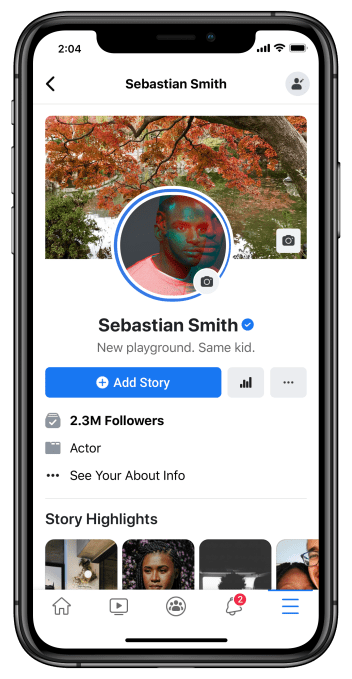
Facebook is testing a new design for Facebook Pages that will, among other things, remove the “Like” count, offer a cleaner and more readable layout, and make it easier for those who operate Pages to actually use and manage them. These features and others were initially tested with a small percentage of public figures on the mobile app, but are now being expanded to a broader group of Pages.

Currently, the public figures involved in the test include actors, authors, creators and a small handful of media entities, like bands and books. If included in the test, the Pages will see an option to opt in to try out the new experience when they’re logged in on mobile.

Facebook says it’s now expanding the test to include a small percentage of English-language business Pages, as well.

Image Credits: Facebook (Old vs New Pages)

The updated design and feature set is meant to make using Pages less complex, something the company understands can be an issue. It also acknowledges the need to simplify the use of Pages now, in particular, with so many people continuing to practice social distancing and choosing to instead connect with their communities online.

The new Page layout is meant to make it easier for visitors to a Page to see key information, like the Page’s bio and posts. Notably, the design does away with the Page Likes and the Like button. Instead, the Page will only display a Follow button and follower count.

This change better reflects the Page’s true reach. Many people have “Liked” various Pages over the years, but then unfollowed them from their News Feed as they outgrew their interest. (Or they unfollowed them because they were only liking the Page as a favor, after being sent a request, for example.) The Follows count, meanwhile, indicates how many people are actually receiving the Page’s update in their News Feed.

Image Credits: Facebook

Having both options has led to a more complicated process where users first “like” a Page, which creates an automatic follow. But the person can then back out of that follow by changing their settings at any time. Page owners find this to be confusing and unhelpful because they want to engage with followers who are actually interested in the Page and its contents.

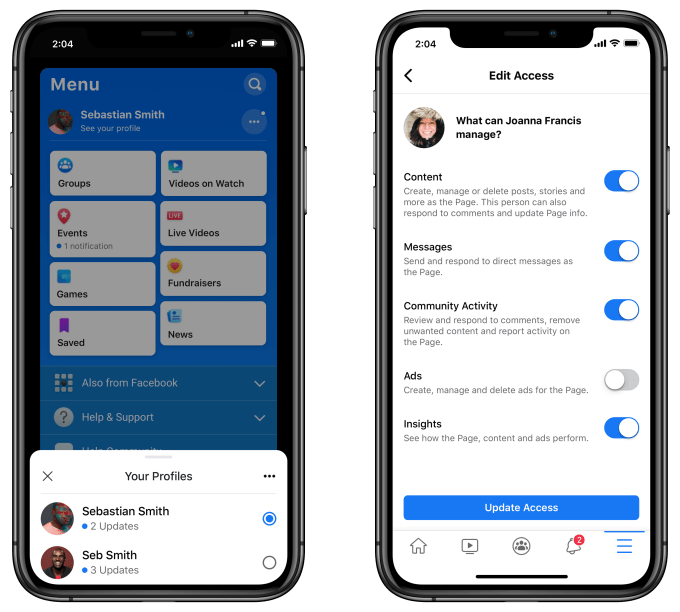
In addition, Page owners will be able to better connect with followers by browsing their News Feed, and then quickly switch between their personal Facebook profile and the public-facing Page (or Pages) they manage when they want to comment or react to posts they come across.

On the Page management side, they’ll be able to more clearly assign and manage admin access permissions based on specific tasks. This will be handled by an updated “Edit Access” screen, where owners can toggle on and off specific management tasks, like who can create Page content, send direct messages as the Page, create ads, respond to comments and more.

Image Credits: Facebook

The update additionally aims to make it simpler to navigate to the Page Insights section, which is where Page owners and managers track analytics related to the Page’s performance.

Now, Page owners will be able to get to these insights from the Page itself or even directly from a post. Within the Insights section, they’ll gain access to a handful of newly added insights, as well, including top performing posts and a new metric that shows the Page’s audience overlap with its connected Instagram account.

They’ll receive fewer notifications from their Pages, too, as Facebook will now group together relevant and related data, like mentions and post reactions, when sending updates.

Image Credits: Facebook

The test is running now in the Facebook mobile app, but it’s not limited only to those who are seeing the simplified app design (pictured here with the colorful blue background and boxes.)

Facebook isn’t sharing when the update will roll out more broadly as this is still considered a test for the time being.

Facebook VP of AI Jerome Pesenti says OpenAI's GPT-3 can "easily output toxic language that propagates harmful biases", as some critics point out issues of bias (Bryan Walsh/Axios)

Bryan Walsh / Axios:
Facebook VP of AI Jerome Pesenti says OpenAI's GPT-3 can “easily output toxic language that propagates harmful biases”, as some critics point out issues of bias  —  While GPT-3 has earned ecstatic reviews from many experts for its capabilities, some critics have pointed out clear issues around bias.


Facebook is testing a new design for Pages with the removal of the Like button and Like counts while keeping follower counts, which reflect a Page's true reach (Sarah Perez/TechCrunch)

Sarah Perez / TechCrunch:
Facebook is testing a new design for Pages with the removal of the Like button and Like counts while keeping follower counts, which reflect a Page's true reach  —  Facebook is testing a new design for Facebook Pages that will, among other things, remove the “Like” count …


Spiritual posts in big demand

Live-streaming of festivals, recorded sessions of church services and daily meditation and yoga classes on WhatsApp and Facebook are becoming popular. https://ift.tt/2WNBpCP https://ift.tt/eA8V8J

Docs: Israeli AI chip startup Hailo is pursuing an urgent IPO via a SPAC merger at a valuation of less than $500M; it was last valued at $1.2B in 2024 (Meir Orbach/CTech)

Meir Orbach / CTech : Docs: Israeli AI chip startup Hailo is pursuing an urgent IPO via a SPAC merger at a valuation of less than $500M; ...