Tuesday, May 26, 2020
Amazon in talks to buy autonomous vehicle startup Zoox

Ola Electric acquires Etergo, plans to launch own two-wheeler next year
Nokia Shuts Plant in Tamil Nadu After 42 Test Positive for Coronavirus
Walmart partners with fashion consignment marketplace thredUP
Walmart is continuing its foray into fashion e-commerce, announcing a strategic partnership with fashion resale marketplace thredUP to list a large number of the items on Walmart’s digital storefront.
With this partnership over 750,000 items from thredUP will be available on walmart.com/thredup, starting today.
Notably, only clothing items and shoes marked as “new” or “like new” will be listed, though accessories and handbags marked as “gently used” will also be available, Walmart says. The companies didn’t share details of the partnership’s revenue share model.
ThredUP’s marketplace, which bills itself as the web’s largest consignment and thrift store, allows people to buy and sell secondhand women’s and children’s apparel. Rather than simply connecting sellers with buyers, sellers send a bunch of items directly to thredUP which then inspects them and returns ones they don’t want and photographs and lists the items they do on its marketplace. When an item sells, thredUP handles shipping the item and paying out sellers.
This partnership brings Walmart access to sales of a new slew of fashion brands. The retailer has added over 1,000 fashion brands to its site over the past several years, the company notes. This isn’t thredUP’s first major partnership with an existing physical retailer, the company has previously partnered with both Macy’s and JCPenney on pilot programs of in-store rollouts of curated item selections.
One of the biggest benefits of the partnership will be the ability to score free shipping on orders over Walmart’s $35 threshold as well as the ability to return items for free at Walmart stores.
ThredUP has raised over $305 million from investors including Goldman Sachs Investment Partners, Irving Investors and Redpoint. The company shared that they had closed $175 million in funding this past August. Last year, CEO James Reinhart told TechCrunch that the team had grown to 1,200 employees and was on track to process their 100 millionth item by year’s end.


Israel-based D-ID, which is working on tech to make faces unrecognizable to face recognition software, raises $13.5M led by AXA Ventures (Jonathan Shieber/TechCrunch)


Israel-based D-ID, which is working on tech to make faces unrecognizable to face recognition software, raises $13.5M led by AXA Ventures — If only Facebook had been using the kind of technology that TechCrunch Startup Battlefield alumnus D-ID was pitching, it could have avoided exposing …
Truecaller record of 4.75 crore Indians on sale, claims report; company denies hack
Facebook renames its Calibra cryptocurrency wallet as Novi
Indonesian startup Delman raises $1.6 million to help companies clean up data
Delman, a Jakarta-based data management startup, has raised $1.6 million in seed funding. The round was led by Intudo Ventures, with participation from Prasetia Dwidharma Ventures and Qlue Performa Indonesia, and will be used to establish a research and development center and hire software engineers and data scientists.
Delman was founded in 2018 by chief executive officer Surya Halim, chief product officer Raymond Christopher and chief technology officer Theo Budiyanto, who were classmates at the University of California, Berkeley. After graduation, they worked at tech companies in Silicon Valley, including Google and Splunk, before deciding to focus on the Indonesian market.
Originally launched as an end-to-end big data analytics provider, Delman shifted its focus to data preparation and management after talking to clients in Indonesia, said Halim. Many companies said they had budgeted for expensive data analytics solution, but then realized their data was not ready for analysis because it was spread across multiple formats. Delman’s mission is to make it easier for data engineers and scientists to do their jobs by cleaning up and preparing data.
Halim says many large companies in Indonesia typically spend up to $200,000 to clean and warehouse data, but Delman gives them a more cost-efficient and faster alternative.
“We have the capability to do analytics and data visualization for clients, but there are so many established companies that already do that, which is why we shifted our business model to something more niche and needed,” said Halim. “It also enables us to open our door to partner with everyone doing data analytics services.”
While newer companies and startups have cleaner datasets, Halim said many older Indonesian companies, especially ones with branches in multiple cities, often have large amounts of data spread across pen-and-paper ledgers, Excel spreadsheets and other software. The data may also have code, keywords and typos that need to be corrected.
“It’s easier for a new company, because everything is already standardized,” Halim said, “But if a company that was established in the 1970s wants to unify previous generations of data to integrate it into their system and keep notes on what customer behavior is like in order to compete with up-and-coming companies, then they need to have a data-driven policy.”
Delman is industry-agnostic and its clients range from large corporations and consulting firms to government agencies. Its customers have included PWC and Qlue. Halim said that the startup plans to expand into other Southeast Asian markets and expects that as COVID-19 changes the way people work, companies will want to invest more heavily in their IT infrastructure and make their databases easier to access outside of a central location.
In a press statement, Intudo Ventures founding partner Eddy Chan said, “By combining a highly localized approach with global technical expertise, Delman is providing Indonesian businesses with Indonesian-developed big data solutions, ultimately leading to better outcomes for end-users. Since meeting the Delman founding team in Silicon Valley in 2017, we have witnessed their growth as a management team, and are excited to continue to support them in their entrepreneurial journey ahead.”


With $84 million in new cash, Commonwealth Fusion is on track for a demonstration fusion reactor by 2025
Commonwealth Fusion Systems closed on its latest $84 million in new funding two weeks ago. The U.S. was still very much in the lockdown phase and getting a deal done, especially a multi-million dollar investment in a new technology aiming to make commercial nuclear fusion a reality after decades of hype, was “an interesting thing” in the words of Commonwealth’s chief executive, Bob Mumgaard.
It was actually one time when the technical complexity of what Commonwealth Fusion is trying to achieve and the longterm horizon for the company’s first test technology was a benefit instead of an obstacle, Mumgaard said.
“We’re in a unique position where it’s still something that’s far enough in the future that any of the recovery models are not going to affect the underlying needs that the world still has a giant climate problem,” he said.
Commonwealth Fusion Systems purports to be one solution to that problem. The company is using technology developed at the Massachusetts Institute of Technology to leapfrog the current generation of nuclear fusion reactors currently under development (there are, in fact, several nuclear fusion reactors currently under development) and bring a waste-free energy source to industrial customers within the next ten years.
Commonwealth Fusion Systems core innovation was the development of a high power superconducting magnet that could theoretically be used to create the conditions necessary for a sustained fusion reaction. The reactor uses hydrogen isotopes that are kept under conditions of extreme pressure using these superconducting magnets to sustain the reaction and contain the energy that’s generated from the reaction. Designs for reactors require their hydrogen fuel source to be heated to tens of millions of degrees.
The design that Commonwealth is pursuing is akin to the massive, multi-decade International Thermonuclear Experimental Reactor (ITER) project that’s currently being completed in France. Begun under the Reagan Administration in the eighties, as a collaboration between the U.S., the Soviet Union, various European nations and Japan. Over the years, membership in the project expanded to include India, South Korea, and China.
While the ITER project also expects to flip the switch on its reactor in 2025, the cost has been dramatically higher — totaling well over $14 billion dollars. The project, which began construction in 2013, will also represent a much longer timeframe to completion compared with the schedule that Commonwealth has set for itself.
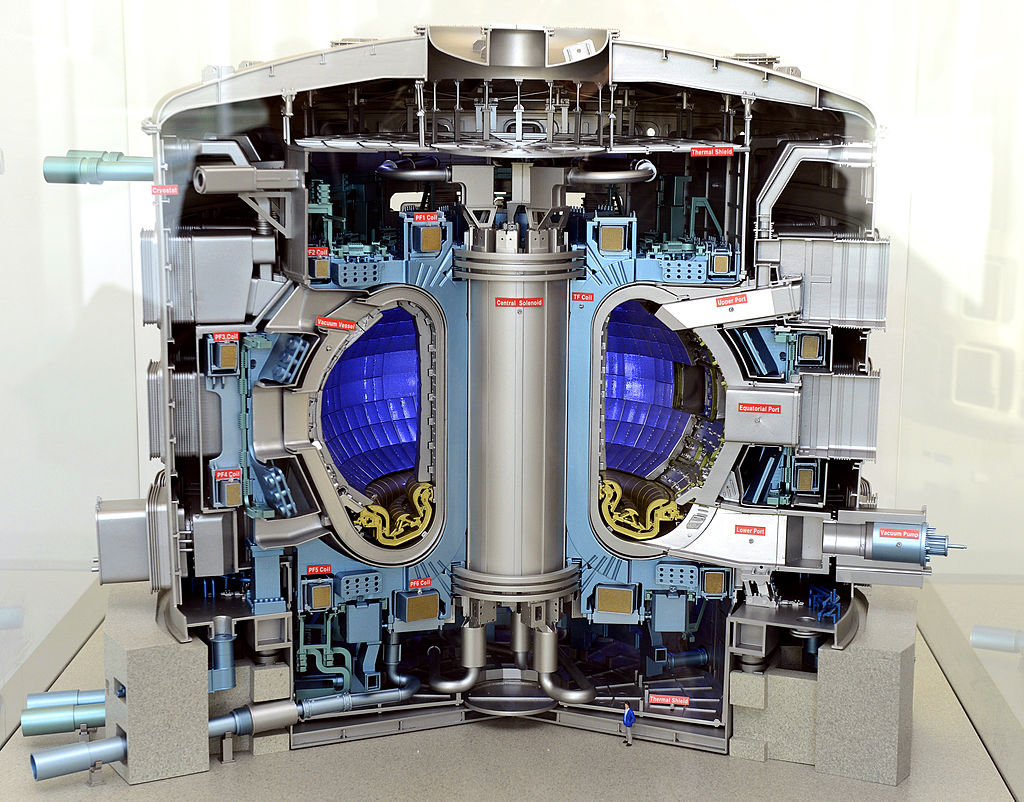
Picture taken on January 17, 2013 in Saint-Paul-les-Durance, southern France shows the model of the reactor of the future International Thermonuclear Experimental Reactor (ITER) . The International Thermonuclear Experimental Reactor (Iter), based at the French Atomic Energy Commission (CEA) research center of Cadarache in Saint-Paul-lès-Durance, was set up by the EU, which has a 45 percent share, China, India, South Korea, Japan, Russia and the US to research a clean and limitless alternative to dwindling fossil fuel reserves. AFP PHOTO / GERARD JULIEN (Photo credit should read GERARD JULIEN/AFP via Getty Images)
“We have set off to build what has been our big goal all along, which is to build the full scale demonstration magnet… we’re in the act of building that,” said Mumgaard. “We’ll turn that on next year.”
Upon completion, Commonwealth Fusion Systems will have built a ten-ton magnet that has the magnetic force equivalent to twenty MRI machines, said Mumgaard. “After we get the magnet to work, we’ll be building a machine that will generate more power than it takes to run. We see that as the Kitty Hawk moment,” for fusion, he said.
Other startup companies are also racing to bring technologies to market and hit the 2025 timeline. They include the Canadian company General Fusion and the United Kingdom’s Tokamak Energy.
Within the next six to eight months, Commonwealth Energy hopes to have a site selected for its first demonstration reactor.
Financing the company’s most recent developments are a slew of investors new and old who have committed over $200 million to the company, which formally launched in 2018.
The round was led by Temasek with participation from new investors Equinor, a multinational energy company, and Devonshire Investors, the private equity group affiliated with FMR LLC, the parent company of Fidelity Investments.
Current investors including the Bill Gates-backed Breakthrough Energy Ventures; MIT’s affiliated investment fund, The Engine; the Italian energy firm ENI Next LLC; and venture investors like Future Ventures, Khosla Ventures; Moore Strategic Ventures, Safar Partners LLC, Schooner Capital, and Starlight Ventures also participated.
“We are investing in fusion and CFS because we believe in the technology and the company, and we remain committed to providing energy to the world, now and in a low carbon future,” said Sophie Hildebrand, Chief Technology Officer and Senior Vice President for Research and Technology at Equinor, in a statement.
The company said it would use the new financing to continue developing its technology which would offer fusion power plants, fusion engineering services, and HTS magnets to customers. Funding will also be used to support business development initiatives for other applications of the company’s proprietary HTS magnets, the key component to its SPARC reactor, which also has various other commercial uses, the company said.
Helping the cause, and potentially accelerating the timelines for many fusion players is a new initiative from the federal government that could see government dollars go to support construction of new facilities. The Department of Energy recently released a request for information (RFI) on potential cost share programs for the development of nuclear fusion reactors in the U.S.
Modeled after the Commercial Orbital Transportation Services program which brought the world SpaceX, Blue Origin, and other U.S. private space companies, a cost-sharing program for fusion development could accelerate the development of low-cost, pollution free fusion reactors across the U.S.
“The COTS program transitioned the space industry from ‘Here’s a government dictated space sector’ to a vibrant commercial launch industry,” said Mumgaard.
One investor who’s seen the value of public private partnerships to spur commercial innovation is Steve Jurvetson, the founder of Future Ventures, and a backer of Commonwealth Fusion Systems. Jurvetson acknowledged the necessity of fusion investment for the future of the energy industry.
“Fusion energy is an investment in our future that offers an important path toward combating climate change. Our continued investment in CFS fits strongly within our mission as we seek long-term solutions to address the world’s energy challenges,” said Steve Jurvetson, Managing Director and Founder, Future Ventures.


GoBear raises $17 million to expand its consumer financial services for Asian markets
Singapore-based fintech startup GoBear has raised $17 million from returning investors Walvis Participaties, a Dutch venture capital firm, and Aegon N.V., a life insurance and asset management provider. The funding brings GoBear’s total funding so far to $97 million, and will be used to expand its consumer financial services platform, which is available in seven Asian markets: Hong Kong, Indonesia, Malaysia, the Philippines, Singapore, Thailand and Vietnam.
Founder and CEO Adrian Chng told TechCrunch that GoBear will focus on what it calls its “three growth pillars”: an online financial supermarket that evolved from the company’s financial products aggregator/comparison service; an online insurance brokerage; and its digital lending business, which it recently expanded by acquiring consumer lending platform AsiaKredit.
The company has also added three new executives over the past few months: chief information technology officer Valeriy Gasratov; chief strategy officer Jinnee Lim as Chief Strategy Officer; and Mike Singh from AsiaKredit as its new chief lending officer.
GoBear originally launched in 2015 as a metasearch engine, before transitioning into financial services. The company now works with over 100 financial partners, including banks and insurance providers, and says its platform has been used by over 55 million people to search for more than 2,000 personal financial products.
The startup serves consumers who don’t have credit cards or other access to traditional credit building tools. Similar to other fintech companies that focus on underbanked populations, GoBear aggregates and analyzes alternative sources of data to judge lending risk, including patterns in consumer behavior. For example, Chng said if a loan application is filled out in less than a minute, it is more likely to be fraudulent, and applications made between 8:30PM and midnight are less risky than ones made between 2AM to 5AM.
Data points from smartphones is also used to assess creditworthiness in markets like the Philippines, where the credit card penetration rate is less than 10%, but more than 40% of the population uses a smartphone.
Despite the COVID-19 pandemic, Chng said GoBear has been gross margin positive since the end of 2019. Interest in travel insurance has declined, but the company has continued to see demand for other insurance products and lending. Its online insurance brokerage has grown its average order by 52% over the last three months, and the company has seen 50% year-over-year growth from its loan products.
There are other fintech companies in Asia that overlap with some of the services that GoBear offers, like comparison platform MoneySmart, CompareAsiaGroup and Grab Financial Group. In terms of competition, Chng told TechCrunch that not only is the market opportunity in Asia huge (he said there are 400 million underbanked people across GoBear’s seven markets), but the company also differentiates with its three core services, which are all interconnected and draw on the same data sources to score credit.
Chng anticipates that the pandemic will spur more financial institutions to begin digitizing their products and looking for partners like GoBear to help them manage risk. In turn, that will make more financial institutions open to using non-traditional data to score credit, enabling underbanked markets to have increased access to financial products.
“The momentum is here. I think now is the time for tech and data to transform financial services,” he said. “As a platform, we are really looking for partners to come with us for the next phase of growth and investment. I feel positive even with COVID-19, because I think that we will have more acceleration, and the opportunity to change people’s lives and benefit them and investors by solving tough problems will only increase.”


Spotify lifts its 10,000 song cap on personal libraries, allowing unlimited songs; limit remains for downloaded songs and playlists (Joanna Nelius/Gizmodo)

Spotify lifts its 10,000 song cap on personal libraries, allowing unlimited songs; limit remains for downloaded songs and playlists — Long before Spotify was a thing, I collected music on my computer during my college days. That collection, which had everything from Cradle of Filth …
Mercedes-Benz launches sales of its premium all-electric EQV van
Mercedes-Benz is now selling its EQV 300 all-electric premium van in Europe, the second EV to come out of the automaker’s initiative to produce a line of battery-powered models under its new EQ brand.
A concept version of the EQV was first shown in March 2019. But unlike so many concepts destined for nonexistence, this one was marked for series production. The EQV, which can seat up to eight people, is designed to appeal to customers seeking a more luxurious ride. The base price of €71,388 (about $78,359) provides a hint at who Mercedes is targeting.
Mercedes is marketing this toward families, upscaled adventurers and corporate clients who might be looking for a shuttle vehicle. The vehicle’s seating can be configured in numerous ways to meet various customers’ needs. It also can be customized for packages, not people.
The EQV comes with a compact electric drivetrain on the front axle that produces 150 kW, or 201 horsepower, as well as a 100 kWh battery pack, and can travel an estimated 418 km (260 miles) under Europe’s WLTP standards. The company is also showcasing its MBUX infotainment system in the EV, which has a number of tech-forward features, such as a self-learning voice control system with connectivity features.
Mercedes is selling the EQV 300 and a longer wheelbase version called AVANTGARDE. Both will be produced at the company’s plant in Vitoria in northern Spain, alongside the V-Class and the Mercedes-Benz Vito.
The van comes with a four-year maintenance plan that covers the battery up to 160,000 km, or eight years. Buyers also get the company’s navigation services for free for 36 months, as well as a membership to EV charger Ionity each for one year. Owners will also have one-year free access to Mercedes me Charge. The feature shows the charging infrastructure network in Europe and lets users start, stop and pay for charging via the Mercedes me app, a credit card or through the media display in the vehicle.
Mercedes announced its “EQ” technology brand in 2016. Since then the company has unveiled several EQ- related concepts as well as its first series-production vehicle, the EQC electric drive SUV. The company has previously said it plans to invest more than $12 billion to produce a line of battery-powered models under its new EQ brand and spend another $1.2 billion in global battery production.


Sources: Amazon is in advanced talks to buy self-driving car startup Zoox; the deal will value Zoox at less than the $3.2B valuation it achieved in 2018 (Wall Street Journal)

Sources: Amazon is in advanced talks to buy self-driving car startup Zoox; the deal will value Zoox at less than the $3.2B valuation it achieved in 2018 — Deal expected to value Zoox at less than its last private valuation — Amazon. com Inc. is in advanced talks to buy Zoox Inc. in a move …
Meet unc0ver, the new jailbreak that pops shell—and much more—on any iPhone

Enlarge (credit: Maurizio Pesce / Flickr)
Hackers have released a new jailbreak that any user can employ to gain root access on any iPhone, regardless of the hardware as long as it runs iOS 11 or later.
Dubbed unc0ver, the exploit works only when someone has physical access to an unlocked device and connects it to a computer. Those requirements mean that the jailbreak is unlikely to be used in most malicious scenarios, such as through malware that surreptitiously gains unfettered system rights to an iPhone or iPad. The inability for unc0ver to survive a reboot also makes it less likely it will be used in hostile situations.
Rather, unc0ver is more of a tool that allows users to break locks Apple developers put in place to limit key capabilities such as what apps can be installed, the monitoring of OS functions, and various other tweaks that are standard on most other OSes. The jailbreak, for instance, allows users to gain a UNIX shell that has root privileges to the iPhone. From there, users can use UNIX commands to do whatever they’d like.
Read 6 remaining paragraphs | Comments


Sources: amid the Iran war, Asian bankers say rising power prices and energy security are becoming a bigger consideration in data center financing decisions (Bloomberg)
Bloomberg : Sources: amid the Iran war, Asian bankers say rising power prices and energy security are becoming a bigger consideration in ...

-
The first project we remember working on together was drawing scenes from the picture books that our mom brought with her when she immigrate...
-
http://bit.ly/2XqNIDz