Sunday, May 17, 2020
SoftBank Proposes Three New Board Members as Alibaba's Jack Ma Resigns

Realme Narzo 10 First Sale in India Kicks Off at 12 Noon Today
Huawei P40 Lite 5G With Kirin 820 SoC, 64-Megapixel Main Camera Launched
OnePlus 8 Will Go on Sale Today at 2pm on Amazon
Alibaba's Jack Ma resigns from SoftBank board, as he pulls back from formal business roles to focus on philanthropy; SoftBank to propose three new appointments (Sam Nussey/Reuters)


Alibaba's Jack Ma resigns from SoftBank board, as he pulls back from formal business roles to focus on philanthropy; SoftBank to propose three new appointments — TOKYO (Reuters) - SoftBank Group Corp said on Monday that Alibaba co-founder Jack Ma will resign from its board …
Jio to Get Rs. 6,598 Crores Investment From General Atlantic
E-Commerce Companies May Resume Full Services From Today
General Atlantic open to raising stake in Jio Platforms: Sandeep Naik
Oppo suspends production at Greater Noida factory after workers test Covid-19 positive
Fitbit’s Chinese rival Amazfit mulls a transparent, self-disinfecting mask
The COVID-19 pandemic has ushered in a wave of Chinese companies with manufacturing operations to produce virus-fighting equipment: Shenzhen-based electric vehicle giant BYD quickly moved to launch what it claims to be the world’s largest mask plant; Hangzhou-based voice intelligence startup Rokid is making thermal imaging glasses targeted at the US market; and many more.
The latest of such efforts comes from Huami, the NASDAQ-listed wearables startup that makes Xiaomi’s Mi Bands and sells its own fitness tracking watches under the Amazfit brand in more than 70 countries. In a phone interview with TechCrunch, the firm said it is developing a see-through plastic mask with built-in ultraviolet lights that can disinfect filters within 10 minutes when connected to a power supply through a USB port. The caveat is that the lights only sanitize the inside of the mask and users still have to clean the outer surface themselves.
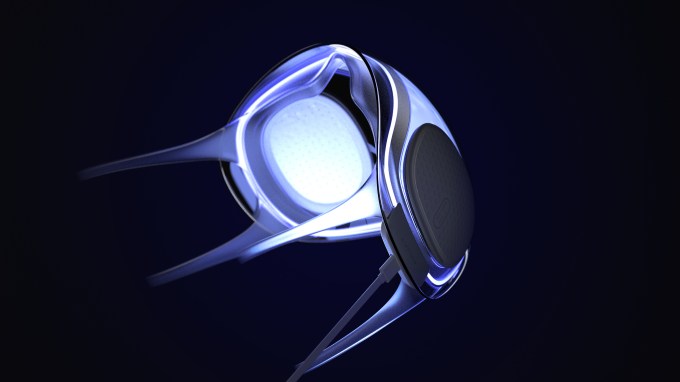
The Aeri concept comes with built-in ultraviolet lights that can disinfect filters within 10 minutes when connected to a power supply through a USB port.
Called Aeri, the mask uses removable filters that are on par with N95 filtration capacity. If the concept materializes, each filter could last up to a month and a half, significantly longer than the average life of surgical masks and N95 respirators. The modular design allows for customized accessories such as a fan for breathable comfort, hence the mask’s name Aeri, a homophone of “airy”.
Aeri started from the premise that wearing masks could thwart the increasingly common adoption of facial recognition. That said, imaging companies have been working on biometric upgrades to allow analyses of other facial features such as irises or the tip of noses.
Aeri might still have a market appeal though, argued Pengtao Yu, vice president of industrial design at Huami. “Whether people need to unlock their phones or not, they want to see each other’s faces at social occasions,” said Yu, the California-based Chinese designer who had served clients including Nest Labs, Roku, GoPro and Huawei prior to joining Huami.
Huami’s U.S. operation, which focuses on research and development, opened in 2014 and now counts a dozen of employees.
Many companies turning to pandemic-fighting manufacturing have taken a hit from their core business, but Huami has managed to stay afloat. Its Q1 revenue was up 36% year-over-year to hit $154 million, although net income decreased to $2.7 million from $10.6 million. Its stocks have been declining, however, sliding from a high point of $16 in January to around $10 in mid-May.
Huami is in the process of prototyping the Aeri masks. In Shenzhen, which houses the wearables company’s headquarters, the development cycle for hardware products — from ideation to market rollout — takes as short as 6-12 months thanks to the city’s rich supply chain resources, said Yu.
Huami hasn’t priced Aeri at this early stage, but Yu admitted that the masks are targeting the “mass consumer market” around the world, not only for protection against viruses but also everyday air pollution, rather than appealing to medical workers. Given Huami’s history of making wearables at thin margins, it won’t be surprising that Aeri will be competitively priced.
The Aeri project is part of Huami’s pivot to enter the general health sector beyond pure fitness monitoring. The company has recently teamed up with a laboratory led by Dr. Zhong Nanshan, the public face of China’s fight against COVID-19, to track respiratory diseases using wearables. It’s also in talks with the German public health authority to collaborate on a smartwatch-powered virus monitoring app, the company told TechCrunch.


Google Meet, which became free to use at the end of April, passes 50M installs on the Play Store, after passing 5M at the beginning of March (Hagop Kavafian/Android Police)

Google Meet, which became free to use at the end of April, passes 50M installs on the Play Store, after passing 5M at the beginning of March — Due to the coronavirus pandemic, most people are stuck at home and looking for ways to keep in touch with each other.
Apple says it's reopening 25 US stores this week plus 12 stores in Canada, adding to nearly 100 global locations that have reopened so far (Bloomberg)

Apple says it's reopening 25 US stores this week plus 12 stores in Canada, adding to nearly 100 global locations that have reopened so far — - Company has 100 stores back in operation after virus closures — Plans temperature checks and face coverings at every location
Mandatory to best effort basis: Aarogya Setu app rule eased for companies
Apple begins reopening some stores with temperature checks and other safeguards in place
In mid-March, Apple closed all of its stores outside of China “until further notice.” It was a sweeping — but necessary — move for a world facing down a growing pandemic. In a statement issued today until the title, “To our Customers,” Retail SVP Deirdre O’Brien offered insight into the company’s plans to reopen locations.
Nearly 100 stores have already resumed services, according to O’Brien — though the famously open retail spaces are taking on a new look in the face of the highly contagious novel coronavirus. “In every store, we’re focused on limiting occupancy and giving everybody lots of room, and renewing our focus on one‑on‑one, personalized service at the Genius Bar and throughout the store,” she writes.
A spokesperson for the company adds, “Next week we’ll continue our very gradual and thoughtful reopening of US stores, adding more than 25 locations in seven states. While we know many customers are eager for their local store to reopen, our commitment is to reopen our stores when we are confident the environment is safe. We miss our customers and look forward to seeing them again soon.”
As seen in the above image, face covers will be required for both employees and customers alike — already a legal requirement in many locales. More unusual for many retail establishments is the addition of temperature checks now conducted at the store’s entrance, coupled with posted health questions. Apple has also instituted deeper cleaning on all surfaces, including display products.
That last point is an important one, given how much of the company’s store layout revolves around hands-on products. Curb-side pick and drop off have been added, as well, for those who understandably would like to avoid the in-person experience.
As for when each location reopens, Apple says it’s monitoring health trends and local/national guidance to determine the timeframe. You can check your local store’s status here. And as the conversation of secondary waves begin to become a reality in many areas, O’Brien says the company will close stores down again, if necessary. “These are not decisions we rush into,” she writes, “and a store opening in no way means that we won’t take the preventative step of closing it again should local conditions warrant.”


A look at what's next for Netflix and Comcast's Peacock after the WBD-Paramount deal; Nielsen says Netflix had six of the top 10 original streaming shows in Q1 (Lucas Shaw/Bloomberg)
Lucas Shaw / Bloomberg : A look at what's next for Netflix and Comcast's Peacock after the WBD-Paramount deal; Nielsen says Netfl...

-
The first project we remember working on together was drawing scenes from the picture books that our mom brought with her when she immigrate...
-
Sohee Kim / Bloomberg : South Korean authorities are investigating a data leak at e-commerce giant Coupang that exposed ~33.7M accounts; ...

