Thursday, May 14, 2020
TikTok Violated Agreement on Child Protection, Activists Allege

Facebook, telcos plan subsea cable to connect Africa, Middle East and Europe
The race to deploy COVID-19 contact tracing apps
France to impose digital tax this year regardless of any new international levy
TDS cut to make e-commerce attractive for merchants
Multiplexes' pain is Amazon Prime Video's gain
Patanjali plans Swadeshi-only portal OrderMe
TSMC to build a $12 billion advanced semiconductor plant in Arizona with U.S. government support
Taiwan Semiconductor Manufacturing Co., the world’s largest contract semiconductor foundry, said today that it plans to build an advanced chip foundry in Arizona with support from the state and the United States federal government.
The announcement follows a Wall Street Journal report earlier this week that White House officials were in talks with TSMC and Intel to build foundries in the U.S., as part of its effort to reduce reliance on chip factories in Asia. Based in Hsinchu, Taiwan, TSMC provides chip components for many of the world’s largest semiconductor companies and its U.S. clients include Apple and Qualcomm.
The plant, scheduled to start production of chips in 2024, will enable TSMC’s American customers to fabricate their semiconductor products domestically. It will use the company’s 5-nanometer technology and is expected to create 1,600 jobs and have the capacity to produce 20,000 wafers a month.
The U.S.-China trade war, national security concerns, geopolitical unrest and the COVID-19 pandemic have all underscored the shortfalls of relying on foundries located abroad and international supply chains.
The U.S. government has reportedly been in talks with TSMC for months, though one sticking point for the company was the high cost of building a new foundry. TSMC chairman Mark Liu told the New York Times in October that the project would require major subsidies because it is more expensive to operate a factory in the U.S. in Taiwan.
In today’s announcement, TSMC said “U.S. adoption of forward-looking investment policies to enable a globally competitive environment for a leading edge semiconductor technology operation in the U.S. will be crucial to the success of this project.”
The company expects to spend about $12 billion between 2021 and 2029 on the project, with construction slated to begin next year.
TSMC already operates a foundry in Camas, Washington, and has design centers in Austin, Texas and San Jose, California.


Critics of the FCC's Lifeline telecommunication subsidy program say the government doesn't promote the service enough and has restrictive mobile data caps (Emmanuel Martinez/The Markup)


Critics of the FCC's Lifeline telecommunication subsidy program say the government doesn't promote the service enough and has restrictive mobile data caps — As America's financial distress deepens, with unemployment reaching levels not seen since the Great Depression …
COVID-19 linked to 30-fold increase in rare childhood inflammatory disease
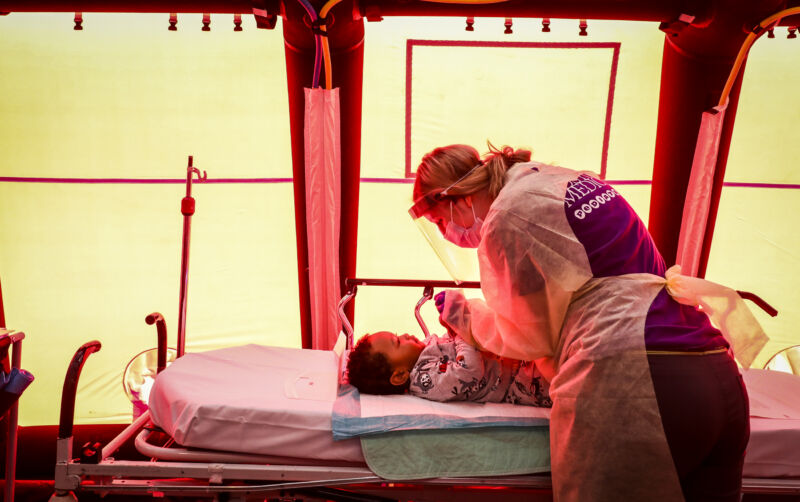
Enlarge / Boston Medical Center Child Life Specialist Karlie Bittrich sees to a baby while in a pediatrics tent set up outside of Boston Medical Center in Boston on April 29, 2020. (credit: Getty | Boston Globe)
Evidence is stacking up to support a link between COVID-19 and a rare, mysterious inflammatory disease in children, which can be life-threatening.
Though reports of the new disease have trickled in from several countries, many of them have been anecdotal to this point. Now, doctors in an area of Italy hardest hit by the COVID-19 pandemic have published detailed data on a cluster of 10 children who experienced an unusual inflammatory disease amid the outbreak, lending solid support for the link. Their report appeared Wednesday in The Lancet.
The doctors describe the condition they saw as “Kawasaki-like,” referring to a rare disease in children that causes inflammation of blood vessels. Kawasaki disease—identified in Japan in 1967 by Tomisaku Kawasaki—is typically marked by sustained fever, rash, swelling of hands and feet, and swollen lymph nodes in the neck. In the worst cases, it can lead to heart problems and aneurisms.
Read 15 remaining paragraphs | Comments


Apple's macOS Tahoe 26.7 RC has references to unreleased products: a Home Hub, home accessories, new Beats, AirPods Pro 4, Apple Intelligence in China, and more (Juli Clover/MacRumors)
Juli Clover / MacRumors : Apple's macOS Tahoe 26.7 RC has references to unreleased products: a Home Hub, home accessories, new Beats,...

-
http://bit.ly/2XqNIDz
-
Sohee Kim / Bloomberg : South Korean authorities are investigating a data leak at e-commerce giant Coupang that exposed ~33.7M accounts; ...