Thursday, May 7, 2020

Platforms scramble as ‘Plandemic’ conspiracy video spreads misinformation like wildfire

A coronavirus conspiracy video featuring a well-known vaccine conspiracist is spreading like wildfire on social media this week, even as platforms talk tough about misinformation in the midst of the pandemic.

In the professionally-produced video, a solemn interviewer named Mikki Willis interviews Judy Mikovits, a figure best known for her anti-vaccine activism in recent years. The video touches on a number of topics favored among online conspiracists at the moment, filtering most of them through the lens that vaccines are a money-making enterprise that causes medical harm.

The video took off mid-week after first being posted to Vimeo and YouTube on May 4. From those sites, it traveled to Facebook, Instagram and Twitter where it circulated much more widely, racking up millions of views. Finding the video is currently trivial across social platforms, where it’s been reposted widely, sometimes with its title removed or reworded to make it more difficult to detect by AI moderation.

According to Twitter, tweets by Mikovits apparently don’t violate the platform’s rules around COVID-19 misinformation, but it has marked the video’s URL as “unsafe” and blocked the related hashtags “#PlagueOfCorruption and #Plandemicmovie. The company also hasn’t found evidence that her account is being amplified as part of a coordinated campaign.

Over on Facebook, the video indeed runs afoul of the platform’s coronavirus and health misinformation rules—but it’s still very easy to find. For this story, I was able to locate a copy of the full video within seconds and at the time of writing Instagram’s #plandemic hashtag was well-populated with long clips from the video and even suggestions for related hashtags like #coronahoax. Facebook is currently working to stem the video’s spread, but it’s already collected millions of views in a short time.

On YouTube, a search for “Plandemic” mostly pulls up content debunking the video’s many false claims, but plenty of clips from the video itself still make the first wave of search results.

The video itself is a hodgepodge of popular false COVID-10 conspiracies already circulating online, scientifically unsound anti-vaccine talking points and claims of persecution.

Mikovits, who in the video states that she’s not opposed to vaccines, later goes on to make the claim that vaccines have killed millions of people. “The game is to prevent the therapies ‘til everyone is infected and push the vaccines, knowing that the flu vaccines increase the odds… of getting COVID-19,” Mikovits says, conspiratorially. At the same time, she suggests that doctors and health facilities are incentivized to overcount COVID-19 cases for the medicare payouts, an assertion that contradicts the expert consensus that coronavirus cases are likely still being meaningfully undercounted.

In the video, Mikovits accuses Dr. Anthony Fauci of suppressing treatments like hydroxychloroquine—falsely touted by President Trump as a likely cure for the virus. While her claims appear to have landed at the perfect opportunistic moment, her beef with Fauci is actually longstanding. As Buzzfeed reported, in a book she wrote six years ago, Mikovits accused Dr. Fauci of banning her from the NIH’s facilities—an event Fauci himself was not familiar with.

Mikovits also touches on a popular web of conspiracy theories fixated on the idea Bill Gates is somehow implicated in causing the pandemic to profit off the eventual vaccine and makes the unfounded claim that “it’s very clear this virus was manipulated and studied in the laboratory.”

In other interviews, Mikovits has suggested that face masks pose a danger because they can “activate” the virus in the wearer. In the “Plandemic” clip, Mikovits also makes the unscientific claim that beaches should not have been closed due to “healing microbes in the saltwater” and “sequences” in the sand that protect against the coronavirus.

To the uninformed viewer, Mikovits might appear to ably address scientific-sounding topics, but her own scientific credentials are extremely dubious. In 2009, Mikovits authored a study on chronic fatigue syndrome that was retracted by the journal Science two years later when an audit found “evidence of poor quality control” in the experiment and the results could not be replicated in subsequent studies. That event and her subsequent firing from a research institute appear to have kicked off her more recent turn as an anti-vaccine crusader, conspiracist and author.

With “Plandemic,” Mikovits seems to have positioned herself successfully for relevance in the pandemic’s information vacuum—her book sales have even soared on Amazon. Toward the end of the clip, her interviewer even cannily sets up a future outrage cycle at the inevitable crackdown from social media platforms, where the video flouts rules ostensibly banning harmful health conspiracies like the ones it contains.

“It’s other people shutting down other citizens and the big tech platforms follow suit and they shut everything down,” Willis says with steely concern. “There is no dissenting voices allowed any more in this free country.” 

As we’ve reported previously, the coronavirus crisis is fertile ground for conspiracy theories and potentially lethal misinformation— a fact that the “Plandemic” video’s apparent mainstream crossover success demonstrates. Widespread uncertainty and fear is a powerful thing, capable of breathing new life into debunked ideas that would have otherwise kept collecting dust in conspiracist backwaters, where they belong.

Mi 10, Mi Box, Mi True Wireless Earphones 2 to Launch in India Today

Mi 10 has already been listed on Amazon India, and the company notes that pre-orders will begin at 2pm IST today. Customers who pre-order the Mi 10 will get a free Mi Wireless Powerbank worth Rs.... https://ift.tt/35EVvSW

Samsung, Oppo, Vivo & Lava get UP govt nod to restart operations

These handset makers have received approvals to restart production in their Noida and Greater Noida facilities from this week, albeit with limited 20-30% capacity. https://ift.tt/3bcLVI7 https://ift.tt/eA8V8J

A look at the symbiotic ties of anti-vaxxers and COVID-19 conspiracy theorists with mainstream YouTubers, as the platform tries to regulate misinformation (Abby Ohlheiser/MIT Technology Review)

Abby Ohlheiser / MIT Technology Review:
A look at the symbiotic ties of anti-vaxxers and COVID-19 conspiracy theorists with mainstream YouTubers, as the platform tries to regulate misinformation  —  Covid-19 conspiracy theorists are still getting millions of views on YouTube, even as the platform cracks down on health misinformation.


Move to make Aarogya Setu mandatory challenged in Kerala HC

Earlier in the week, the central government had mandated all its employees as well as those working with public sector organisations to download the app. https://ift.tt/2YKsZhu https://ift.tt/eA8V8J

Owkin raises $25 million as it builds a secure network for healthcare analysis and research

Imagine a model of collaborative research and development among hospitals, pharmaceutical companies, universities and other research institutions where no one shared any actual data.

That’s the dream of the new New York-based startup Owkin, which has raised $25 million in fresh financing from investors including Bpifrance Large Venture, Cathay Innovation and MACSF (the French Pension Fund for Clinicians), alongside previous investors GV, F-Prime Capital and Eight Roads

The company’s pitch is that data scientists, clinical doctors, academics and pharmaceutical companies can all log in to the virtual lab that Owkin calls the Owkin Studio.

In that virtual environment, all parties can access anonymized data sets and models exclusively to refine their own research and development and studies to ensure that the most cutting edge insights into novel biomarkers, mechanisms of action and predictive models inform the work that all of the relevant parties are doing.

The ultimate goal, the company said, is to improve patient outcomes.

In its quest to get more companies and institutions to open up and share information — with the promise that the information can’t be extracted or used in a way that isn’t allowed by the owners of the data — Owkin is replicating work that other companies are pursuing in fields ranging from healthcare to financial services and beyond.

The Israeli company Qedit has developed similar technologies for the financial services industry, and Sympatic, a recent graduate from one of the recent batches of Techstars companies, is working on a similar technology for the healthcare industry.

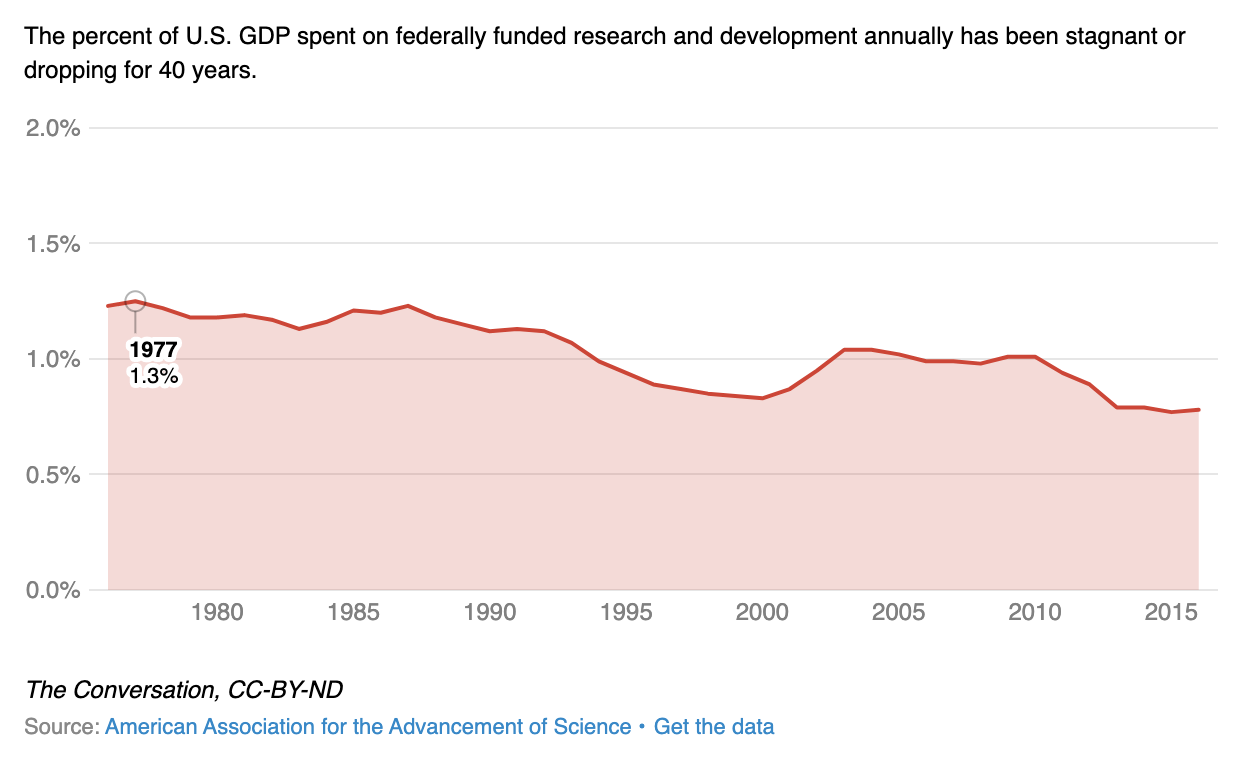
Owkin makes money by enabling remote access to the data sets for pharmaceutical companies and licensing the models developed by universities to those companies. It’s a way for the company to entice researchers to join the platform and provide another revenue stream for research institutions who have seen their funding decline over the last forty years.

We have a huge loop of academic universities that have access to the data and are developing algorithms and we share data,” said the company’s chief executive Dr. Thomas Clozel. “At the end what it helps is developing better drugs.”

Declines in federal funding for scientific research since the 1980s (Image courtesy of The Conversation)

The investment from Owkin’s new and existing investors takes the company to $55 million in total capital raised through the extension of its Series A round. In all the round totaled $52 million, Clozet said.

“We are exactly where we need to be because it’s about privacy and privacy is more important than ever before,” said Clozet.

The COVID-19 epidemic has emphasized the need for closer collaboration among different corporations and research institutions, and that has also increased demand for the company’s technology. “It touches everything… We have access to the right data sets and centers to build the best models for COVID,” said Clozet. “We’re lucky to have the right traction before the COVID happens and we have the right research that has been done.”

In fact, the company has launched the Covid-19 Open AI Consortium (COAI), and is using its platform to advance collaborative research and accelerate clinical development of effective treatments for patients infected with the coronavirus, the company said.  All of its findings will be shared with the global medical and scientific communities.

The initial focus on the research is on cardiovascular complications in COVID-19 patients in collaboration with CAPACITY, an international registry working with over 50 centers worldwide, the company said. Other areas of research will include patient outcomes and triage, and the prediction and characterization of immune response, according to Owkin.

“Since we first backed Owkin in 2017, we have been sharing its vision to apply AI to fighting one of the most dreadful diseases on earth: cancer,” said Jacky Abitbol, a partner at Cathay Innovation. “Owkin has risen to become a leader in digital health, we are proud to grow our investment in the company to fuel its ambition to pioneer AI for medical research, while preserving patient-privacy and data security.”


Report: Facebook posts from 2012 show Iran's national broadcaster trialed a US political influence campaign via 300+ fake accounts, years earlier than thought (Kevin Collier/NBC News)

Kevin Collier / NBC News:
Report: Facebook posts from 2012 show Iran's national broadcaster trialed a US political influence campaign via 300+ fake accounts, years earlier than thought  —  The attempts seem to be experiments that were quickly abandoned, and none of those identified received substantial engagement.


In filing, Clearview AI says it is canceling client accounts not associated with law enforcement or other government entity, amid mounting scrutiny (BuzzFeed News)

BuzzFeed News:
In filing, Clearview AI says it is canceling client accounts not associated with law enforcement or other government entity, amid mounting scrutiny  —  Clearview AI — the controversial face-tracking company known for scraping more than 3 billion photos from social media sites including Facebook …


Roku posts revenue of $320.8M for Q1, up 55% YoY, and a net loss of $54.6M, warns that ad revenue growth will slow this year; stock down 9%+ after hours (Todd Spangler/Variety)

Todd Spangler / Variety:
Roku posts revenue of $320.8M for Q1, up 55% YoY, and a net loss of $54.6M, warns that ad revenue growth will slow this year; stock down 9%+ after hours  —  Roku's first-quarter revenue beat Wall Street estimates as COVID-19 quarantines have resulted in a massive streaming surge for the company.


Wednesday, May 6, 2020

Colombia's coronavirus app troubles show rocky path without tech from Apple, Google

https://ift.tt/2zdWKwi

Facebook's Libra appoints HSBC legal chief Stuart Levey as CEO

https://ift.tt/3b8VPus

Uber Says Will Cut 3,700 Jobs, CEO Dara Khosrowshahi 14 to Waive Base Salary

Uber Inc will cut about 3,700 full-time jobs and Chief Executive Officer Dara Khosrowshahi will forgo his base salary for the remainder of the year, the company said on Wednesday, as the COVID-19... https://ift.tt/35E8t3j

Uber to cut 3,700 jobs, CEO Khosrowshahi to waive base salary

Uber and rival Lyft have already withdrawn their full-year financial outlooks as demand for app-based rides dropped sharply across the world after governments imposed stay-at-home orders to curb the transmission of the coronavirus. https://ift.tt/35D9t7T

Zoom adds ex-Trump adviser, tech lobbyist to PR push

https://ift.tt/35FBHiw

Facebook names first members of oversight board that can overrule Mark Zuckerberg

David Kaye, U.N. special rapporteur on freedom of opinion and expression, said the board's efficacy would be shown when it started hearing cases. https://ift.tt/2YCSNMp

Airbnb launches a pilot in NYC, LA, and other cities that lets users to select from a range of boutique hotels alongside private homes in a bid to boost growth (Stephanie Stacey/Financial Times)

Stephanie Stacey / Financial Times : Airbnb launches a pilot in NYC, LA, and other cities that lets users to select from a range of bouti...