Bloomberg:
A look at efforts by developers, hobbyists, and students in South Korea, Japan, Taiwan, and other Asian countries to track and offer information about COVID-19 — Lee Dong-hoon couldn't take any more of the bloody masks. This was January, early in the coronavirus's sweep through South Korea …
Tech Nuggets with Technology: This Blog provides you the content regarding the latest technology which includes gadjets,softwares,laptops,mobiles etc
Wednesday, April 15, 2020
A look at efforts by developers, hobbyists, and students in South Korea, Japan, Taiwan, and other Asian countries to track and offer information about COVID-19 (Bloomberg)
Mayfield raises $750 million across two funds
Silicon Valley mainstay the Mayfield Fund has raised $750 million across two new funds, the firm said today.
The venture capital firm said its Mayfield XVI will continue to invest in early-stage companies, while its Mayfield Select II will invest in later-stage rounds of breakout portfolio companies. One difference in the new Select fund will be its ability to invest in growth-stage companies outside of its portfolio.
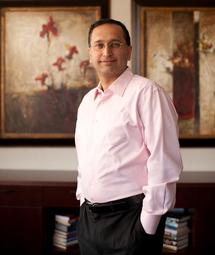
Navin Chaddha
In its blog post announcing the new funds, Mayfield managing partner Navin Chaddha recalled the timing of its fund XIII, raised in September 2008 right after the market crash.
In the wake of the crisis, Chaddha writes, Mayfield stuck to core principles. The firm decided not to dramatically increase the size of its investment vehicles (unlike some of its peers, which now hold several billion under management in current funds), and kept to a four-year fundraising cycle.
Kleiner Perkins, by contrast, went through a $600 million investment vehicle in about a year and went back out to market to raise another fund shortly thereafter.
“We stuck to our conviction of staying as an early-stage venture investor over four subsequent funds even as the venture industry was shifting. We went deeper into domains we were already experts in vs. following shiny new objects. We raised funds at a measured pace of every four years and built a team of investors who were company builders,” Chaddha wrote.
To date, Mayfield has backed a slew of companies that have gone on to successful exits, including Lyft, Marketo, ServiceMax and SolarCity — all deals that came out of the 2008 financial crisis and its subsequent funds. Current portfolio companies, like the CRISPR-focused biotech company Mammoth Biosciences and retail investments like PoshMark, show that the firm hasn’t lost its luster for picking new deals.
The secret to the firm’s continued success is its focus on what Chaddha considers to be the “craftsman model” of investors “working closely with a handful of entrepreneurs.”
“As many of our peers raised mega-funds, it took courage and discipline for us to stay focused rather than follow the crowd. We raised a similar size fund every four years and invested in thirty companies per fund. We primarily led Series A investments and were comfortable with the fact that the companies we invested in will evolve,” Chaddha wrote.
So what’s next for the venerable firm as it heads into its latest fund? Chaddha flags biology as technology; human-centered artificial intelligence; the resurgence of chip design; the future of work; privacy and security; and next-generation consumer brands as areas where Mayfield will look to commit capital.
Medopad rebrands as Huma, acquires BioBeats and TLT to expand its biomarker platform
Some big changes are underway for London-based Medopad, a startup that builds software for medical practitioners to monitor patients remotely based on digital biomarkers — measurable indicators of the progression of illnesses, diseases or overall health that are picked up not with blood samples or in-doctor visits but using apps and wearables.
The company is rebranding to Huma and appointing its first chairman, the former U.K. Health Minister Alan Milburn. And alongside that, Huma is announcing the acquisition of two AI startups to expand the scope of its business: the mental health-focused BioBeats, and cardiovascular specialist Tarilian Laser Technologies (TLT).
The financial terms of the deals have not been disclosed, but we understand BioBeats was around a $10 million deal, and TLT includes software assets, a number of patents and a new hardware device that measures blood pressure continuously but in a non-invasive way that is currently awaiting FDA approval.
Both will help Huma expand its biomarker monitoring to new areas of coverage (specifically mental health-related biomarkers, and all of the indicators related to blood pressure), and extend into areas around preventative, proactive human health, alongside monitoring for chronic illnesses, diseases and other conditions.
Huma has built a strong network of partnerships to expand its reach and scope. They include working with Tencent on a trial to measure the progress of Parkinson’s just by monitoring you as you speak into the camera on your smartphone. And with pharmaceutical giant Janssen, it’s working on a way to measure Alzheimer’s based on the sound of your voice. It’s also collaborating closely with leading research hospitals like Kings and Barts in London and Johns Hopkins in the U.S. to develop other biomarker tests.
But when it comes to building some of the early work, it would take years for Huma to build up knowledge and teams that would be on par with what BioBeats and TLT have built: hence the move to acquire.
That’s a pattern that the startup plans to follow.
Huma is currently working on closing a fundraise in the coming weeks and months that’s targeted to be one of the biggest ever in the U.K. health technology sector (the high watermark is Babylon Health, which last year raised $550 million).
The fundraise will be to make more acquisitions, not to run the business itself: Huma still has more money in the bank than it last raised (it announced a $25 million round led by Bayer last November), and has, according to CEO and founder Dan Vahdat, already hit its revenue target for the whole year (and it’s only April).
Part of that strong business funnel is due to the novel coronavirus. Huma announced a COVID-19 tracker at the end of March that aims to help keep hospitals from overflowing. People with confirmed or suspected cases of COVID-19 that are not serious enough to land them in the hospital are instead monitored closely using measurements taken using smartphones, watches and other devices. If their biomarkers indicate that their illness may be taking a turn for the worse, they can subsequently be ordered to come into the hospital before the case becomes a dire one.
At a time when many health systems around the world are being stretched to the breaking point with the influx of coronavirus cases, this is one way to try to triage the traffic, and that’s struck a chord in many places. Huma is due to announce its first official deals for the service in multiple countries in the coming weeks, Vahdat said.
“I’m pleased to work with Huma to help transform the health sector by developing a new understanding of the human body through digital biomarkers,” said Milburn in a statement. “We’re at the very early stages of what could be breakthroughs in how we understand health, diagnose and treat illnesses and Huma could become a true leader in this promising new area for life sciences, innovation partners and healthcare.”
WHO answers Trump’s attack with call for unity against COVID-19
Enlarge / World Health Organization (WHO) Director-General Tedros Adhanom Ghebreyesus attends a daily press briefing on COVID-19, the disease caused by the novel coronavirus, at the WHO headquaters in Geneva on March 11, 2020. (credit: Getty | Fabrice Coffrini)
The director-general of the World Health Organization called for global unity and continued focus on saving lives and fighting the common enemy, COVID-19, on Wednesday—a day after US President Donald Trump attacked the organization for allegedly “severely mismanaging” the pandemic response. Trump announced he would halt funding to the WHO until his administration reviewed its response.
The WHO, an agency formed in the 1940s by the United Nations and supported by its member states, receives around 15 percent of its funding from the United States.
“We regret the decision of the President of the United States to order a halt in funding to the World Health Organization,” WHO director-general, Tedros Adhanom Ghebreyesus (aka Dr. Tedros) said in a press briefing Wednesday. “With support from the people and government of the United States, WHO works to improve the health of many of the world’s poorest and most vulnerable people,” he went on.
Tuesday, April 14, 2020
Mobile apps' usage spikes in lockdown
Lockdown brings 15-20% surge in voice calls as people reconnect
Millions of mobile phones, thousands of appliances pile up for repairing amidst lockdown
E-commerce firms, kirana stores tie-up to maintain essentials' supply
In letter to senators, Verily says it has tested 7,390 people for COVID-19 as of April 9, less than a month after site launch, will keep Google login mandatory (Hugh Langley/Business Insider)
Hugh Langley / Business Insider:
In letter to senators, Verily says it has tested 7,390 people for COVID-19 as of April 9, less than a month after site launch, will keep Google login mandatory — - Google's Verily division has been screening and testing participants for COVID-19, but lawmakers are concerned over how it is collecting and using people's data.
Pay your rent through credit card, get cheaper loans on Cred
Washington AG Bob Ferguson sues Facebook, saying the company violated its commitment to not sell political ads in the state (Monica Nickelsburg/GeekWire)
Monica Nickelsburg / GeekWire:
Washington AG Bob Ferguson sues Facebook, saying the company violated its commitment to not sell political ads in the state — Washington Attorney General Bob Ferguson filed a new lawsuit against Facebook claiming the social network continues to violate state laws governing political ad disclosures.
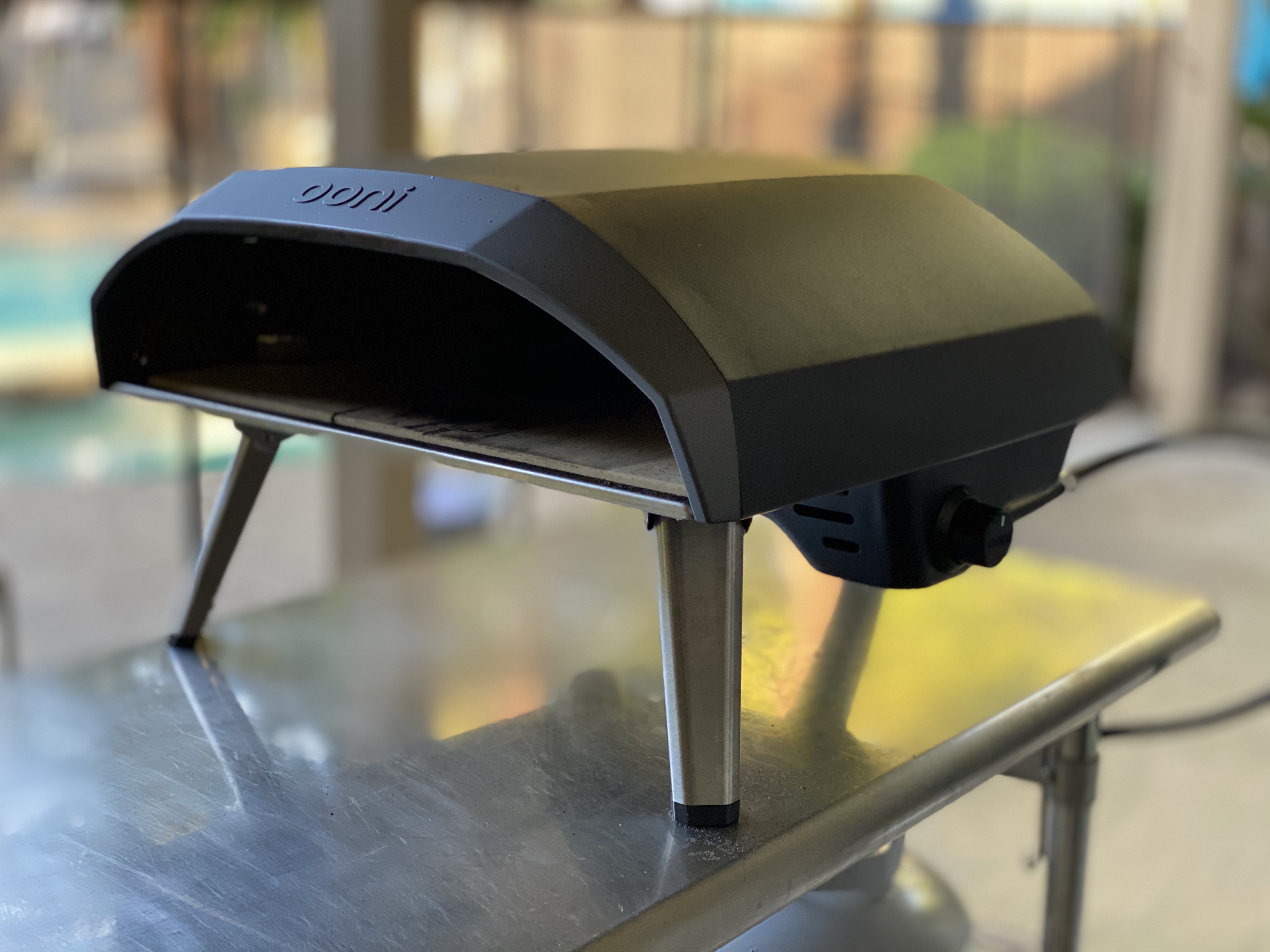
Ooni’s Koda 16 pizza oven is the rare kitchen gadget that delivers on its promise
Ooni (nee Uuni), has been around for a few years now, but its latest oven, the Koda 16, launched in March. Just like everyone else, I’ve been cooped up at home for weeks with nothing but all of the projects I would get around to one day.
At the top of my list was learning how to make decent pizza at home (we don’t have many decent pizzaiolo’s in my town). I’d been hearing about the Ooni oven for a while — mostly via Neven Mrgan’s great Instagram feed — so I spring for the Koda 13” and started firing some pies.
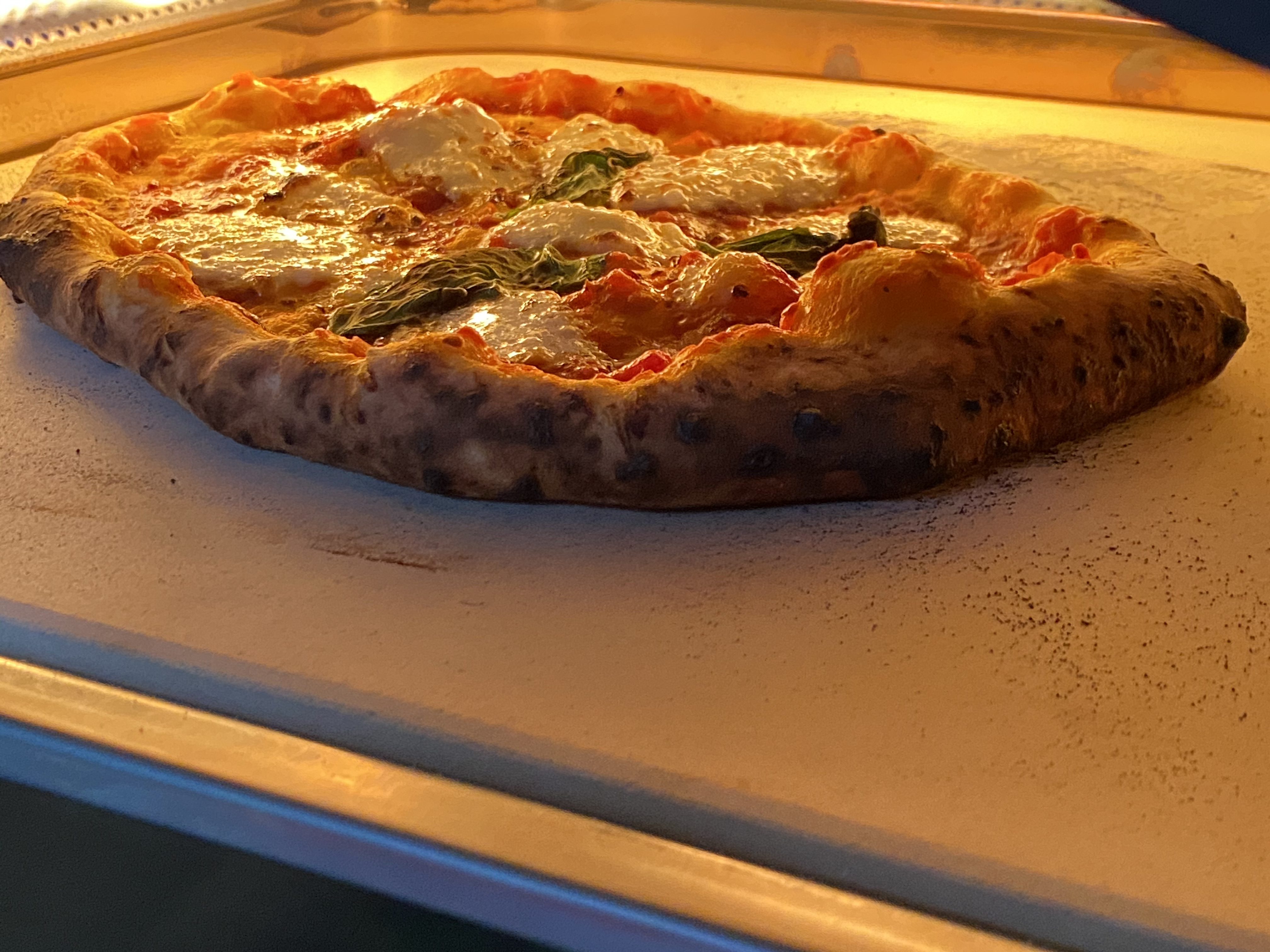
I was immediately enamored with the eye popping results. Chewy, crispy, well cooked Neopolitain-style pizza within 30 minutes of taking it out of the box. And I’m not exaggerating. After a couple of pizza launching disasters (this is not as easy as it looks, people), I was eating the product of my own hands and the Ooni’s 800+ degree baking surface. While not even an advanced amateur chef, I have always had somewhat of an aversion to single-use gadgets. Technique always wins, right?
The problem with that thinking is that it is really impossible to cook true Neopolitain pizza at home in the US because our ovens just don’t get hot enough. A ton of experimental dough situations have resulted in a few workable New York style pizza recipes for 500 degree ovens. But for thinner crusts there is zero substitute for that true 800-1000 degree cooking environment.
The Ooni delivers that in under 20 minutes attached to a bog standard propane tank. It’s brilliant.
Ooni co-founder Kristian Tapaninaho started messing around with building a decent pizza oven in 2010. He got into making home pies and realized that there was pretty much no way to do it other than building a large, expensive oven in his back yard. He began prototyping what became the company’s original oven in 2012, and he says that the original oven’s design stemmed from a super simple yet super obvious (in hindsight) design constraint: what could they ship affordably?
Due to shipping restrictions, it had to be under 10kg and had to fit in a certain footprint. Everything piece of design work on the first oven stemmed from those constraints. Why, for instance, does the Ooni oven have 3 legs? Because the 4th one would have put them over weight.
Within those constraints, the original oven took shape — delivering that super high-heat surface with a simple wood-fired unit that more than doubled its original funding goal on Kickstarter. Kristian and co-founder Darina Garland defined this high-heat, high results at-home outdoor pizza oven market at scale, along with other later entrants like Roccbox.
I had a bit of a chat with Kristian about how Ooni was doing lately, with the specter of coronavirus and the new business realities that have resulted.
“This COVID-19 situation began for us in mid January as our suppliers started informing us that they were delaying return to work from Chinese New Year,” Kristian said. “At the time the worry was if we’d have enough supply for the summer which is of course peak season for us. As our supply chain was restarting, it was clear that we’d have similar lockdowns in our main markets as well. Overall, however, we started the year at a strong inventory position which helped buffer any interruptions.” 
He says that Ooni was lucky given that the initial production run of the Ooni 16 was already in warehouses by the time things got really hairy in Edinburgh and the surrounding areas. And the team was fairly ready for the new challenge of stay-at-home work.
“Much of our team comms already happened over Slack so the team’s been really quite well setup for working from home,” he told me. “We have great relationships with our 3rd party logistics providers and while they’ve been incredibly busy, they’ve been able to maintain a good level of service, at least in the grand scheme of things.”
In addition, Ooni has just launched the Fyra, an updated version of the original Ooni 3. It’s a wood pellet powered design that offers a similar “get up and go” quick pizza path. The wood brings an additional smoky flavor, of course. At 23 pounds, it’s a super portable wood version of the gas stoves I’ve been playing with.
Yeah, but how does it work?
Once Kristian saw that I was playing with my Ooni 13 he offered to send the newly launched 16″ model over to play with. I jumped at the chance to make a bigger pie.
My experiences with the Ooni ovens so far have been nothing short of revelatory. Though I’ve pondered indoor options like the Breville Smart Oven, I knew in my heart that I wanted that brilliant taste that comes from live fire and the high heat that would let me enjoy super thin crust pizzas. I’ve now fired over three dozen pizzas in the Ooni and am coming to know it a bit better. Its recovery time, rotation needs and cooking characteristics. I have never used a more enjoyable cooking utensil.
I’ve tried a few dough recipes, because I know I’ll get questions about it, but I’ve used two to good effect. Ooni’s own recommended dough (though I hydrate a bit more) and this Peter Reinhart recipe, recommended to me by Richie Nakano.
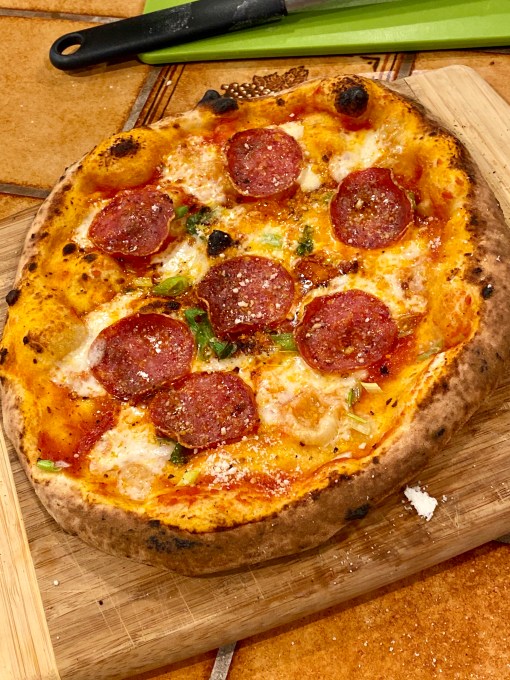
The pizzas that result are bursting with umami. The oven enables that potent combination of cheese, sauce and randomly distributed carbonization that combines into the perfect bite. Your pie goes in somewhat pedestrian — whitish dough, red sauce, hunks of fresh mozzarella — and you see it come to life right in front of your eyes. Within 60-90 seconds, you’ve transmogrified the simple ingredients into a hot endocrine rush of savory, chewy flavor.
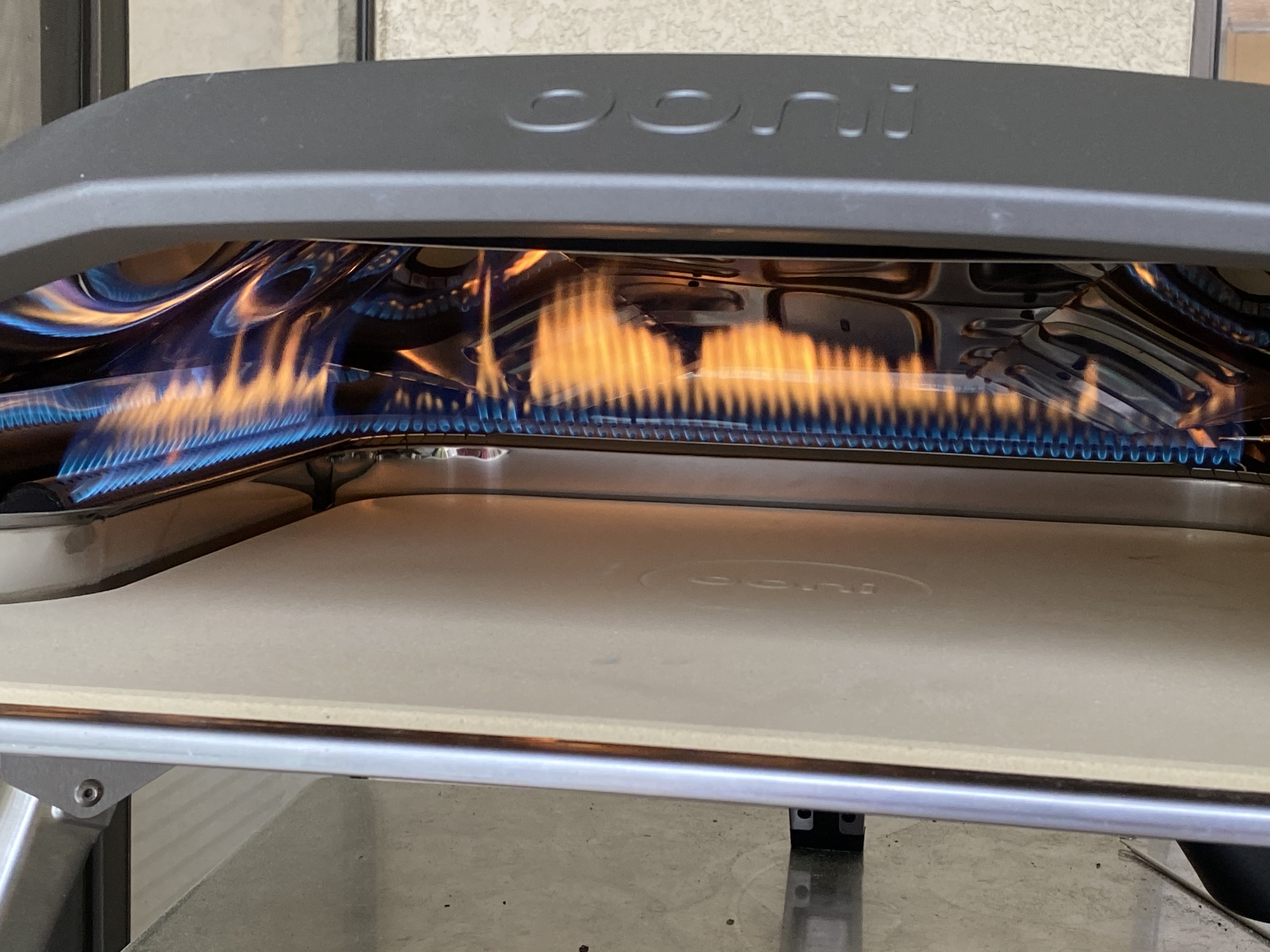
As I mentioned before, the setup is insanely simple. Flip out the legs, put it on an outdoor surface with some support and attach a propane tank. An instant of lighting knob work and you’re free to step away. Fifteen minutes later and you’ve got a cooking environment to die for. The flip down legs make the 13” model super great for taking camping or anywhere you want to go to create your own pizza party. Ooni even sells a carrying case.
The design of the oven’s upper shell means that all of the heat is redirected inwards, letting the baking surface reach 850 degrees easily in the center, up to 1000 degrees near the back. The Koda 16 has such an incredibly roomy cooking surface that it is easy to see to the sides and around your pizza a bit to tell how the crust is rising and how the leoparding is coming along. Spinning your pie mid-cook is such an important part of this kind of oven and the bigger mouth is smashing for this.
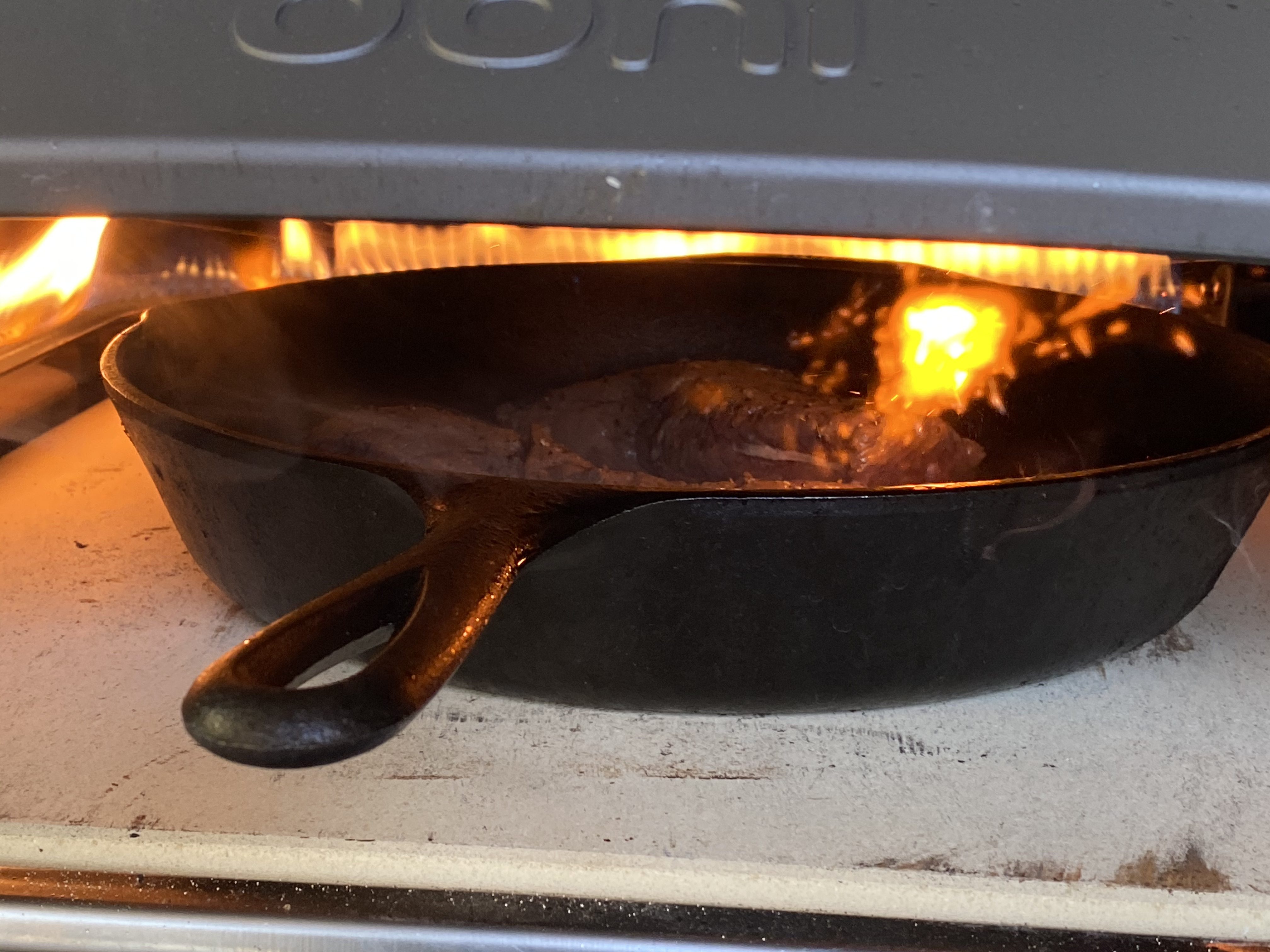
Heck I even cooked steak in it, to mouth watering results.
“Our core message has always been ‘great restaurant quality pizza at home’ and while the situation is what it is, more people spending more time at home looking for great home cooking options has been strong for our online sales,” Kristian said when I asked him about whether more people were discovering Ooni now. “Pizza making is a great way to have fun family time together. It’s about those shared experiences that bring people together.”
This mirrors my experiences so far. I’m not precisely ‘good’ at this yet, but I’m plugging away and the Ooni makes even my misses delicious. This weekend I was even confident enough to hold a socially distanced pizza pick-up party. Friends and family put in their orders and I fired a dozen pies of all kinds. Though I couldn’t hug them, I could safely hand them a freshly fired pizza and to most Italians like me, that’s probably better.
In my mind, the Ooni Koda pulls off a rare trifecta of kitchen gadgets: It retains the joy and energy of live flame, delivers completely on its core premise and still remains incredibly easy to use. Highly recommend.
Crowdfunding platforms to the rescue for vulnerable populace during Covid-19
MediaTek says it has started to use Intel Foundry's advanced chip packaging in addition to TSMC's, as the mobile chip designer bets on AI demand for growth (Cheng Ting-Fang/Nikkei Asia)
Cheng Ting-Fang / Nikkei Asia : MediaTek says it has started to use Intel Foundry's advanced chip packaging in addition to TSMC's...
-
Sohee Kim / Bloomberg : South Korean authorities are investigating a data leak at e-commerce giant Coupang that exposed ~33.7M accounts; ...
-
The first project we remember working on together was drawing scenes from the picture books that our mom brought with her when she immigrate...