Wednesday, November 27, 2019

Vinted, the second-hand clothes marketplace, raises $141M at a $1B+ valuation

The market for second-hand clothes — the “circular economy” as it’s sometimes called — has been on the rise in the last several years, fuelled by economic crunches, a desire to make more responsible and less wasteful fashion choices, and a wave of digital platforms that are bringing the selling and buying of used clothes outside the charity shop. Today, one of the bigger companies in Europe working in the third of these areas is announcing a huge round of funding to double down on the trend.

Vinted, a site where consumers can sell and buy second-hand fashion, has raised €128 million (around $140.9 million) in a round that is being led by Lightspeed Venture Partners, with previous backers Sprints Capital, Insight Venture Partners, Accel and Burda Principal Investments also participating. With this investment, the startup — founded and headquartered out of Vilnius, Lithuania — has passed a valuation of $1 billion (it is not specifying an exact amount), making it one of the biggest startups to come out of the country (but not the Baltics’ first unicorn… Estonian Uber competitor Bolt, formerly known as Taxify, is also valued at over $1 billion.)

The company is going to use the money to continue expanding in Europe, and building out more features on its platform to improve the buying and selling process, while sticking to its goal of providing a platform for consumers to list and buy used fashion.

“We want to make sure we don’t have new products,” CEO Thomas Plantenga said in an interview earlier. “All our sellers are regular people.” Some 75% of Vinted’s customers have never bought or sold second hand clothes in their lives before coming to the platform, he added. “The stigma is no longer there.”

Vinted’s growth comes on the heels of a remarkable turnaround for the startup. Founded in 2008 by Milda Mitkute and Justas Janauskas as a way to help Mitkute clear out here wardrobe before a house move, the company expanded fast, but at a price: by 2016, it was close to running out of money and business had slowed down to a crawl. Investors brought in Plantenga to turn it around.

“We changed the business model in 2016 to make the costs as low as possible for users to list clothes,” Pantenga said today. “That produced a dramatic change in our growth trajectory.”

The company, more specifically, went through some drastic changes. First, it clawed back a lot of its pricey international expansion strategy (and along with that a lot of the costs associated with it); and second, it removed all listing fees to encourage more people to list. Now, Vinted charges a 5% commission only if you conduct transactions on Vinted itself, bundling in buyer protection and shipping to sweeten the deal. (You can still post, sell and buy for free if you pay offline but you don’t get those perks.)

The turnaround worked, and the company bounced back, and two years later, in 2018, it went on to raise €50 million. Today, Vinted has some 180 million products live on its platform, 25 million registered users in 12 markets in Europe (but not the US) and 300 employees. It expects to sell €1.3 billion in clothes in 2019, has seen sales grow 4x in the last 17 months.

Vinted’s rise has matched a wider trend in the region.

Europe is the home to some of the world’s biggest “fast fashion” businesses: companies like H&M, Zara and Primark have built huge brands around making quick copies of the hottest styles off the fashion presses, and selling them for prices that will not break the bank (or at least, no more than you might have previously paid to buy a pair of average jeans on the discount rack of a Gap).

But it turns out that it’s also home to a very thriving market in second-hand clothes. One estimate has it that two out of every three Europeans has bought a second-hand good, and 6 out of 10 have sold their belongings using platforms dedicated to second-hand trade.

Even as the company continues to hold back on expanding into the US — perhaps burned a little too much by its previous efforts there; or simply aware of the wide competition from the likes of Ebay, OfferUp, Letgo, Poshmark, and many more — Vinted’s growth in Europe has caught the eye of investors in the that market.

“At Lightspeed, we look for outlier management teams building generational companies. We’ve been impressed by the team’s ability to build an incredible product and value proposition for their community, and adapt and expand their business along the way,” said Brad Twohig, a partner at Lightspeed. “Vinted is defining its market and has built a global brand in C2C commerce and communities. We’re proud to partner with Vinted and leverage our global platform and resources to help them continue to build on their success and achieve their goals.”

While charity shops have traditionally dominated this market, sites like eBay, followed by a secondary wave of platforms like Vinted and another competitor in this space, Depop, have made selling and buying items into an established, low-barrier business.

All the same, given that extending the life of one’s goods feeds into a do-good ethos, it’s noticeable to me that Vinted hasn’t quite replaced the Salvation Army: there is virtually no way to sell on Vinted and give the proceeds to charity, if you so choose.

It appears that this might be something Vinted will try to address in the future.

“We are looking at making fashion circular for our users so that clothing that they bought doesn’t go to waste,” Plantenga said. “[Giving proceeds to charity] is super interesting and we should explore it as part of our growth story. To be honest, those things have been in the background and not developed because we’ve just been trying to keep up with everything, but the idea fits into our culture.”

Revolut supports direct debits in the UK

Fintech startup Revolut is adding a key feature for users who want to replace their traditional bank account altogether. You can now pay with GBP direct debits. Revolut already added EUR direct debits last year.

While most people use cards to pay for goods and services in the U.K., some businesses require you to pay with direct debit. It can be a utility bill, a gym membership or a phone contract for instance.

Compared to card transactions, direct debits pull money directly from your account and transfer it to the recipient’s account. It doesn’t go through Mastercard or Visa. Some businesses love direct debits because it’s usually cheaper than card processing fees. Direct debits also don’t have an expiry date, unlike cards.

Customers from the European Economic Area can now share their GBP account details for direct debits in the U.K. Direct debits are protected against some fraud and payment errors by the U.K. Direct Debit Guarantee.

Revolut has partnered with Modulr for this feature as it uses Modulr’s API. Business customers will also be able to take advantage of direct debits. You can now pay suppliers with your account details, which could be convenient for large sums of money for instance.

Tuesday, November 26, 2019

Vivo U20 vs Vivo U10: What's the Difference?

Vivo U20 offers a noteworthy bump in performance and camera department. https://ift.tt/2Ol7TRb

Kasada, which has developed tech to fight bot-powered attacks, says it has closed $7M Series A, which includes funding from its newest investor In-Q-Tel (Zack Whittaker/TechCrunch)

Zack Whittaker / TechCrunch:
Kasada, which has developed tech to fight bot-powered attacks, says it has closed $7M Series A, which includes funding from its newest investor In-Q-Tel  —  Kasada, an anti-bot startup we profiled earlier this year, has raised $7 million in its Series A with In-Q-Tel, the non-profit venture arm …


This debut venture firm, backed by an Argentine conglomerate, is investing $60 million in far-flung U.S. startups

Nico Berardi considers himself to be a citizen of the world, with a penchant for travel and a wide range of interests. Unlike many other VCs, who’ve increasingly specialized their mandates as the market has grown more crowded, Berardi is nearly as wide-ranging in his approach to venture capital, too.

Somewhat counterintuitively, it’s paying off. At least, Berardi’s venture firm, Animo Ventures, has been investing a $60 million debut vehicle since closing it in July of last year.

It’s an impressive, surprising, amount for someone raising a fund for the first time, but then, Berardi’s trajectory into the world of venture capital hasn’t been completely straightforward, either. To wit, Berardi grew up in Argentina, where his professional life began at a community-focused nonprofit Techo, a kind of Habitat for Humanity focused on Latin America. He was so good at his development job, in fact, that he was moved to Miami as the CEO of Techo’s U.S operations.

It was there, over his six year career with the organization, that he was first introduced to the world of investing. Specifically, encouraged by several board members who were angel investors — and aided by some backing from the Knight Foundation — Berardi left the nonprofit world in 2014 to launch a still-active angel investor group called Miami Angels that funnels around $3.5 million into roughly 10 local companies each year.

In quick succession, he then applied to and was accepted into the tuition-based Kauffman Fellows Program, fell in love with a medical student in Boston, and headed to Harvard Business School to be closer to her, spending his summers with the Boston (and San Francisco-based) early-stage firm Resolute Ventures.

He imagined he’d land in San Francisco afterward, to work with Resolute. But when that medical student — now his wife — wound up landing a job back in Miami, he headed there instead and decided to launch his own venture firm. Enter Animo, a Latin word that means with intention or purpose and also, notes Bernardi, “sounds international.”

The latter matters because while Berardi is the sole general partner of the firm, he’s running it with two colleagues, neither of whom lives in the U.S. One of these is partner Antonio Osio, a native Mexican who was running his own firm, Capital Invent, when he first met Berardi through Kauffman Fellows. (“I poached him,” says Berardi.) They also have an operations partner in Caro Acevedo, who worked with Berardi as his COO at Techo and who still lives in Argentina.

As for the money, Berardi says it “mostly comes from Latin America and Europe,” including from anchor investor Techint. It’s a 60,000-person Argentine conglomerate that owns steel, construction, oil, gas, and healthcare businesses around the world and whose CEO, Paulo Rocco, sees Animo as a way to put the company’s resources into new materials sciences and manufacturing technology and machine learning startups, says Berardi.

“We want to make a dent in the universe, and there aren’t a lot of Latinx investors around and we want to carry that flag,” he offers.

To date, Animo has announced 12 deals, all in the U.S., including six investments in New York and six others in other places, including Scottsdale, Az.; Toronto, Ontario; Miami; and Richmond, Va.

Notably, Animo does not have plans to invest in Latin American companies, though it has backed a number of Latin American founders in the U.S. “I think every investor has their own set of biases,” says Berardi. “Our diversity numbers point in that way, but it hasn’t been a conscious effort. That’s just who we are.” He suggests that a much bigger focus for the firm is using its connections in “tier one ecosystems” like San Francisco and New York to “help [founders] outside the bubble enter it.”

Berardi does say there are a few things Animo won’t consider. “We stay away from FDA-regulated stuff because we don’t understand it well enough and therefore can’t be useful.” Mostly, however, he’s open to anyone and everyone who appreciates hard work, he suggests. “We’re younger, we’re hungry. We work 100-hour weeks and travel like crazy people.”

To underscore his point, Berardi tells a story about Intello, a SaaS operations platform that helps companies manage their SaaS spend, usage and compliance data and an Animo portfolio company. The startup had rented a booth at a conference organized by Okta, the publicly traded identity and access management company. “They didn’t have enough people to man the booth,” says Berardi, “and I was in town, so I was like, ‘I’ll man the booth with you in a cloud suit.’ They thought I was joking and I made an idiot of myself, but it drew a lot of people to the booth.”

Pictured above from left to right, Animo founders Nico Berardi, Caro Acevedo, and Antonio Osio.

Honor V30 and V30 Pro 5G smartphones launched with 40MP triple rear camera

Honor has officially launched the Honor V30 and V30 Pro at an event in Beijing, China. Both the smartphone will be available for pre-order in China on December 5 and there is no information on when the devices will be available internationally. Both the V30 and V30 Pro boast of 5G connectivity and are the first Honor 5G phones to be launched. Both smartphones come with five cameras - 2 on the front and 3 on the back and are powered by the Kirin 990 chipset under the hood. 

The Honor V30 and V30 Pro sport a 6.57-inch LCD display with a Full HD+ resolution. The fingerprint sensor on the smartphones is on the side, much like the Samsung Galaxy S10e.  When it comes to optics, both smartphones have three cameras at the back. The cameras are housed in a slight bump. Both the V30 and V30 Pro house a 40MP Sony IMX600 sensor with Dual OIS and laser AF as the main sensor. However, it must be noted that the V30 Pro has a faster f/1.6 lens when compared to the f/1.8 lens on the V30. Next up is an 8MP telephoto lens with 3x optical zoom, f/2.4 aperture and OIS. This module is identical between the two smartphones. Last but not least, is the ultrawide camera. The Honor V30 has a 12MP f/2.2 sensor whereas the V30 has an 8MP f/2.4 sensor. 

At the front, both the smartphones have a dual-camera setup. It is a punch hole camera design and because there are two sensors, it has an oval shape. The smartphones house a 32MP main selfie cam that boasts of Super Night Mode accompanied by an 8MP ultra wide-angle camera that has a 105-degree FoV.

Under the hood, both the smartphones have the Kirin 990 SoC, but there is a slight difference between the two. The Honor V30 sports the basic 7nm Kirin 990. This chipset is accompanied by the Balong 5000 modem. The V30 Pro, on the other hand, sports the 7nm+ Kirin 990 with an integrated modem. Both the devices support 5G and are the first smartphones from the house of Honor to do so. The devices will run on Android 10 out of the box with Honor’s Magic UI 3.0.1 overlaying it. The devices also have GPU Turbo and Kirin Gaming+ 2.0 to enhance the users gaming experience. 

Both V30 and V30 Pro will support 40W Honor SuperCharge. In addition, the V30 Pro also supports 27W Super Wireless Charge. When it comes to battery capacity, the Honor V30 has a 4,200mAh battery and the V30 Pro has 4,100mAh.

Coming to the pricing and availability, the Honor V30 will be priced at CNY 3,299 (Rs 33,500 approx. directly converted) for the 6/128 GB variant and the 8/128 GB variant is priced at CNY 3,699 (Rs 37,700 approx. directly converted).

The 8/128 GB variant of the Honor V30 Pro is priced at CNY 3,899 (Rs 40,000 approx. directly converted) whereas the 8/256GB variant is priced at CNY 4,199 (Rs 43,000 approx. directly converted).

As for availability, there is no word on when the devices will hit the international market. But they will go on pre-order in China starting December 5 with a flash sale taking place seven days later. The smartphones will be available in Orange, Pearl White, Blue and Black colour options.  

https://ift.tt/2KVfUtM

Amazon announces new Alexa emotions for developers to let Alexa respond to questions from US users with a "happy/excited" or a "disappointed/empathetic" tone (Jay Peters/The Verge)

Jay Peters / The Verge:
Amazon announces new Alexa emotions for developers to let Alexa respond to questions from US users with a “happy/excited” or a “disappointed/empathetic” tone  —  Alexa is also getting a radio DJ-like voice  —  You might hear a little more emotion from Alexa's vaguely-robotic voice …


Ola Begins Signing Up Drivers in London as Uber Gets Banned

Ola said it had started signing up drivers in London on Tuesday and will start service in the city within weeks. https://ift.tt/2DgVHue

Aadhaar Excludes Homeless and Transgender People, Study Shows

Ten years after it was introduced, India's national digital identity system is becoming ubiquitous in the country, even as large numbers of homeless and transgender people are excluded and many denied... https://ift.tt/2OloRP8

Samsung Galaxy S11+ Renders Highlight Rectangular Penta Camera Setup

Samsung Galaxy S11+ renders have surfaced online to suggest its design, display, and camera specifications ahead of any formal announcement. The Galaxy S11+ is said to have a penta rear camera setup. https://ift.tt/2OLLxqN

Oppo Hopes Localised Features on ColorOS 7 Will Give It a Leg-Up Over MIUI

ColorOS 7 competes with Xiaomi's MIUI with a list of localised features for India, including DocVault and Riding Mode. However, it does have some reminiscent of MIUI with a three-finger screenshot... https://ift.tt/34v184Y

30 useful government apps every Indian should download

https://ift.tt/2XXsHBq

You can take my Dad’s tweets over my dead body

Editor’s note: Drew is a geek who first worked at AOL when he was 16 years old and went on to become a senior writer at TechCrunch. He is now the VP of Communications for venture equity fund Scaleworks.

There are a few ways that people use Twitter, but for the most part the ones who have pushed the social platform into the national lexicon are regular users who like to communicate with each other using the thing. They’re the ones who use it a lot. They’re the ones who make Twitter go.

Now, mind you, I’m an extreme case. I share a lot. I’ve shared my cancer diagnoses, my stem cell treatment, new jobs, my wedding. And the loss of my father Barry.

Today, Twitter announced that it will reclaim dormant accounts. That is, if you haven’t logged into yours for a long time, it is considered inactive and will be included in the reclamation process.

At first I thought that was pretty cool. There are a ton of accounts that get squatted on, forcing new users to use crappy AOL-like names, such as Joe583822. No fun at all. And these accounts aren’t even in use! As in not active.

No big deal.

But then I saw this:

My heart sank. And I cried. You see, I didn’t think about this. It is a big deal.

My father’s Twitter account isn’t active. He passed away over four years ago. My Dad was a casual tweeter at best. He mostly used it because I, well, overused it. And it was charming. Once in a while he’d chime in with a zinger of a tweet and I’d share it humbly with the folks who kindly follow me.

He got a kick out of that, and so did I. I still do. I still read his tweets, and from time to time I still share them with you. It’s my way, odd or not, of remembering him. Keeping his spirit alive. His tweets are timestamped moments that he shared with the world.

And Twitter is sweeping them up like crumpled-up paper and junk in a dustbin.

Surely, my father isn’t the only person who has passed away and left a Twitter account unkept — or, as the company puts it, “inactive.” I can think of a few others. And I get even more upset at the thought of their thoughts disappearing. I might not remember everyone we’ve lost, but not being able to recall something they’ve said or shared in the past is depressing.

When people ask me why I use Twitter so much, it’s mostly because I see the platform as a living organism. It’s not perfect. In fact, it’s awful sometimes. Lately, a lot of times.

During events and during holidays it’s almost as if that tiny little app on my phone has a pulse. And a heart. Because of course it does: It’s full of human beings with feelings and real thoughts. That’s what makes Twitter Twitter.

And just because someone’s pulse no longer beats doesn’t mean their thoughts no longer matter.

I sincerely hope that Twitter didn’t think about this first and reverse course. Perhaps they’ll offer a way to memorialize an account. I don’t have my dad’s login. I can’t “wake up” his account to keep it safe. I am truly sad at the thought of losing some of his quirky nerdy tweets.

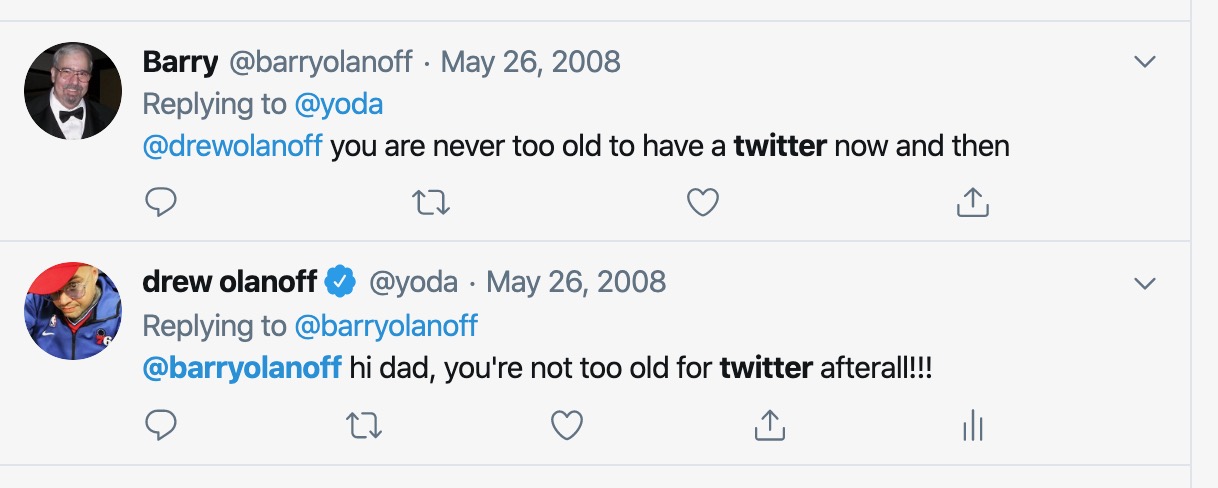
Especially this one:

My dad thought I was the only person on the damn site and I never corrected him or schooled him on Twitter. He used it the way he wanted to, and that reminds me of the person he was. If you take that away from me, then what is Twitter anyway?

Facebook allows you to memorialize someone’s page and that’s pretty great. Unfortunately, my father’s page was deactivated and deleted without my having been consulted. By the time I realized it was gone, Facebook told me there was nothing it could do. It was really traumatizing for me and my other family members. So many interactions there, thoughts, smiles. A timeline. No, a time capsule.

Just gone. Like my dad.

Big tech companies are good at a lot of things, but what they seem to lack is collective empathy and heart. When humans use the things you build and you stop treating them like humans, but rather like bits and bytes and revenue dollars, you’ve given your soul away. And maybe it’s just me getting older, but I’ve had about enough of it.

To quote the late great Barry Olanoff:

Think about it, Twitter. Do better. Because every time you make me question your humanity, I’m one step closer to not being that whale of a user that helped get you here in the first place.

ETtech Top 5: Law to monitor state’s tech surveillance, Govt’s EV push & more

A closer look at today's biggest tech and startup news and why they matter. https://ift.tt/2sdMgJI https://ift.tt/eA8V8J

Tatas pump in more to CLiQ and grow

Tata Group infused Rs 231 crore into Tata CLiQ in FY20 despite an 18% rise in etailer’s loss in FY19. Tata Unistore net losses jumped to Rs 246.75 crore in 2018-19, while it more than doubled total income to Rs 110.75 crore. https://ift.tt/33u8EM8 https://ift.tt/eA8V8J

Some startups and researchers who can't access the most advanced chips are adopting a "frugal AI" approach, building smaller models on open-weight systems (Rina Chandran/Rest of World)

Rina Chandran / Rest of World : Some startups and researchers who can't access the most advanced chips are adopting a “frugal AI” app...