Wednesday, October 2, 2019
Bithumb to talk to govt for regulated exchange

ShareChat transparency report says it provided user info to govt on 33 out of 41 requests
Political parties go big on Facebook ads as state elections near
Leo Aerospace provides bespoke rocket launches — from a hot air balloon
The demand for orbital launches is increasing steadily, and the industry is nowhere near keeping up. Leo Aerospace thinks it can help with a launch technique that’s more efficient and requires far less infrastructure than an ordinary rocket: a hot air balloon. With a rocket attached to it, of course. It sounds wacky at first, but it could prove to be an economical and flexible way of getting to orbit.
Leo is originally out of Purdue, one of two such teams on stage this week at Disrupt SF Startup Battlefield. Co-founder and CEO Dane Rudy said they were looking into new and better ways to achieve orbit besides the traditional surface-based rocket approach.
 “We found this really elegant solution that was actually tested in a rudimentary way in the 50s by the Air Force, which is launching rockets from an aerostat — a balloon,” he said.
Perhaps used to countering narrowed eyes and barely disguised incredulity at this point, he hastened to follow up.
“It actually worked really well for what it was designed for. The issue they ran into was that the U.S. shifted toward sending people to the Moon — so there just wasn’t a need for that technology in the Apollo program. But the rise in small satellites has created a huge demand tailored to these capabilities,” he said.
It turns out using a balloon has big benefits. A large amount of a rocket’s fuel and engineering is dedicated to pushing it from the ground, where the atmosphere is heaviest, to the thinner upper atmosphere, where drag and other issues are much less of a worry. By going the first few miles straight up in a balloon, much less rocket is needed to get into orbit, since you’re skipping one of the hardest parts.
The technique is more or less exactly what you’d imagine: A large balloon inflates and lifts the payload, a small rocket, to a designated altitude. Once there it aligns itself and… well, lifts off is perhaps the wrong term. But it ignites and exits the atmosphere at a planned trajectory and inserts the payload into orbit.
There are already air-launch systems out there that use planes rather than balloons, presenting their own challenges and advantages. Leo Aerospace’s main draws are flexibility and cost.
“Our system is fully mobile — it doesn’t require any ground infrastructure,” said Rudy. “The whole thing fits into a regular shipping container.”
That means it can take off wherever and, perhaps more importantly, whenever the client chooses.
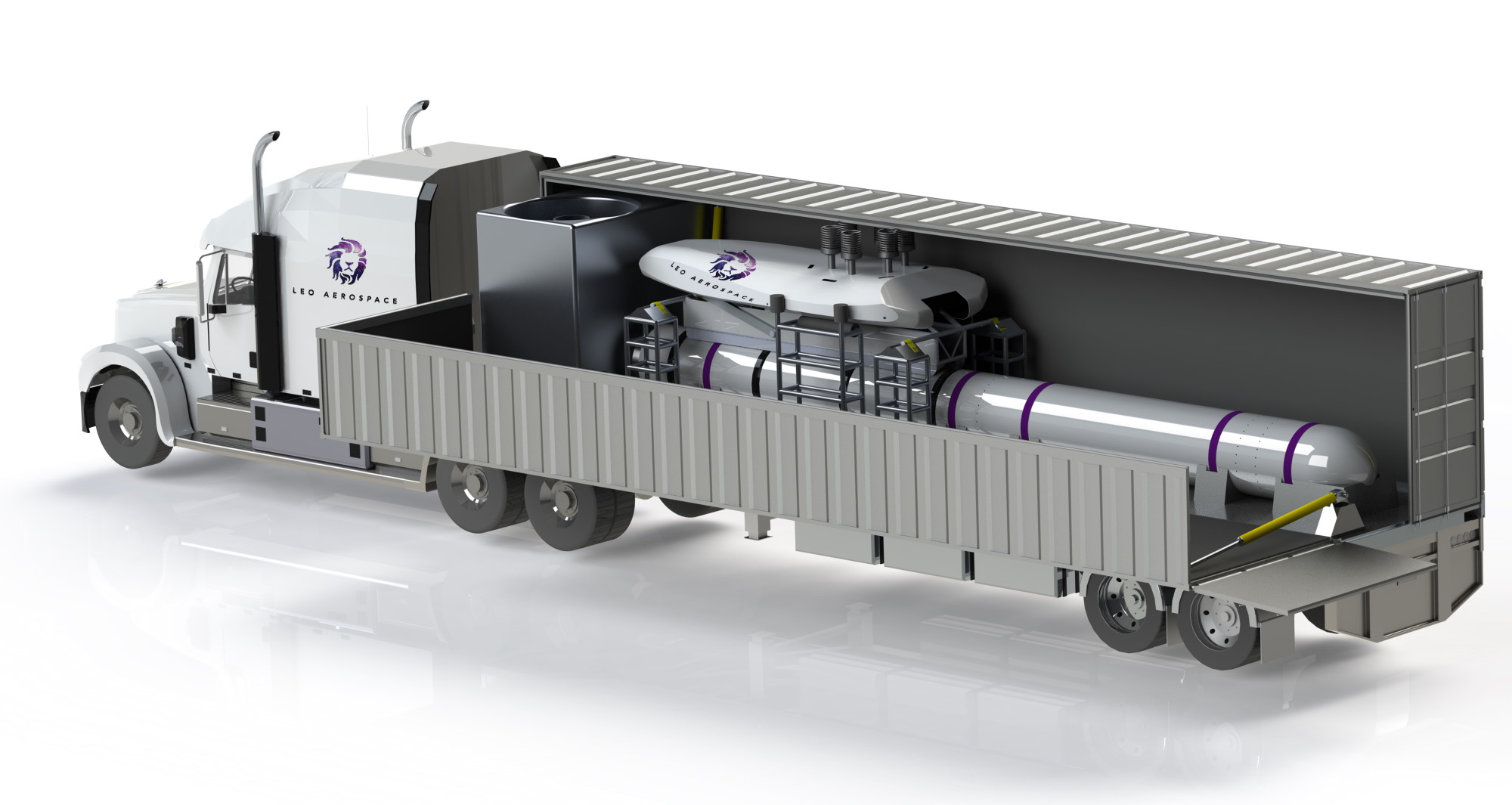
Right now the launch industry is expanding like crazy, both because of an increase in total launches and the rise of “ride-sharing,” where dozens of payloads share the cost of a single rocket. The cost goes down, but there are serious inconveniences.
“They don’t have much choice in when they launch or what orbit they’re going to. There’s also the complexity of having to ride with a bunch of other payloads on board — you have to compromise on timing and so on,” Rudy said.
While ride-sharing means many payloads will get to space that might not have a few years ago, it also means they might wait for years while the rest of the seats fill up and get ready to roll. With Leo it’s practically Domino’s for orbit.
That’s all great in theory, but the fact is no one has made a balloon-based commercial launch system. When the Air Force did it, it was pretty crude: The rocket was carried in a vertical position and shot right through the balloon when it went up. That kind of rules out reusing the balloon, but Leo’s entire business is founded on reusability, since that brings costs down immensely.
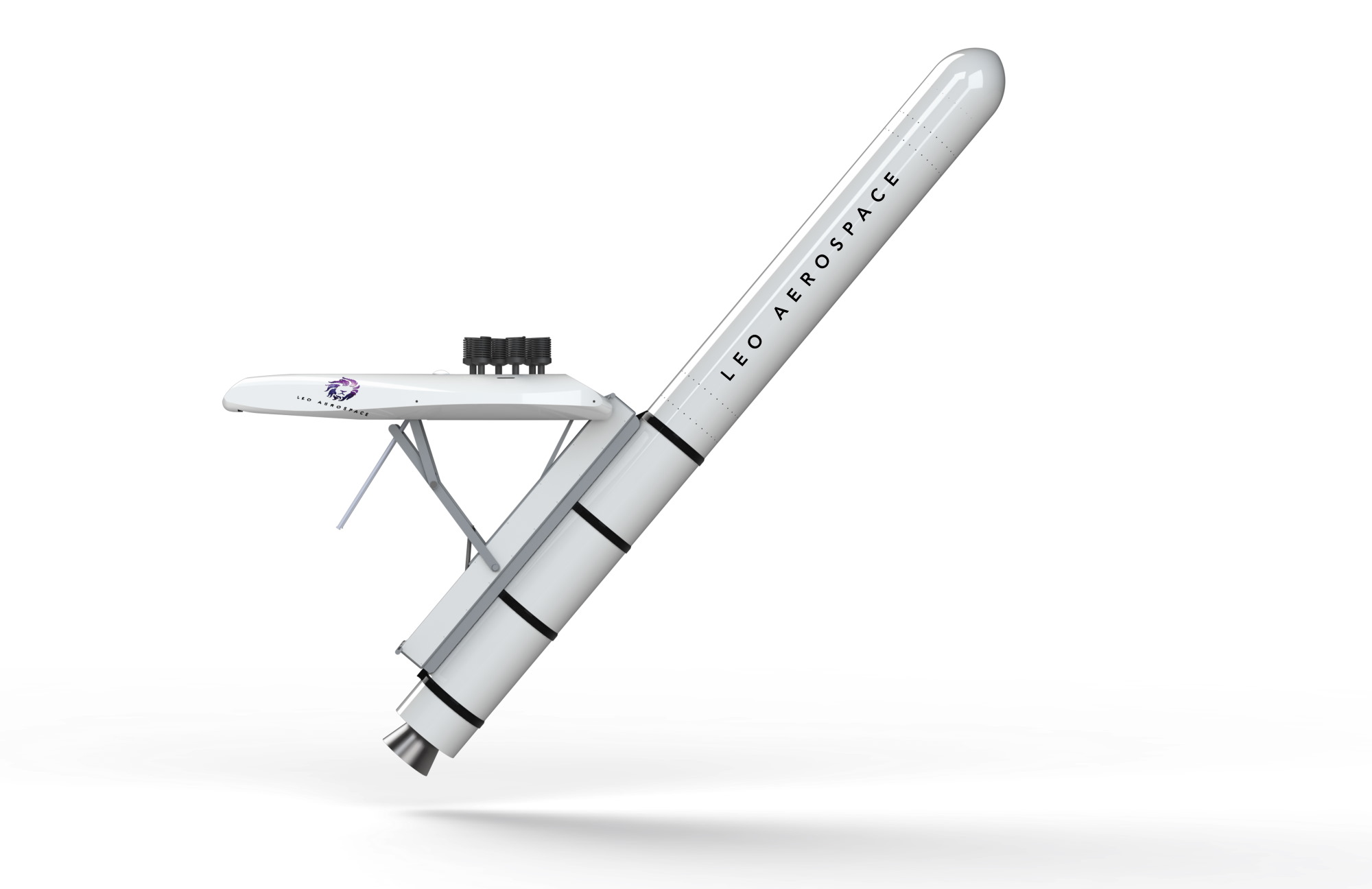
“That was one of the big problems we had to solve — the expense of the balloon itself; helium is expensive, and the envelope [i.e. the balloon material] is expensive and fragile,” said Rudy. “How do we make that zero stage, as we call it, reusable?”
Amazingly, they determined that tough, ripstop nylon and hot air were actually the best solution. It’s remarkably close in principle to an ordinary recreational hot-air balloon, but with the slight difference that it has to fly up to 18 kilometers of altitude and carry a rocket with it.
“The difference is how do you control and command this sort of vehicle, integrate it into airspace, suspend the rocket beneath it and all that,” Rudy said. “All the stuff you have at Vandenberg Air Base for a launch — we have to make all that mobile.”

A bit like going from an ordinary car to a self-driving one, Leo’s balloon may be similar to the recreational type in its basic form, but the technical advances are in how it is controlled and tracked. They can adjust for wind, control the yaw and rotation, rise to a very precise altitude, and so on — naturally, all remotely and with partial autonomy.
The rocket doesn’t shoot through its balloon as before, but fires off at a mission-determined angle. 18 km closer to space, with far less air resistance to worry about, the three-stage rocket (two solid, then one non-cryo liquid) can be much smaller and have far less mass — requiring less than half the fuel to lift a given mass to orbit. To be specific, the system is specced to send 33 gross kilograms, 25 kg of payload, to a 550 kilometer orbit — or about twice that to 300 kilometers.
December saw the company performing reduced-scale tests at altitude, an important stepping stone to regulatory approval. The plan is to make their first full-scale suborbital launch next year with their first customer’s payload on board. Orbital launches are planned for 2022.
Leo has gotten through December’s tests on a quite barebones budget for a space startup of about $520,000, through TechStars and a grant from the National Science Foundation. That’s great for a foundation, Rudy said, but full-scale tests and an eventual transition to commercial operations will take more than six figures.
An Air Force Small Business Innovation Research grant has opened the door to other government sources, and there’s been interest from that quarter in the non-orbital potential of the system, for instance high-altitude testing, mobile communications infrastructure, and so on. So already there are multiple eggs in multiple baskets — an attractive quality for investors.
“We’ve done all the foundational work,” said Rudy. “Now it’s just about scaling up.”


OzoneAI wants companies to pay you for your data, upending the ad model
Imagine this. Instead of giving away your personal data so web giants can show you ads, you cut out the middle person and allow advertisers to pay you directly for your data.
It’s a novel idea for a new startup that bills itself as a “data privacy” company.
OzoneAI says it preserves users’ privacy by allowing them more granular controls over who gets their data. In the startup’s utopian vision, companies can skip over the major advertising giants like Google and Facebook and buy access to anonymized data from the users themselves. That could mean companies buying your Spotify playlists, your Amazon wish list, or your access to your social media. The user is paid for the access, and the company gets to use the data for better targeting their ads.
The company made its public debut at Disrupt SF on the Startup Battlefield stage.
The startup seeks to capitalize on the wave in recent years of mistrust over online ads. As websites have become more aggressive in their advertising by persistently tracking users and collecting personal data, users have fought back with ad-blockers and privacy apps.
OzoneAI thinks there can be a happy medium between selling and protecting your data. With an app, users can grant companies access to their data and get paid for it. In return, companies get anonymized data which they can use for better targeting consumers.
By taking big tech out of the equation, the startup thinks it can make advertising more efficient for everyone.
But not everyone will see it that way. The privacy-minded with their ad blockers aren’t likely to lower their own bar to allow advertisers any more access to their data than is necessary. But for those who want to make a quick buck, will their actions be motivated more by making money and less about privacy?
When asked, the company’s founders Lyndon Oh and Ben Colman, who both previously worked for Google, denied it was encouraging users.
“However much activity you want to sell, that’s completely up to you,” the founders said. “You are anonymized as an identity; however, your data is not. The fact that you watched ‘The Avengers’ five times last week is not anonymized — you are selling that directly.”
Users’ data is fed into the machine learning engine to make recommendations for other companies and services, allowing the process to match activity to another business. OzoneAI makes its money by charging a 30% cut from the businesses who subscribe to a user’s data, which they say still provides better value than the “spray and pay” model that companies who want to advertise on Facebook and Google are subjected to.
The user can use the OzoneAI app to log in to their various social networks, shopping sites, email provider and anything else. That authorizes OzoneAI to vacuum up your data and begin processing it.
Unsurprisingly, many will turn their nose up at the concept of having a startup they’ve never heard of be effectively given unfettered access to all their online accounts so they can sell your data directly to companies hungry to advertise to you. The startup says it, like any company with similar access to the firehose of a person’s online life, has access to that data but immediately writes the data to its servers in an encrypted way. The user retains the private key to their cloud-stored encrypted data, so OzoneAI says it can’t access the user’s data. Through the app, the user can also “detonate” and destroy any of their collected data.
But by giving users control of their data, the user has to trust OzoneAI more than the existing advertising system. Given how broken the existing system is, it likely wouldn’t take much trust at all. But it’s an uphill battle for an emerging startup with not much of a name. And one hiccup could send that trust tanking.
The founders said other tech companies are “doing the same thing,” and that’s reason enough why users should trust OzoneAI.
But “another company does it” doesn’t mean it’s the right thing. OzoneAI was “just putting users directly in front of the business,” the founders said.
The old saying goes, “If you’re not paying, you are the product.” And yet as much as you are paying — with your data — then you inexplicably are still the product.


Two enterprise-worthy password managers: LastPass and RoboForm
Twitter and TweetDeck are experiencing partial outages
It’s not just you, Twitter has gone wobbly again. Users of the social network in Asia and Europe are reporting a range of problems tweeting and viewing certain types of content this morning.
Among the problems being reported are not being able to post certain types of content to the site (such as polls and media), though at least some users are still able to post text tweets saying they’re having problems.
Other users aren’t seeing latest replies to their tweets. In my case I’m unable to view latest replies on Twitter’s desktop product but can see them on an (older) version of Twitter’s iOS app.
Some Twitter users are also reporting problems posting to Android.
A Twitter spokeswoman confirmed to TechCrunch it’s having problems — pointing us to a tweet from @TwitterSupport where the company says it’s experiencing outages across both Twitter and its alternative client, TweekDeck.
The problem is also affecting being able to view DMs, per the tweet.
“We’re currently working on a fix, and should be back to normal soon,” Twitter adds, without providing detail about the cause of the issues.
The flakey service comes a few months after a major outage for Twitter.
Back in July Twitter’s service went down for a full hour. In that case an “internal configuration change” caused the issue — which Twitter subsequently rolled back.
It also suffered problems with direct messages in the same month.
Coincidentally or not, the company rolled out a major redesign of its desktop product this summer.
Twitter’s new ‘Facebook-style’ look has not been universally popular, to put it politely. Whether the redesign is the root cause of the recent bout of service flakiness remains to be seen.
Twitter’s status page sheds zero light on the matter — currently reporting that “all systems are operational” when that’s patently not the case.
We’ll update this report with any further details on the problems from Twitter.


Impala builds a single API for the entire hotel industry
Meet Impala, a London-based startup that wants to make it easier to interact with hotel data. The startup is building a layer on top of legacy hotel systems to standardize everything with a modern REST API.
And Impala has just raised an $11 million Series A funding round from Stride.VC, Xavier Niel/Kima Ventures, Jerry Murdock, the partners of DST Global and existing investors. The company had previously raised a $1.75 million seed round.
Essentially, Impala wants to be as simple as Stripe, Twilio or Plaid. With a few lines of code, any developer should be able to get started with Impala before diving deeper.
If you’re not familiar with the tech stack of the hotel industry, hotels use Property Management Systems to manage rooms, room types, pricing, extras, taxes, etc.
“One of the reasons it's necessary is that hotels never replace that underlying system (ever) and so there's no incentive for those old systems to build open APIs (even if they could),” co-founder and CEO Ben Stephenson told me.
Developers working on products in the hotel industry currently have to build a ton of integrations to connect to all the different hotel systems. Impala wants to do the same work once and for all, and standardize the API for anyone building services on top of hotel systems.
In other words, if you want to know how many standard rooms are left in different hotels, you can query those hotels using the same API call. It becomes much easier to manage one or multiple hotels, and build apps, websites and internal services that interact with a hotel system.
With today’s funding round, the company wants to build more integrations with hotel systems. It currently supports 8 different systems, but universal support will be key when it comes to making Impala the universal language of the hotel industry.
Impala is also working on a direct booking API. Right now, many hotels manually upload booking data to Booking Holdings websites (Booking.com, Priceline, Agoda, Kayak…) and Expedia Group websites (Expedia, Hotels.com, HomeAway, Trivago…), or use a channel manager.
Those channel managers act as middlepersons that send information to multiple websites at once. “The problem with this is that if you and I wanted to start a new online seller tomorrow, we would have to connect to all of the different channel managers,” Stephenson said.
A direct booking API would lower the barrier to entry for Expedia and Booking competitors. It would also open up possibilities for new types of players who don’t necessarily sell hotel rooms today. You could imagine being able to book a room directly from a city guide website, a conference website or a music festival app.
It wouldn’t be a Booking.com embed, it would leverage Impala’s direct booking API to book directly with the hotel, which would lead to reduced commissions.


Now, gamers can get university degrees in esports
Ex-Yahoo worker pleads guilty on hacking account for nudes
Visa, Mastercard reconsider backing Facebook's Libra: Report
Trump administration cannot bar states from passing own internet rules, says US court
Tuesday, October 1, 2019
Super Mario Maker 2 catches up with 1998, lets you play online with friends
-

This brand-new startup sequence (as of version 1.1.0) revolves around four-player hijinks. Frequent SMM2 players know this scenario, when one player has a key and others try to snatch it to beat them to the exit. [credit: Nintendo ]
Though Super Mario Maker 2 was the first game in the decades-old Nintendo series to support online multiplayer, the feature premiered in late June with a curious twist. Its owners could jump online and play a slew of custom-created levels in either versus or co-op modes, but only against strangers.
Shortly before the game's Switch launch, Nintendo acknowledged how crazy this sounded and promised that friends would eventually be able to pair up in these online modes via friend lists. In the months that followed, Nintendo remained utterly silent... until the wee hours of Tuesday night, when the game's 1.1.0 patch went live.
We can confirm that Super Mario Maker 2 now works like most every other online game we've ever played. We were able to contact people we knew on a Nintendo Switch friend list, start a SMM2 session, and play with (or against) said friends. (Only Nintendo could merit an entire article about playing an online game with friends in 2019.)
Read 5 remaining paragraphs | Comments


Twitter, TweetDeck suffer global outage
Visa, Mastercard reconsider backing Facebook's Libra as governments grumble: Report
Preliminary findings: the EU Commission says TikTok's accounts for minors violate the DSA, citing features that could expose children to bullying and predators (Foo Yun Chee/Reuters)
Foo Yun Chee / Reuters : Preliminary findings: the EU Commission says TikTok's accounts for minors violate the DSA, citing features t...

-
Sohee Kim / Bloomberg : South Korean authorities are investigating a data leak at e-commerce giant Coupang that exposed ~33.7M accounts; ...
-
Top fintech companies are rushing to tap into this new consumer trend, with several of them offering digital solutions to small merchants. h...
