Thursday, July 18, 2019
ShopClues lets go of 50% workforce

Before store opens, Ikea to go online in Mumbai
CricBuzz: Second most downloaded app in the world
Private sector banks go easy on correspondents network
Keep a close watch on TikTok, PMO tells IT Ministry after complaints
Tesla’s new V3 Supercharger can charge up to 1,500 electric vehicles a day
Tesla has opened a massive next-generation electric vehicle charging station in Las Vegas that combines the company’s core products into one sustainable energy ecosystem, fulfilling a vision CEO Elon Musk laid out nearly three years ago.
The new V3 Supercharger, which supports a peak rate of up to 250 kilowatts, is designed to dramatically cut charging times for its electric vehicles. Tesla unveiled its first V3 Supercharger in March at its Fremont, Calif. factory. A second V3 Supercharger is located in Hawthorne, Calif., near the Tesla Design Studio. Both of these locations, which were initially used as test sites, lack two key Tesla products.
This new location in Las Vegas is considered the first V3 Supercharger. It’s notable, and not just because of the size — there are 39 total chargers in all. This V3 Supercharger also uses Tesla solar panels and its Powerpack batteries to generate and store the power needed to operate the chargers. The result is a complete system that generates its own energy and passes it along to thousands of Tesla vehicles.
The new Supercharger, located off the Las Vegas Strip, below the High Roller on the LINQ promenade, was built on Caesars Entertainment property. The site is part of Caesars Entertainment’s goal to reduce greenhouse gas emissions 30% by 2025.
There are caveats to the capabilities of this Supercharger station. Only one Tesla vehicle — the Model 3 Long Range iteration — can charge at the peak rate of 250 kW. The 250 kW results in up to 180 miles of range added to the battery in 15 minutes on a Model 3 Long Range.
The company’s new Model S and Model X vehicles can charge up to a 200 kW rate.
However, even older Model S and X vehicles and more basic versions of the Model 3 will experience faster charging rates at this location because there is no power sharing, a standard practice at Tesla’s other charging stations.
Improvements to charging times are critical for the company as it sells more Model 3 vehicles, its highest volume car. Wait times at some popular Supercharger stations can be lengthy. Early adopters might have been content to wait, but as new Tesla customers come online that patience could dwindle. And as more of these V3 Superchargers come online, potential customers might be encouraged to buy the pricier long range version Model 3.
Tesla has said in the past that these improvements will allow the Supercharger network to serve more than twice as many vehicles per day at the end of 2019 compared with today.
The V3 is not a retrofit of the company’s previous generations. It’s an architecture shift that includes a new 1 MW power cabinet, similar to the company’s utility-scale products, and a liquid-cooled cable design, which enables charge rates of up to 1,000 miles per hour. Tesla uses air-cooled cables on V2 Superchargers.


Fresh trouble for TikTok as govt fires 24 questions
Tried to Bring "A Bit of the Monkey": His Dark Materials' Ruth Wilson
Oppo K3 With Snapdragon 710 SoC Set to Launch in India Today
The Lion King Out Now in India in English, Hindi, Tamil, and Telugu
Chrome and Firefox extensions with up to 4M installs leaked sensitive data, including names and passwords, to marketing intelligence service Nacho Analytics (Geoffrey A. Fowler/Washington Post)


Chrome and Firefox extensions with up to 4M installs leaked sensitive data, including names and passwords, to marketing intelligence service Nacho Analytics — As many as 4 million people have Web browser extensions that sell their every click. And that's just the tip of the iceberg.
WeWork CEO Adam Neumann has reportedly cashed out of over $700 million ahead of its IPO
Adam Neumann, the co-founder and chief executive of the international real estate co-working startup, WeWork, has reportedly cashed out of more than $700 million from his company ahead of its initial public offering.
The size and timing of the payouts, made through a mix of stock sales and loans secured by his equity in the company, is unusual considering that founders typically wait until after a company holds its public offering to liquidate their holdings.
Despite the loans and sales of stock, first reported by The Wall Street Journal, Neumann remains the single largest shareholder in the company.
According to the Journal’s reporting, Neumann has already set up a family office to invest the proceeds and begun to hire financial professionals to run it.
He’s also made significant investments in real estate in New York and San Francisco, including four homes in the greater New York metropolitan area, and a $21 million 13,000 square-foot house in the Bay Area complete with a guitar shaped room (I guess a fiddle would be too on the nose). In all, Neumann reportedly spent $80 million on real estate.
Neumann has also invested in commercial real estate (the kind that WeWork leases to provide workspace with more flexible leases for companies and entrepreneurs), including properties in San Joes, Calif. and New York. Indeed four of Neumann’s properties are leased to WeWork — to the tune of several million dollars in rent. According to the Journal, Neumann will transfer those property holdings to a WeWork-controlled fund.
The WeWork chief executive has also invested in startups in recent years. He’s got an equity stake in seven companies including: Hometalk, Intercure, EquityBee, Selina, Tunity, Feature.fm, and Pins, according to CrunchBase.
The rewards that Neumann is reaping from the loans and stock sales are among the highest recorded by a private company executive. In recent years, Evan Spiegel sold $8 million in stock and borrowed $20 million from Snap before its 2017 public offering and Slack Technologies chief executive Stewart Butterfieldsold $3.2 million of stock before Slack’s public offering in June.
The only liquidation of stock and other payouts that have been disclosed which come close to Neumann’s payouts are the $300 million that GroupOn co-founder Eric Lefkofksy’s sold before his company’s IPO and the over $100 million that Mark Pincus took off the table ahead of Zynga’s offering.
WeWork declined to comment for this article.


Chinese space station Tiangong-2 is about to burn up over the Pacific
The final hours for China’s Tiangong-2 space station are at hand, as the 8-ton piece of hardware will fall to earth, or rather sea, some time in the next 20 hours or so in a controlled deorbit manuever. But unlike with its predecessor, it isn’t a mystery where this particular piece of space debris is going to fall.
Tiangong-2 is a small space station that was put into orbit in 2016 to test a number of China’s orbital technologies; it was originally planned to stay up there for two years, but as many a well-engineered piece of space kit has done, it greatly exceeded its expected lifespan and has been operational for more than a thousand days now.
Chinese Taikonauts have visited the station to perform experiments, test tools, orbital refueling, and all that sort of thing. But it’s not nearly as well equipped as the International Space Station, nor as spacious — and that’s saying something — so they only stayed a month, and even that must have been pretty grueling.
The time has come, however, for Tiangong-2 to be deorbited and, naturally, destroyed in the process. The China National Space Administration indicated that the 18-meter-wide station and solar panels will mostly burn up during reentry, but that a small amount of debris may fall “in a safe area in the South Pacific,” specifying a rather large area that does technically include quite a bit of New Zealand. (160-190°W long by 30-45°S lat)
They did not specify when exactly it would be coming down, except that it would be during July 19 Beijing time (it’s already morning there at the time of publishing). It should produce a visible streak but not anything you’ll see if you aren’t looking for it. This visualization from The Aerospace Company shows how the previous, very similar station would break up:
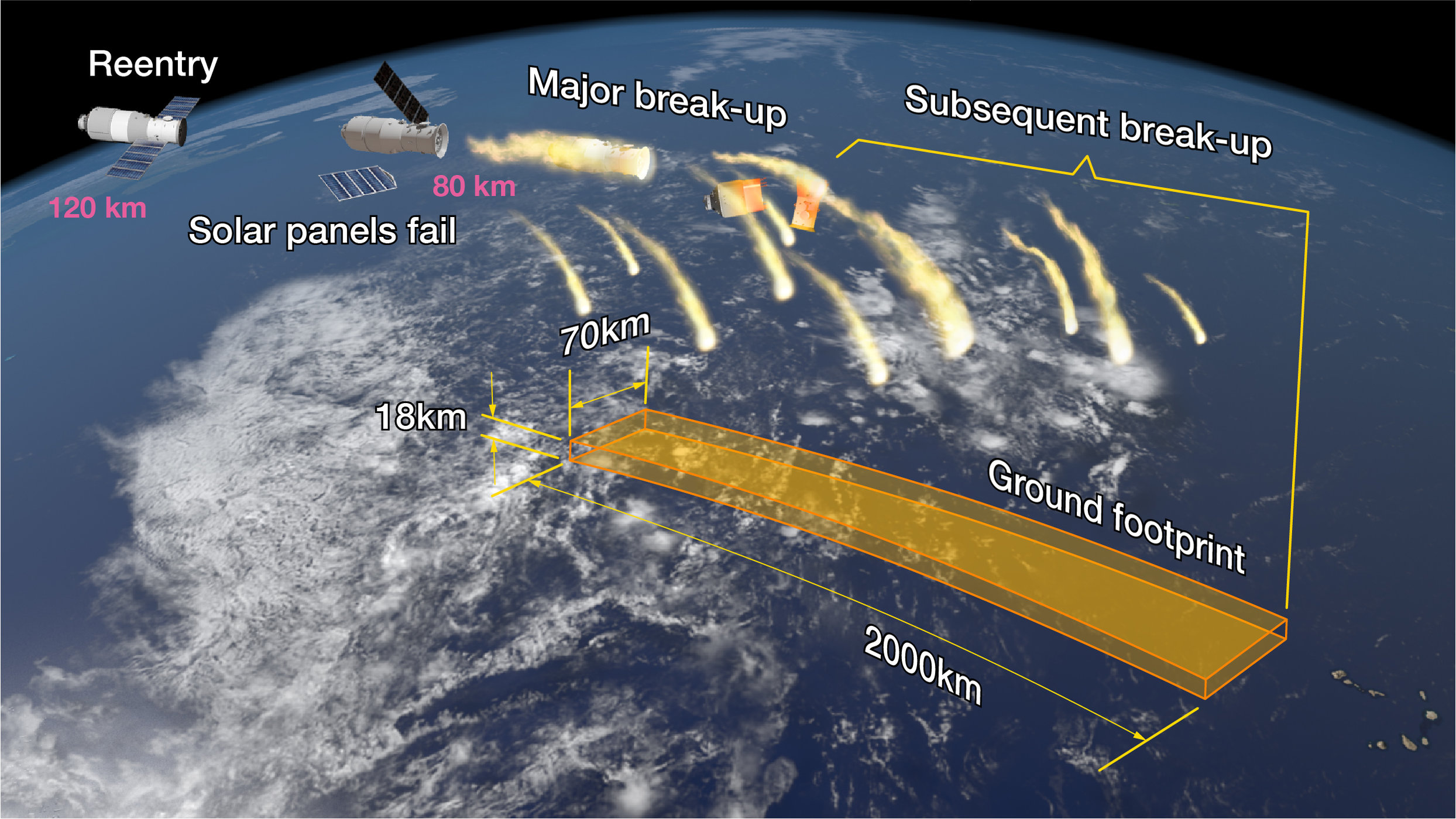
It’ll be different this time around but you get a general idea.
That’s much better than Tiangong-1, which stopped responding to its operators after several years and as such could not be deliberately guided into a safe reentry path. Instead it just slowly drifted down until people were pretty sure it would be reentering sometime in the following few days — and it did.
There was never any real danger that the bus-sized station would land on anyone, but it’s just fundamentally a little unnerving not knowing where the thing would be coming down.
This isn’t the last Tiangong; Tiangong-3 is planned for a 2020 launch, and will further inform the Chinese engineers and astronauts in their development of a more full-featured space station planned for a couple years down the line.
Controlled deorbit is the responsible thing to do, not to mention just plain polite, and the CNSA is doing the right thing here. All the same, Kiwis should probably carry umbrellas tomorrow.


How improved infrastructure & tech firms are changing game development in India
Watch the New Comic-Con Trailer for His Dark Materials, Out This Autumn
Russian cryptocurrency payment network A7 expands to Africa, as Moscow builds an alternative payments system amid western sanctions after its Ukraine invasion (Financial Times)
Financial Times : Russian cryptocurrency payment network A7 expands to Africa, as Moscow builds an alternative payments system amid weste...

-
The first project we remember working on together was drawing scenes from the picture books that our mom brought with her when she immigrate...
-
Sohee Kim / Bloomberg : South Korean authorities are investigating a data leak at e-commerce giant Coupang that exposed ~33.7M accounts; ...

