Tuesday, June 11, 2019

Modern Fertility raises $15 million to sell its hormone tests — and gather more fertility data from its users

Modern Fertility is a San Francisco-based company that sells fertility tests directly to consumers, but increasingly, those customers will be educating the company, too. Indeed, the two-year-old startup now plans to develop a database of anonymized data about its largely younger demographic.

A fresh $15 million in funding led by Forerunner Ventures should help. Forerunner founder Kirsten Green, who takes a board seat as part of the round, is known for countless savvy bets on a wide number of consumer brands that have taken off with users, from Dollar Shave Club to Bonobos to Glossier. With Forerunner’s help, Modern Fertility may well become a breakout hit, too, though potential customers should also understand its limitations before they click the “buy” button.

First, let’s back up. We’d originally written about Modern Fertility last year, when it began selling a kit from its website that’s sent to women’s doorsteps and allows them to gauge their levels of eight different reproductive hormones by using a finger prick. More specifically, the startup sends off its customers’ panels to CLIA-certified labs, where the tests are conducted, and most prominently, those tests are looking at the women’s level of AMH, or anti-mullerian hormone.

Why that’s relevant: every egg inside a woman’s ovaries sits within a fluid-filled sac full of cells that support egg maturation and produce hormones, including AMH. A woman’s AMH levels can provide one clue about how many of these sacs — or follicles — she has. That in turn provides a clue as to how many eggs she can release, or her ovarian reserve.

The point, says Modern Fertility’s cofounder and CEO, Afton Vechery, is to enable women to learn more about their bodies without having to shell out $1,500 to gain access to a similar picture by turning to a reproductive endocrinologist, of which there are relatively few.  According to the Centers for Disease Control and Prevention, there are roughly 500 infertility clinics in the U.S., and 2,000 reproductive endocrinologists.

Mixed feelings in medical community . . .

It’s a compelling pitch, especially given that women are putting off children longer for a variety of reasons, including to secure their financial future. In 2017, for the first time, U.S. women in their early 30s eclipsed younger moms to become the group with the highest birth rate, according to CDC data.

But there is room for pushback. The reality is that AMH and other tests can be conducted elsewhere, including by competing startups, for roughly the same cost that Modern Fertility is charging its customers. (Its kits originally sold from its website for $199; today, they sell for $159.)

Fertility testing is also generally is covered by health insurance plans because fertility problems can be linked to or caused by other health problems like endometriosis. (Not covered, typically: actual infertility treatments.)

A far bigger concern to some doctors is the unnecessary alarm that AMH screening may create for women who haven’t been diagnosed with infertility and who are less than 35 years old.

As Zev Rosenwaks, director of the Center for Reproductive Medicine at Weill Cornell Medicine and NewYork-Presbyterian, told the New York Times a couple of years ago, “All it takes is one egg each cycle . . . AMH is not a marker of whether you can or cannot become pregnant.”

Esther Eisenberg, the program director of the Reproductive Medicine and Infertility Program at the National Institutes of Health, has also said that AMH doesn’t dictate a woman’s reproductive potential. In fact, the NIH funded research in 2017 that found a “non-statistical difference” between low and normal AMH levels in a time-to-pregnancy study of women who were between the 30 to 44 years and who did not have a history of infertility.

Asked about such findings, Vechery, who was most recently a former product manager at the genetic testing company 23andMe, has clearly heard such criticisms. She readily acknowledges that AMH is “not an indicator of your ability to get pregnant right now in this moment,” adding that “it has so many other helpful benefits in thinking about your reproductive health in a much broader sense.”

Vechery also notes the company’s team of PhDs. She points to a clinical study that was published in The Green Journal (the official publication from The American College of Obstetricians and Gynecologists). She also speaks of Modern Fertility’s medical advisory board, which includes dedicated five medical doctors, including reproductive endocrinologists Nataki Douglas, a former associate professor at Columbia University Medical Center, and Scott Nelson, a professor at the University of Glasgow.

All are important pieces to building Modern Fertility, but it’s nevertheless worth mentioning that the company employs just two full-time PhDs currently.

Further, the company’s medical advisory members, including Nelson, are paid consultants.

As for the study, which Modern Fertility sponsored, it doesn’t actually prove anything about the power of AMH testing, though it does underscore that AMH, along with the seven other hormones the company measures on behalf of its customers, can be tested just as effectively with “fingerstick sampling” as a traditional blood draw.

The educator turns the tables . . .

Those curious about Modern Fertility — often younger women eager to get a jump on any later reproductive issues they may face — may well decide that information about their hormone levels is enough to part with the cost of a kit, which includes a one-on-one phone consultation with a nurse.

Interestingly, when they do, they’ll increasingly be asked to opt-in to questions about their health, lifestyles, and more. They may be asked repeatedly, too, as the company recommends that customers re-take the test yearly to track their hormones over time. Indeed, because so many of Modern Fertility’s customers do not have fertility issues, the company hopes to aggregate as much pertinent information from them as possible in order to complement the vast amounts of research that has been conducted on infertility.

“The fertility space needs to catch up, and a huge part of what we’re focused on is moving fertility science forward,” says Vechery. “So much research is primarily done on these women who are having issues; Modern Fertility is interested in flipping that around.”

It’s a strange state of affairs, but we’ve talked with several customers of the company in the past, and one can imagine them supporting it however they can, thanks in part to the sense of community that Modern Fertility has also been fostering. Among other things, for example, the company hosts get-togethers for customers in San Francisco so they can share their thoughts, their fears, and, presumably, their results.

As for whether Modern Fertility is also interested in selling that anonymized data as has happened at genetic testing outfits like Ancestry and Vechery’s former employer, 23andMe, Vechery insists that it will not, that the information will instead be used to inform the company’s product development.

Fertility startups have generally been on a fundraising tear, and little wonder. According to one estimate, the  global fertility services market is expected to exceed $21 billion by 2020. In fact, while venture capital has poured into everything from period-tracking apps to sperm storage startups, Modern Fertility has its own direct competitors, excluding obstetricians. Among these is KindBody, a New York-based startup that raised $15 million two months ago, and three-year-old, Austin-based Everlywell, which has garnered $55 million from VCs so far.

Notably, Modern Fertility represents Forerunner’s first foray into the so-called femtech space. Asked about Green’s involvement, Vechery notes she was particularly “excited about the community,” which Phil Barnes of First Round Capital, has also cited as the reason he wrote Modern Fertility an early check.

Ultimately, though, says Vechery, “Our business model is information, and I think for Kirsten, seeing what that trusted brand could do in women’s health and the conversations it could spark” was what she found most compelling about the company.

We understand why. We also can’t help but wonder if those conversations will drive some women to see — unnecessarily — the very specialists that Modern Fertility wants to free them of visiting.

Modern Fertility has now raised $22 million to date. Among its other backers are Maveron and Union Square Ventures as investors.

Pictured above: Modern Fertility cofounders Afton Vechery and Carly Leahy. Vechery is CEO; Leahy is the company’s CCO, or chief commercial officer.

Sources: Huawei has indefinitely postponed the announcement of a new Windows laptop, originally scheduled for this week, due to ongoing US trade sanctions (Juro Osawa/The Information)

Juro Osawa / The Information:
Sources: Huawei has indefinitely postponed the announcement of a new Windows laptop, originally scheduled for this week, due to ongoing US trade sanctions  —  Huawei has indefinitely postponed the announcement of a new laptop computer that was originally scheduled for this week …


Move to ban cryptocurrency has Indian Blockchain firms worried

According to the yet-to-be-released report compiled by Blockchained India, illegitimate transactions, evasion of taxes and lack of talent are some of the other critical problems plaguing the cryptocurrency and blockchain industry http://bit.ly/2IGdwoK https://ift.tt/eA8V8J

Mi 9T, Mi 9T Pro Set to Launch Today: Everything You Need to Know

Xiaomi is hosting events in Madrid, Milan and Paris to launch the Mi 9T smartphone series globally. http://bit.ly/2IGc6uK

Facebook will not remove deepfakes of Mark Zuckerberg, Kim Kardashian and others from Instagram

Facebook will not remove the faked videos featuring Mark Zuckerberg, Kim Kardashian and President Donald Trump from Instagram, the company said in a statement.

Earlier today, Vice News reported on the existence of videos created by the artists Bill Posters and Daniel Howe and video and audio manipulation companies including CannyAIRespeecher and Reflect. 

The work, featured in a site-specific installation in the UK as well as circulating in video online, was the first test of Facebook’s content review policies since the company’s decision not to remove a manipulated video of House Speaker Nancy Pelosi received withering criticism from Democratic political leadership.

“We have said all along, poor Facebook, they were unwittingly exploited by the Russians,” Pelosi said in an interview with radio station KQED, quoted by The New York Times. “I think they have proven — by not taking down something they know is false — that they were willing enablers of the Russian interference in our election.”

After the late May incident Facebook’s Neil Potts testified before a smorgasbord of international regulators in Ottawa about deep fakes, saying the company would not remove a video of Mark Zuckerberg. This appears to be the first instance testing the company’s resolve.

“We will treat this content the same way we treat all misinformation on Instagram. If third-party fact-checkers mark it as false, we will filter it from Instagram’s recommendation surfaces like Explore and hashtag pages,” said an Instagram spokesperson in an email to TechCrunch.

The videos appear not to violate any Facebook policies, which means that they will be subject to the treatment any video containing misinformation gets on any of Facebook’s platforms. So the videos will be blocked from appearing in the Explore feature and hashtags won’t work with the offending material.

Facebook already uses image detection technology to find content that has been debunked by its third-party fact checking program on Instagram. When misinformation is only present on Instagram the company is testing the ability to promote links into the fact-checking product on Facebook.

“Spectre interrogates and reveals many of the common tactics and methods that are used by corporate or political actors to influence people’s behaviours and decision making,” said Posters in an artist’s statement about the project. “In response to the recent global scandals concerning data, democracy, privacy and digital surveillance, we wanted to tear open the ‘black box’ of the digital influence industry and reveal to others what it is really like.”

Facebook’s consistent decisions not to remove offending content stands in contrast with YouTube which has taken the opposite approach in dealing with manipulated videos and other material that violate its policies.

YouTube removed the Pelosi video and recently took steps to demonetize and remove videos from the platform that violated its policies of hate speech — including a wholesale purge of content about Nazism.

These issues take on greater significance as the U.S. heads into the next Presidential election in 2020.

“In 2016 and 2017, the UK, US and Europe witnessed massive political shocks as new forms of computational propaganda employed by social media platforms, the ad industry, and political consultancies like Cambridge Analytica [that] were exposed by journalists and digital rights advocates,” said Howe, in a statement about his Spectre project. “We wanted to provide a personalized experience that allows users to feel what is at stake when the data taken from us in countless everyday actions is used in unexpected and potentially dangerous ways.”

Perhaps, the incident will be a lesson to Facebook in what’s potentially at stake as well.


Pinterest has suspended anti-abortion group Live Action for "misinformation related to conspiracies and anti-vaccination advice" (Brianna Sacks/BuzzFeed News)

Brianna Sacks / BuzzFeed News:
Pinterest has suspended anti-abortion group Live Action for “misinformation related to conspiracies and anti-vaccination advice”  —  Pinterest has permanently banned Live Action, the influential anti-abortion group that published videos claiming Planned Parenthood harvested …


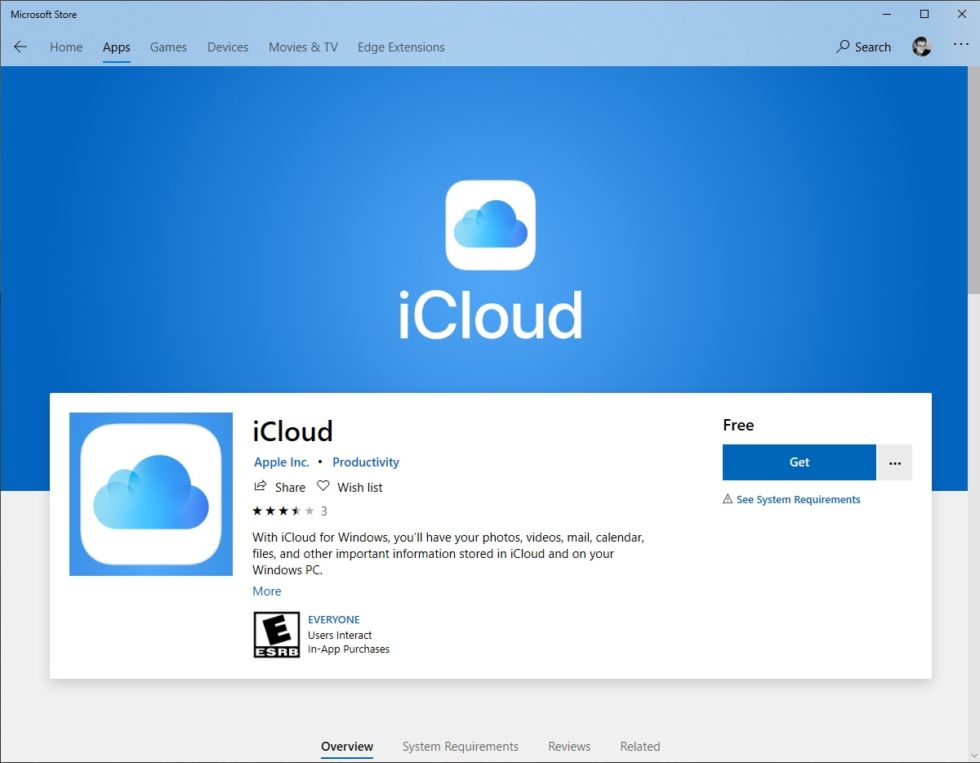
Apple’s iCloud has been a poor experience in Windows, but a new update seeks to fix that

Apple has released a new version of iCloud for Windows 10 in the Microsoft Store, according to a recent blog post by Microsoft and a handful of Apple customer support documents. The new version claims to be a major improvement, with more robust features and more reliable syncing—the latter of those has been a common complaint for users of Apple's previous version.

Features listed by Microsoft include:

  • Access your iCloud Drive files directly from File Explorer without using up space on your PC
  • Choose the files and folders you want to keep on your PC
  • Safely store all your files in iCloud Drive and access them from your iOS device, Mac, and on iCloud.com
  • Share any file right from File Explorer and easily collaborate with others—edits will be synced across your devices

Interestingly, Microsoft says the new iCloud app is "powered by the same Windows technology that also powers OneDrive's Files On-Demand feature"—an unexpected technical and corporate partnership. But it shouldn't be too surprising at this point; despite the storied history and rivalries of the 1980s and '90s (as well as competition in areas like, yes, cloud services), Microsoft and Apple have largely played together nicely in recent years.

Read 2 remaining paragraphs | Comments

https://arstechnica.com

Super Mario Maker 2’s online mode will get a “friends” patch after launch [Updated]

Update, June 11: Shortly after Nintendo's E3 2019 "Direct" video presentation on Tuesday, the game maker hosted a "Treehouse" panel on YouTube with updates about previously announced Nintendo Switch games. One of those updates confirmed some good news for hopeful Super Mario Maker 2 owners: its online matchmaking service will indeed receive "friends-only" modes after all.

When discussing upcoming support for the June 28 game, producer Takashi Tezuka said through a translator, "A new update will let people play with your friends online." The game will not ship with this feature in June, and no date was attached to this eventual update. But we're glad to see the company publicly reverse course and reach feature parity with other first-party Nintendo Switch Online games.


Read 7 remaining paragraphs | Comments

https://arstechnica.com

Google Pixel 4 details are starting to leak, indicating that the upcoming flagship may have a square rear camera bump, Project Soli radar tech for new gestures (Dieter Bohn/The Verge)

Dieter Bohn / The Verge:
Google Pixel 4 details are starting to leak, indicating that the upcoming flagship may have a square rear camera bump, Project Soli radar tech for new gestures  —  Project Soli returns?  —  Google has been releasing Pixel phones in October for three years now, and so we're expecting a Pixel 4 and a Pixel 4 XL this October too.


Tesla has a design for a submarine car just sitting around

Tesla wants to show off a prototype of an electric pickup this year and it’s working on bringing the Model Y and Class 8 semi truck into production.

But really, who cares about any of that because Tesla apparently has a design for a submarine car just sitting around collecting dust.

Tesla CEO Elon Musk mentioned the electric submarine car in response to a question during the company’s annual shareholder’s meeting Tuesday in Mountain View, Calif. The shareholder asked whether Tesla had considered building an aquatic car, meaning a vehicle that could travel on roads, and then transition into or under water.

It turns out a design exists for a submarine car inspired by the Lotus Esprit featured in the James Bond film, the Spy Who Loved Me.

“I thought that was like the coolest thing,” Musk said, adding that he owns the vehicle from the movie.

Musk said it’s technically possible to make a functioning version, but added “I think the market for this would be small — small, but enthusiastic.”

Building such a a vehicle would be a distraction, Musk said. However, he left the opportunity open that maybe someday Tesla would make it a show car.

NASA moves to final planning stages for mission to explore 16 Psyche’s full metal asteroid

The value of all the nickel and iron that scientists believe make up 16-Psyche’s potato-shaped asteroid in the outer reaches of the asteroid belt totals some $10,000 quadrillion.

It’s an astronomical sum, but NASA’s Psyche mission, which has now received approval to enter the final design and development stages before manufacturing begins for its 2022 launch, is actually after a much bigger prize… one of the secrets to how the Earth came to exist.

NASA scientists and researchers at Arizona State University believe that Psyche holds a key to understanding how planetary bodies are formed. The theory is that Psyche is actually the core of a planet which broke apart after a series of cataclysmic collisions.

Scientists hope that they can get a look into the distant past of the solar system, when protoplanet encounters created Earth and destroyed other would-be terrestrial planets —  like the one whose remnants are floating between Mars and Jupiter.

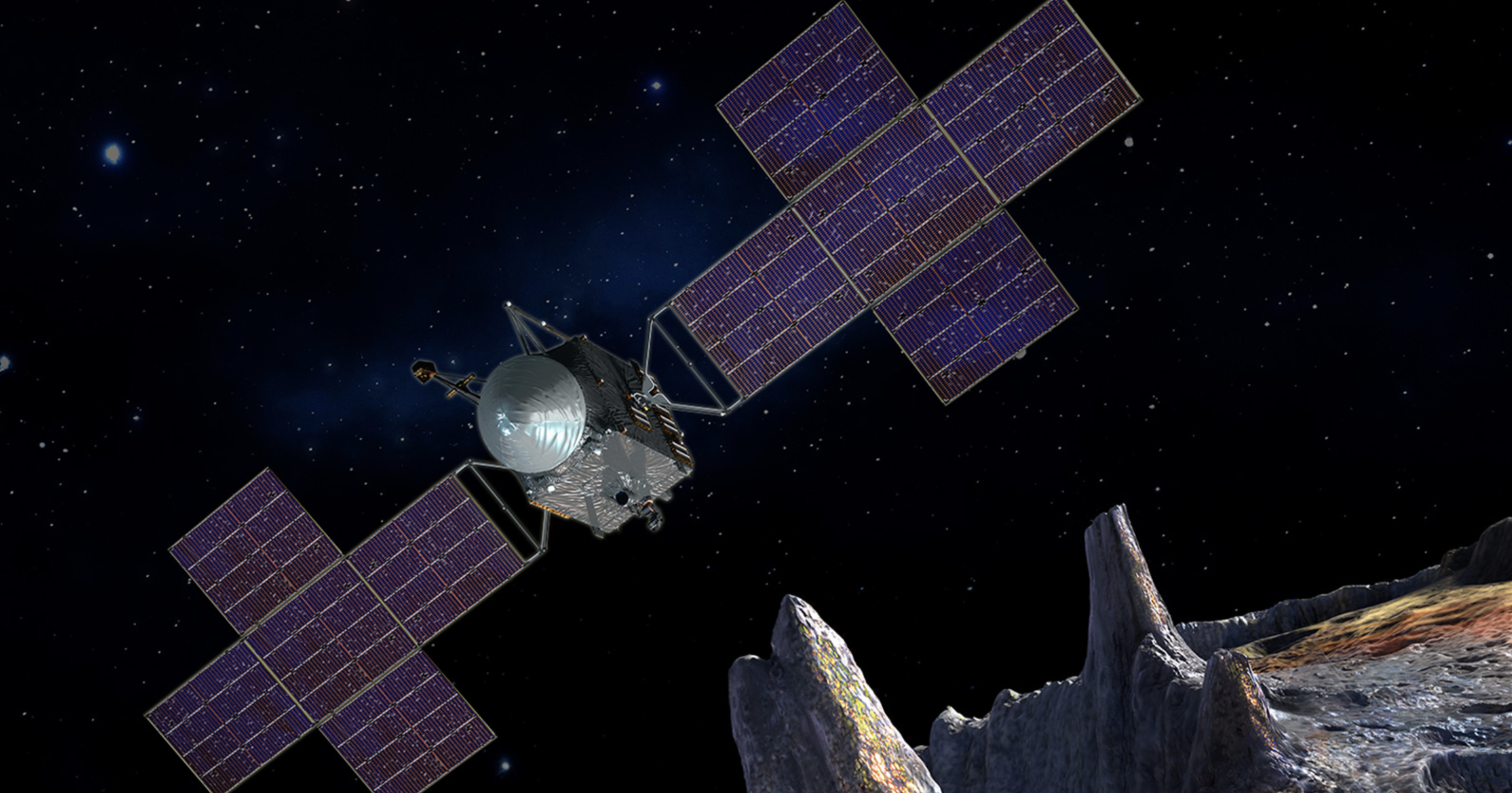
This artist’s-concept illustration depicts the spacecraft of NASA’s Psyche mission near the mission’s target, the metal asteroid Psyche. The artwork was created in May 2017 to show the five-panel solar arrays planned for the spacecraft. Image credit: SSL/ASU/P. Rubin/NASA/JPL-Caltech

“With the transition into this new mission phase, we are one big step closer to uncovering the secrets of Psyche, a giant mysterious metallic asteroid, and that means the world to us,” said Principal Investigator Lindy Elkins-Tanton of Arizona State University in Tempe, in a statement.

There are still three more phases of mission planning that the Psyche team needs to clear. Phase D will begin in early 2021 includes the final manufacturing and testing of the spacecraft along with the planned launch in early 2022.

Phase E will happen as soon as Psyche’s exploratory craft hits the vacuum of space, NASA said. It’ll cover the deep space operations of the mission and the collection of data for science. NASA expects Psyche will arrive at its eponymous asteroid on Jan. 31, 2026 after buzzing Mars in 2023 (two years before Elon Musk predicted the first human astronauts would arrive).

Instruments on the Psyche craft will include a magnetometer designed to detect and measure the remnant magnetic field of the asteroid. A multi-spectral imager will be on board to provide high-resolution images to determine the composition of the asteroid (how much is metal vs. how much is a silicate). The craft will also include a gamma ray and neutron spectrometer to detect, measure, and map the asteroid’s elemental composition and a new laster technology that’s designed for deep space communications.

Part of the NASA Discovery Program, the mission is being undertaken in conjunction with Maxar Space Solutions, which is providing the electric propulsion chassis, NASA’s Jet Propulsion Laboratory, and Arizona State University.

At Tesla shareholder meeting, Musk assures “there is not a demand problem”

Tesla might get into the mining business to secure minerals for electric batteries

Tesla might get into the business of mining minerals used in electric vehicle batteries if it wants to expand its product lineup and scale production, CEO Elon Musk said during the company’s annual shareholder meeting.

The comments came after Musk talked about plans for an electric pickup truck and an aim to begin production of its all-electric Class 8 semi truck by the end of 2020. He said those plans were dependent on Tesla’s ability to manufacture a lot of lithium-ion battery cells.

“There’s not much point in adding product complexity if we don’t have enough batteries,” he said. “That is complexity, but without gain.”

Tesla’s massive factory in Sparks, Nevada was built to expand global battery capacity, and in turn reduce the cost of electric vehicles. The plant, called Gigafactory 1, produces Model 3 electric motors and battery packs, in addition to Tesla’s energy storage products, Powerwall and Powerpack. Panasonic, its most important partner as a supplier and partner in that project makes the cells. Tesla then uses the cells to make battery packs for its electric vehicles.

For now, Tesla plans to match product rollout with scaling of factory production. Once Tesla increases production to a “very high level,” it will “look further down the supply chain and get into the mining business, I don’t know, maybe a little bit at least,” Musk exclaimed.

“We will do whatever we have to do to ensure that we can scale at the fastest rate possible,” he added.

Concern about the supply of nickel, copper, lithium and related minerals used in electric batteries is not new. Last month, Tesla’s head of minerals procurement said during a closed meeting at an industry conference that the company expects global shortages of nickel, copper and lithium in the near future, Reuters reported.

While much of the attention has focused on lithium supplies, copper and nickel are also vulnerable. Years of underinvestment have depleted copper supplies, prompting companies like Freeport-McMoRan to expand in the United States and Indonesia.

It’s possible that Tesla will focus on nickel mining, a mineral that Musk has pushed the company to use more of in lieu of cobalt.

Sources: the US State Department ordered embassies to push back against foreign influence campaigns, as officials worry anti-US views are taking root worldwide (New York Times)

New York Times : Sources: the US State Department ordered embassies to push back against foreign influence campaigns, as officials worry ...