Monday, June 10, 2019

Moving deeper into enterprise cloud, Intel picks up Barefoot Networks

When it launched out of stealth just three years ago, Barefoot Networks was hailed as a company that would transform the way a generation of computing giants like Facebook, Alphabet, Amazon and Microsoft would function while making chip manufacturers like Intel and networking companies like Cisco take notice

Now, Intel has not only taken notice, it’s acquired Barefoot Networks for an undisclosed amount.

It’s a sign of just how important cloud computing has become, and an opportunity for Intel to stake more of a claim in the networking space after losing ground to the GPU manufacturers whose chipsets have been in demand since the rise of gaming, graphics, and artificial intelligence made them ascendant.

Essentially, Barefoot Networks chips allow its customers to program whatever functionality they need on to the networking chips that Barefoot sells them. 

Previously, companies could customize network architecture down to everything BUT the chipset. The lack of programmable chips meant that network architectures couldn’t be quite as responsive as a company like Facebook, Microsoft, or Google would want, because they were always working around chipsets that had been designed for specific functions.

Based in Santa Clara, Calif., Barefoot Networks was launched from stealth in late 2016 by Dr. Craig Barratt, a former Stanford University professor whose work was critical to the development of the networking architectures that allowed Alphabet, Facebook and others to operate at the massive scale they now have.

As these companies demanded more customized hardware ranging from chipsets to enable their various machine learning algorithms to manage and monitor content (and win Go games), to the servers and routers that they’ve put up in their own internal networks Barratt realized they’d need chipsets that they could modify.

With the acquisition, Intel adds a core knowledge set around p4-programmable high speed data paths, switch silicon development, P4 compilers, drivers oftware, network telemetry and computational networking.

It also provides another bulwark against rival chip manufacturer, Broadcom.

No word from some of Barefoot Networks investors on the result for them in this acquisition. The company raised $155.4 million from investors including Tencent Holdings, DHVC, Alibaba Group, Dell Technologies Capital, Hewlett Packard Enterprise, and Lightspeed Ventures.

Uber competitor Bolt, formerly known as Taxify, to launch in London this week after stopping operations in 2017 following a Transport for London investigation (Ingrid Lunden/TechCrunch)

Ingrid Lunden / TechCrunch:
Uber competitor Bolt, formerly known as Taxify, to launch in London this week after stopping operations in 2017 following a Transport for London investigation  —  Bolt, the Uber rival formerly known as Taxify, is taking a significant step this week in its effort to build out its transportation …


Microsoft working to get “every single Xbox One game” working on Scarlett

LOS ANGELES—When Microsoft announced the first details of its next game console Sunday, it said that "thousands of games across four console generations will look and play best on Project Scarlett." In a video follow-up focused on backward compatibility posted Monday, the company clarified that its goal is that "every single game you play on Xbox One today [will] work on the Scarlett device."

That would be a change from previous Xbox console generations, which have only supported a significant subset of previous generations' titles through software updates. It sounds like getting Xbox One games to run on Project Scarlett will also take some specific software-level effort on the part of Microsoft, rather than being supported directly at the hardware level.

"Ensuring every game that runs on Xbox One is going to run incredibly well on Scarlett will take a ton of commitment and time from our team," Microsoft Head of Xbox Phil Spencer said in the video. "The team is dedicated. We're ramping up our testing facilities to make sure we can hit the ground running and make sure that stuff works."

Read 3 remaining paragraphs | Comments

https://arstechnica.com

Publishers, lobbying for laws around the world that will help them extract payments from platforms like Google for linking to news, are ruining the internet (Jeff Jarvis/Whither news?)

Jeff Jarvis / Whither news?:
Publishers, lobbying for laws around the world that will help them extract payments from platforms like Google for linking to news, are ruining the internet  —  Around the world, news industry trade associations are corruptly cashing in their political capital —&#8202 …


Apple may have leaked the Mac Pro and Pro Display XDR release month

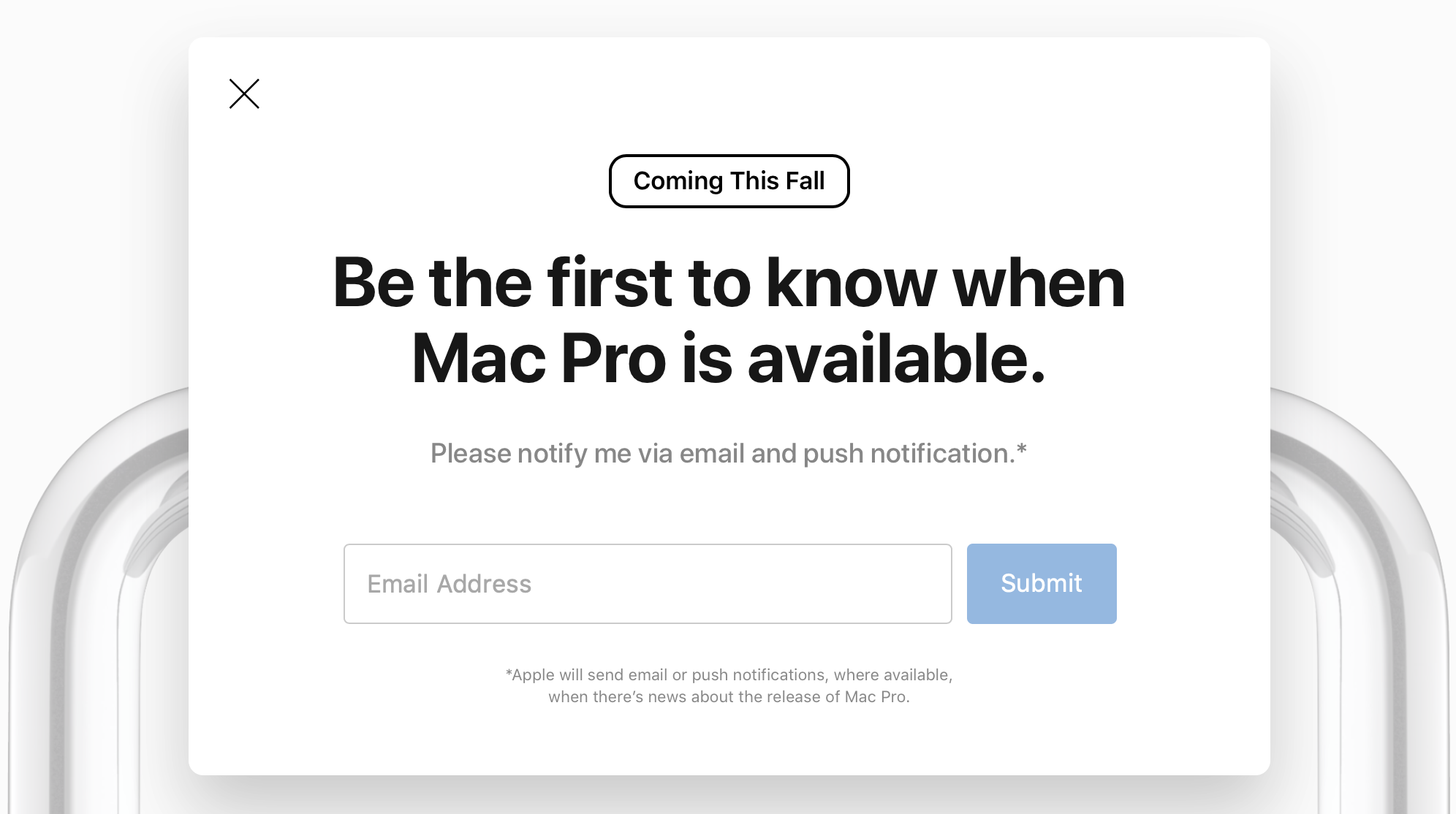
Apple introduced two pricy and powerful pieces of pro-targeted hardware at its developer conference last month: the modular desktop tower Mac Pro, and the creative-focused Pro Display XDR. Although Apple said the devices would come this fall when discussing them during its keynote stage last week, the industry giant didn't get any more specific than that. But an apparent mistake in the Apple Store may have narrowed down the date.

Earlier today, MacRumors and 9to5Mac discovered that, when you clicked on the option to "Notify Me" of availability for the products, they were presented with text that said "coming in September." This was while other parts of the website all said "coming in the fall." Since the news broke, Apple quietly changed the copy in the "notify me" panel to also say "coming in the fall."

September would make sense as a narrower launch window. Apple often holds an event focused on the iPhone and Apple Watch around that time each year, so the company could announce final public availability of the Mac Pro and Pro Display XDR there.

Read 5 remaining paragraphs | Comments

https://arstechnica.com

Oculus sold $5 million worth of Quest content in first 2 weeks on sale

Facebook’s Oculus Quest standalone VR headset hasn’t been out long, but VP of AR/VR Andrew Bosworth says it’s already making significant revenue on content sales for the device.

At Vox Media’s Code conference, the exec detailed that in the first two weeks of sales there has been $5 million in content sales.

The $399 headset does not require a PC or phone to operate and offers camera-based positional tracking like higher-end PC headsets have in the past. At launch the company’s store had just over 50 titles available to download, with a mixture of free titles and games costing as much as $30.

Companies in the VR space — even Facebook — have been reticent to discuss sales because there have been so few success stories. Facebook has gone all-in on the Quest’s launch, their marketing campaigns have been substantial so it makes sense that they’re willing to detail their successes here.

Facebook says it’s shipping new Portal hardware in the fall

Facebook’s Portal devices may still have plenty of privacy questions lingering around them since launch, but that hasn’t swayed the company’s dedication to bringing more video chat hardware to market.

Onstage at Vox Media’s Code Convention, Facebook’s VP of AR/VR Andrew Bosworth shares that sales of the existing hardware were “really good,” but more interestingly let fly that there would be new form factors of Portal hardware coming to market in the fall of this year.


Most signs point to this device being the “Ripley” device that popped up in Portal firmware code late last year. Cheddar had reported that the camera device would attach to the top of a TV and pipe the video feed to its screen. This cuts down on the need to have a wholly dedicated video chat device and allows Facebook to put their hardware in more central locations in people’s homes.

There is of course the possibility that Facebook has even more form factors up their sleeves, but this seems like a potentially low-cost option that would make a lot of sense for them to get out there.


New form factors for Portal video chat devices are coming this fall, Facebook VP of AR/VR Andrew "Boz" Bosworth says (Salvador Rodriguez/CNBC)

Salvador Rodriguez / CNBC:
New form factors for Portal video chat devices are coming this fall, Facebook VP of AR/VR Andrew “Boz” Bosworth says  —  KEY POINTS  — Andrew “Boz” Bosworth, Facebook vice president of AR/VR, spoke on stage at the Code Conference in Phoenix.  —  A LinkedIn photo of Facebook exec Andrew “Boz” Bosworth.


AMD announces its first 7nm Navi GPUs: the $379 Radeon RX 5700 and the $449 RX 5700 XT, with speeds of up to 1.9GHz and up to 9.75 teraflops, available July 7 (Devindra Hardawar/Engadget)

Devindra Hardawar / Engadget:
AMD announces its first 7nm Navi GPUs: the $379 Radeon RX 5700 and the $449 RX 5700 XT, with speeds of up to 1.9GHz and up to 9.75 teraflops, available July 7  —  After unveiling its first 7-nanometer “Navi” GPUs a few weeks ago at Computex, the Radeon RX 5000 series, AMD finally gave us more details at E3.


AMD Radeon RX 5700 XT 'Navi' GPU, 16-Core Ryzen 9 3950X CPU Announced

AMD is continuing to up the ante in terms of CPU specifications, and hopes are high for its first major new GPUs in several years. http://bit.ly/2F2Rfkd

Uber rival Bolt returns to London 21 months after a TfL investigation shut it down

Bolt, the Uber rival formerly known as Taxify, is taking a significant step this week in its effort to build out its transportation-on-demand business across the biggest cities in Europe and Africa, which currently covers 25 million users in 30 countries and 100 cities: it’s finally opening for business again in London, the biggest ride-hailing market in Europe.

“Finally” and “again” are the operative words here: the Tallinn-based company had launched in London as far back as September 2017 — nearly two years ago — only to shut down its services after three days, when Transport for London, the city’s transportation regulator, started to investigate the terms of its license.

It turned out that not all was right in the state of Estonia. To roll out its services more quickly, Taxify (as it was then known) had acquired a London firm with a license valid until 2019 and had launched its own service using that loophole. At a time when TfL was decidedly unhappy with Uber and was already fielding complaints from politicians, a drivers’ association and union reps over Taxify’s launch, the writing was on the wall and Taxify shut down its service.

Slow and steady wins the race

Bolt’s run-in, and eventual cooperation, with TfL underscores the shift we have seen in the transportation market over the last few years in London, which has changed from a hacker mentality of “move fast, break things” to “slow and steady wins the race.”

“So far, there has been a monopoly, which leads to the same problems of higher prices and poor service,” Bolt’s CEO and founder Markus Villig said in an interview this week. “We are here first to fix that, but it will take two to three years to do so.”

Launching with a car-only service in London (it has other transportation products, such as scooters, in other cities like Paris), Bolt is — even before adding in that three year fix-it plan — nevertheless coming to the market relatively late.

Uber has been active for years and is just one of a number of incumbent private car-based ride providers, which include other on-demand transportation services like MyTaxi (owned by Bolt’s investor Daimler) and Gett, other fleet-based providers like Addison Lee, a plethora of local mini-cab firms and, of course, independent Black Cab drivers.

But with late arrival also comes a more knowledgeable approach built on the experience (vast operating costs) shouldered by others.

First and foremost, Villig said the new and improved Bolt will be hoping to woo away both drivers and passengers with competitive discounts based, it seems, mainly on undercutting dominant providers.

On the driver side, Bolt will change a 7.5% commission for the first two months before switching to a 15% commission, which it claims is up to half of what other firms charge, and works out on average to 10% more earnings than driving with competitors.

On the passenger side, Bolt will be launching with a 50% discount that will then default to regular rates that will still be between 5% and 10% cheaper than competitors’.

Price competition is not the only area where Bolt is making a modification. There is also a big change in the app’s safety features: specifically, it will launch with a “panic button” that will let both passengers and drivers alert bolt and police if they feel they are in danger, and also to alert Bolt’s trust and safety team to open a ticket and address the problem.

Villig said that this safety feature is not a default in every market where it operates. It is a variant of a feature that Bolt uses in, for example, its South African business “where safety is also an issue” and while it was not directly mandated by TfL, Villig noted that it pointedly asked about safety features and so this was included, along with other new features, such as sharing details of your ride with a contact.

Safety will also extend to increased vetting of drivers before they ever join the platform — again, to a level higher than in some other markets that have not had track records of safety incidents.

Better service comes at a price

With the drivers getting better commissions and passengers getting lower prices, Villig said that Bolt itself would be absorbing the cost of offering everything.

“The operational costs are higher than in other cities, but the opportunities are so large and there is such a need for an alternative, that it made sense.”

That will, inevitably, mean more funding. Although it has already raised around $185 million — with $176 million of that coming last year in a round led by Daimler that valued Bolt at $1 billion — that will run down fast through launches and the extra operational costs associated with them.

(Uber and Lyft’s books, now open to the world post their public listings, detail the hundreds of millions of dollars that ridesharing efforts can potentially cost companies before they can hope to turn a profit.)

Indeed, we confirmed in May that Bolt was indeed raising another round at a valuation of over $1 billion. This week, Villig said that it has “nothing to announce” on that front just yet. In addition to Daimler, the company is backed by Didi (the Chinese ride-hailing giant) and, ironically, Uber, by virtue of its Didi divestment deal in China,

While expanding beyond motor vehicles might be putting the cart before the horse, so to speak, Bolt does have plans to stay for the long run and use its positioning to become one of two market leaders. That will also eventually take Bolt to other modes of transportation beyond cars, but using a light-touch approach.

“All we want on micro-mobility is to be a platform,” Villig said. “W don’t want to own hundreds of thousands of bikes and other vehicles. The question is: how do we enable all that to appear.” He anticipates that Bolt will start to offer bikes — and other other transportation forms as regulators allow them — by next year.

YouTube CEO Susan Wojcicki addresses hate speech controversy

YouTube chief executive officer Susan Wojcicki is standing by the company’s decision to allow conservative commentator Steven Crowder to remain on the platform. Her comments come one week after an investigation confirmed the right-wing pundit’s treatment of Vox host Carlos Maza was not in violation of its policies, despite Crowder’s consistent use of racist and homophobic slurs. Crowder has more than 3.8 million subscribers.  

“The challenge is when we get an allegation like this we take it very seriously,” Wojcicki told Recode’s Peter Kafka at the Code Conference in Scottsdale, Ariz. on Monday. “We need to enforce those policies consistently because if we were not to enforce them consistently, there would be millions of other people saying what about this video, what about this video, what about this video? If you look at the content on the internet, you look at rap songs, late night talks, a lot of humor, you can find a lot of racial slurs or sexist comments. If we were to take down every video…” 

Maza, a video producer on Vox’s “Strikethrough,” last week took to Twitter to accuse YouTube of allowing abuse, use of homophobic slurs and bullying to run rampant on its platform: “This has been going on for years, and I’ve tried to flag this shit on several occasions,” he wrote. “But YouTube is never going to actually enforce its policies. Because Crowder has 3 million YouTube subscribers, and enforcing their rules would get them accused on anti-conservative bias.”

Ultimately, YouTube suspended Crowder’s channel’s monetization, or the ability for him to earn money by allowing ads on his videos, citing a “pattern of egregious actions [that] harmed the broader community and is against YouTube Partner Program policies.” Crowder also sells a range of merchandise, including t-shirts labeled “Socialism Is For Fgs.” 

YouTube, amid heightened criticism, also made changes to its hate-speech policy that will see the removal of thousands of videos advocating neo-Nazism, white supremacy and other extremist ideologies.

Wojcicki said these changes are amongst many others in the works as the company considers both stricter internal policies and external regulation.

Wojcicki issued a careful apology to the LGBTQ community. If she could do it again, she said, she would have addressed Crowder’s monetization immediately: “I know that the decision we made was hurtful to the LGBTQ community and that was not our intention at all,” she said. “I thought it was really important to be upfront about that and say that wasn’t our intention and we are really sorry about that.”

On monetization specifically, Wojcicki explained that YouTube has a much “higher standard” for creators who earn money from their videos. Still, YouTube has been slow to adopt policies that keep its users safe from hate speech.

Tip-toeing around Kafka’s targeted questions, Wojcicki repeatedly explained the company was having a tough week and avoided providing direct responses to several pointed inquiries.

“We are focused on having high-quality content available but we also want a broad range to enable lots of different point of views,” she said. “Any time that you have a bunch of creators or people are upset, it’s difficult. This week it was unfortunate, we managed to upset everybody. It’s not an easy job. It’s a tough job but I’m encouraged by the fact that I hear so many good stories of people that have been able to pursue their passion [on YouTube].”

Amazon will shut down its Amazon Restaurants food delivery service in the US on June 24, after closing in the UK late last year (Taylor Soper/GeekWire)

Taylor Soper / GeekWire:
Amazon will shut down its Amazon Restaurants food delivery service in the US on June 24, after closing in the UK late last year  —  Amazon will shutter its Amazon Restaurants food delivery service in the U.S. later this month, GeekWire has learned.  —  Amazon Restaurants first launched in Seattle back in 2015.


Russian cryptocurrency payment network A7 expands to Africa, as Moscow builds an alternative payments system amid western sanctions after its Ukraine invasion (Financial Times)

Financial Times : Russian cryptocurrency payment network A7 expands to Africa, as Moscow builds an alternative payments system amid weste...