Tuesday, May 28, 2019

Reminiz automatically indexes and tags videos in real time

Meet French startup Reminiz, a computer vision company that can index any type of video — it’s a sort of Googlebot, but for video content. Reminiz can add tags of people, logos or emotions on live streams and on-demand videos.

“The web is designed so that you can search for text — not video. We are making it possible to search within videos,” co-founder and CEO Jack Habra told me.

There are a few different use cases for Reminiz. First, the company works with broadcasters and telecom companies. For instance, Reminiz has a partnership with Orange so that you can learn more about who’s on the screen right now. It could potentially be leveraged for recommendations or contextual ads for external content.

Reminiz streams live channels on its servers directly, scans images and adds tags. Users then download metadata from the servers.

Second, you can use Reminiz to promote your brand on relevant videos. For instance, Hyundai sponsors Lyon’s soccer team. It wants to distribute Hyundai ads before soccer footage with the team playing. But YouTube keywords aren’t that good when it comes to targeting such a specific audience — a video might talk about the soccer team without showing any actual footage.

Brands can then whitelist videos to distribute ads on those videos in particular. You get charged based on minutes of video footage processed by Reminiz.

The company competes with AWS Rekognition and other generic video analysis APIs from cloud providers. What makes Reminiz stand out is that the company builds its own database of faces, people, brands and tags. It’s also probably easier to implement Reminiz compared to a more generic solution.

“With GDPR, everybody is contacting us to focus more on contextual data instead of personal data,” Habra said.

Ulysses adds split view on the iPad and support for Ghost blogs

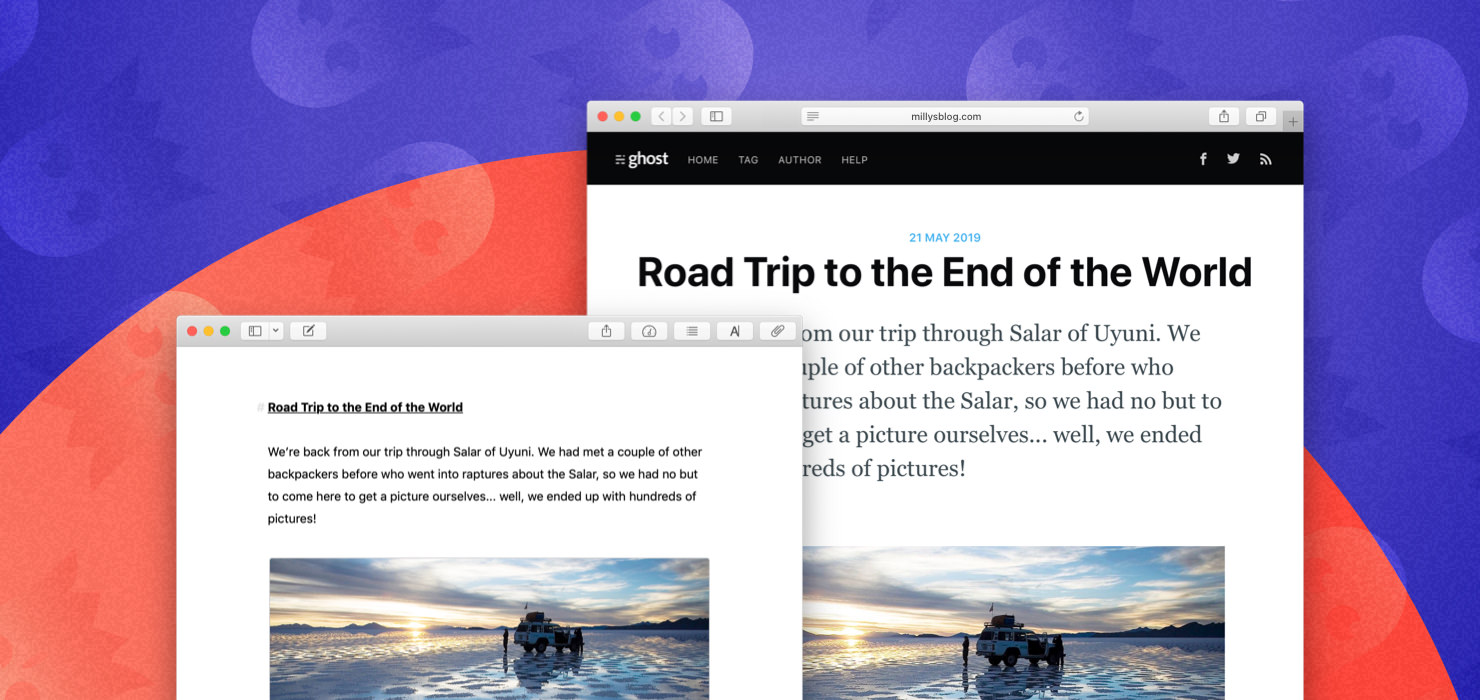
Writing app Ulysses has been updated with a few nifty feature additions. On the iPad, you can now split the editor into two side-by-side editors — this feature alone opens up a lot of possibilities. Ulysses also now supports the option to publish your writing directly to a Ghost blog.

Ulysses is currently available on macOS, the iPad and the iPhone. It’s a Markdown editor with a library of texts that automatically stays in sync across your devices. You can export one or multiple texts in many different formats, including Markdown, HTML, rich text, PDF, ePub, DOCX and a blog.

In addition to Medium and WordPress, Ulysses now supports blogs built using Ghost, an open source CMS platform. If your website is built on Ghost, this should be a nice addition.

But I’m more excited about the ability to open two editors at the same time on the iPad. While the iPad is a great device if you’re looking for a focused writing environment, iOS still thinks “one app = one document”. Sure, you can open two Safari tabs side by side, but most apps only let you open one document at a time.

Ulysses now lets you open two documents at once. You can drag a document from the sidebar and drop it on the right side of the screen to split the screen into two panels. This way, if you’re translating a document, if you need to look at some references, you can scroll through a second document while you write in the main document.

But Ulysses doesn’t stop there. You can also open a second editor from the editor settings to look at different parts of the same document. And if you long press on the export button, you can also open a live preview of the document you’re currently working on.

For instance, you can see what your text will look like before you publish on your blog — headers, images, links and footnotes included. If you edit your text, Ulysses automatically refreshes the preview after a second.

Opening and closing documents is a fluid experience and this split view feature is well implemented. There have been rumors that Apple has been working on improvements at the iOS level to let you open multiple documents using the same app. Today’s Ulysses update is a good example of such a feature and how it would make the iPad even better.

India’s FreshToHome raises $11 million to expand its fish, meat, and vegetable e-commerce platform

Shan Kadavil, who spent early days of his career managing tech support firm Support and then heading India operations of gaming firm Zynga, says he had a calling of sorts when his son was born. Kadavil realized that much of the meat that sells in India is not exactly healthy. The perishables are loaded with chemicals to superficially extend their life by six months, if not more. He wanted to do something better.

Fast forward four years, Kadavil said today that FreshToHome, his new e-commerce startup that delivers “100 percent” pure and fresh fish, chicken, and other kinds of meat, has raised $11 million in Series A funding. The startup has raised $13 million to date.

The round was led by CE Ventures, with participation from Das Capital, Kortschak Investments, TTCER Partners, Al-Nasser Holdings, M&S Partners and other Asia and Valley based Investors. Some of the backers of FreshToHome include Rajan Anandan, the former head of Google Southeast Asia, David Krane, CEO of GV, and Mark Pincus, chairman of Zynga.

FreshToHome has already courted 400,000 customers across four cities — Bengaluru, NCR (Delhi, Gurgaon, Noida, Faridabad, Ghaziabad & Greater Noida), Chennai and Kerala (Kochi, Trivandrum, Calicut & Trichur) — in India. On the backend, the startup does business with 1,500 fishermen across 125 coasts.

In an interview with TechCrunch, Kadavil said the startup is trying to “Uber-ize farmers and fishmen in India. We are giving them an app — around which we have a US patent — for commodity exchange. What farmers and fishermen do is they bid with us (as mandated by local laws) electronically using the app.” By dealing directly with the source, the startup is eliminating as many as half a dozen middlemen to cut costs.
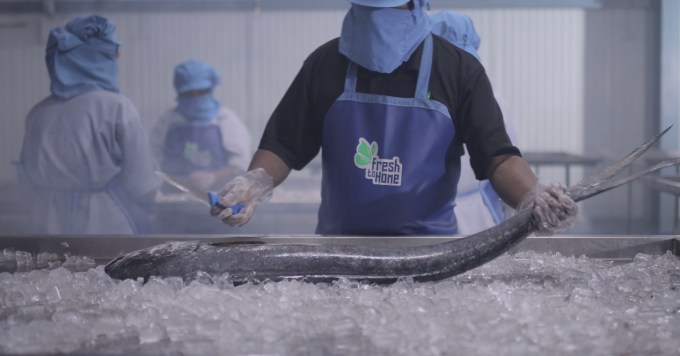
The startup has built its own supply chain network. “We have got a 1,000 people, 100 trucks, and 40 collection points.” The startup, which also uses trains and planes to move inventory, has become one of the biggest clients of airlines Indigo and SpiceJet, he added. Kadavil claimed that FreshToHome is also the largest e-commerce platform for meat with $1.73 million in GMV sales each month.

If this all sounds well strategized, it is because of the people who are running the show. Kadavil founded the FreshToHome with Mathew Joseph, a veteran in the industry who has dealt with fish export for more than 30 years. Joseph started India’s first e-commerce venture in fish and meat called SeaToHome in 2012.

FreshToHome has also emerged as a micro-VC to farmers where it is doing cooperative farming. In such model, FreshToHome guides farmers to use the latest technologies to produce certain kind of fish. As of today, the startup is seeing 60,000 kg (132,227 pound) of production in cooperative farming through its marketplace and over 400,000 kg (881,849 pound) of total products sold per month.

FreshToHome will use the fresh capital to expand its supply chain network, connect with as many as 8,500 new farmers, and start delivering vegetables. It already delivers vegetables in Bengaluru. Kadavil said the startup will also expand to two more cities — Mumbai and Pune.

FreshToHome will compete with a handful of startups, including Licious, which has raised more than $35 million to date, ZappFresh, and BigBasket, which just earlier this month raised $150 million. The cold-chain market of India is estimated to grow to $37 billion in next five years.

In a prepared statement, Tushar Singhvi, Director of CE Ventures said, “The Meat and Seafood segment in India is pegged to be a 50 billion dollar market, but we have to keep in mind that it’s a highly fragmented industry. FreshToHome.com is not only trying to streamline the industry, they’re also using technology to revolutionize the way the industry functions by disintermediating the supply chain, eliminating the middleman and working directly with the fishermen and farmers in a market place model, to make fresh and chemical free food accessible to the masses at large.”

Qualcomm and Lenovo reveal the first Snapdragon-powered 5G PC

Qualcomm announced during its Computex press conference today that it will launch the first Snapdragon-powered 5G PC with Lenovo. The two companies describe the PC, called Project Limitless, as “the world’s first 7nm platform purpose-built for PCs that offers 5G connectivity.”

Qualcomm and Lenovo unveil the first Snapdragon-powered 5G PC at Computex in Taipei

Qualcomm and Lenovo unveil the first Snapdragon-powered 5G PC at Computex in Taipei

The laptop runs on Qualcomm’s Snapdragon 8cx Compute Platform, which is designed to support both 5G and 4G connections, combines the Qualcomm Adreno 680 GPU with the Qualcomm Kryo 495 CPU and has a battery that Qualcomm claims can last for several days per charge. The platform uses the Snapdragon X55 5G modem, which has download speeds of up to 2.5 Gbps.

Project Limitless’ release date and pricing haven’t been revealed yet.

Final week to sign up and save €200 on Disrupt Berlin passes

Planning to join us and more than 1,200 other startuppers at Disrupt Berlin 2019 on 11-12 December? That’s great news, but this is even better; you can save €200 off the super-early-bird ticket price if you sign up for our mailing list.

Here’s the catch: You must sign up before registration officially opens, and that happens in just one week. Once you join, we’ll email you a discount code to use when it’s time to purchase your passes. That means you can get an Innovator pass to Disrupt Berlin for as low as €245 + VAT. Or if you are a founder, you can get one as low as €145 + VAT.

You’ll enjoy everything a Disrupt experience offers even more with €200 still resting comfortably in your wallet. That includes two full days of programming across all the Disrupt stages — speakers, panelists, demos, workshops and Q&A Sessions.

We’re building this year’s lineup of leading founders, technologists, investors and tech icons, and we’ll announce who’s coming in the weeks running up to Disrupt. Another good reason to join our mailing list — you’ll be among the first to know all the cool stuff!

If you’re keen on networking, then CrunchMatch, our free business match-matching platform, will make connecting with the right people so much easier. No more needle in a haystack, CrunchMatch lets you choose who you want to meet based on your specific criteria, goals and interests.

Don’t miss Startup Alley, our exhibition floor and an all-around oasis of opportunity. Hundreds of creative early-stage startups demo their products, platforms and services, and it’s the place to make connections that could change the course of your business. Startup Alley is also home to our TC Top Picks — a group of innovative startups chosen by TechCrunch editors.

And no one ever wants to miss the Startup Battlefield. Our epic pitch-off features exceptional startups vying for $50,000 cash, the Disrupt cup and a boatload of life-altering media and investor exposure. The Battlefield has launched more than 850 companies — including Vurb, Dropbox, Mint and Yammer to name just a few. Those alumni companies have collectively raised more than $8 billion in funding and produced 109 exits. Who will join them?

Want to participate in the Startup Battlefield and the TC Top Picks program? Applications will be open later on this summer, but you can get a head start by starting your application at apply.techcrunch.com.

Registration to Disrupt Berlin 2019 opens in one week, and once that happens, the €200-off deal disappears. Don’t wait — sign up for our mailing list and save.

Is your company interested in sponsoring or exhibiting at Disrupt Berlin 2019? Contact our sponsorship sales team by filling out this form.

TikTok parent Bytedance is reportedly working on its own smartphone

It’s been a busy couple of months for Bytedance, one of the world’s most valuable startups and the operator of globally popular video app TikTok. The Beijing-based company has continued to grow its list of apps to include the likes of work collaboration tool Lark, an instant messenger called Feiliao as well as a music streaming app, and now it appears to be taking a bold step into the hardware realm.

Bytedance is planning to develop its own smartphone, the Financial Times reported (paywalled) citing two sources. A spokesperson from Bytedance declined to comment on the matter, but the rumor is hardly a surprise as smartphone pre-installs have long been a popular way for Chinese internet companies to ramp up user sizes.

There’s also urgency from Bytedance to carve out more user acquisition channels. After a few years of frantic growth, Bytedance failed to hit its revenue target for the first time last year amid slowing ad spending in China, according to a report by Bloomberg.

Some of Bytedance’s predecessors include selfie app maker Meitu, which builds smartphones pre-loaded with its suite of photo editors and recently sold this segment to Xiaomi as the latter tries to capture more female users and newcomers, including Snow-owned camera app B612 and Bytedance’s Faceu, close on Meitu’s heels.

Others have taken a less asset-heavy approach in the early days of the Chinese internet. Baidu, Alibaba and Tencent — known collectively as the BAT for their supremacy in China’s tech world — all worked on their own custom Android ROMs, which come with extra features compared to a stock ROM pre-installed by a phone manufacturer.

Alibaba’s ambition also manifested in a $590 million investment in Meizu in 2016 that saw the eommerce giant take up the challenge to develop a tailored operating system for the handset maker. More recently in March, WeChat owner Tencent teamed up with gaming smartphone maker Razor on a number of initiatives that cover hardware.

There were early clues to Bytedance’s smartphone endeavor. The company confirmed in January that it has acquired certain patents and some employees from phone maker Smartisan, although it said at the time the deal was done to “explore the education business.” That was a curious statement as Smartisan’s business has little to do with education. At the very least, the tie-up confers hardware development capability on the mobile internet upstart.

Indeed, a source told the Financial Times that Bytedance founder Zhang Yiming “has long dreamt of a phone with Bytedance apps pre-installed.” Nonetheless, this is tipped to be an uphill battle, at least in China where smartphone sales are cooling and competition intensifies between entrenched players like Huawei, Vivo, Oppo, Xiaomi and Apple.

Bytedance has built a leg up away from home, thanks to its empire of mobile apps. The company is one of the few — and many would argue the first — Chinese internet startups that manage to gain a meaningful foothold globally. TikTok has consistently topped the worldwide app ranking in the last handful of months, though it’s also encountered a few stumbling blocks in some of its larger markets.

In the United States, the Federal Trade Commission imposed a fined on TikTok for violating children’s privacy protection law. The government of India, which has driven much of TikTok’s recent growth, also took issue with the app to temporarily ban it on account of illegal content.

While the US market may be difficult to penetrate given Washington’s concerns around the security threat that Chinese companies may present, India is now crowded with Chinese brands. A research done by Counterpoint found that in the first quarter, Chinese manufacturers led by Xiaomi controlled a whopping 66 percent of India’s smartphone market. That means Bytedance, alongside its potential ally Smartisan, is not only up against local rivals in India but also the familiar faces from its home market.

Sources: ByteDance, owner of TikTok, is building its own smartphone that will come with its many apps preinstalled, including newsfeeds, video platforms, games (Financial Times)

Financial Times:
Sources: ByteDance, owner of TikTok, is building its own smartphone that will come with its many apps preinstalled, including newsfeeds, video platforms, games  —  China's ByteDance, owner of the popular TikTok streaming app, is taking a step into hardware to develop its own smartphone …


Asia Pacific spending on AI will reach $5.5B in 2019, up 80% YoY, and will reach $15B in 2022, led by the retail industry (IDC)

IDC:
Asia Pacific spending on AI will reach $5.5B in 2019, up 80% YoY, and will reach $15B in 2022, led by the retail industry  —  According to the latest Worldwide Semiannual Artificial Intelligence Systems Spending Guide, Asia/Pacific* spending on artificial intelligence (AI) …


ASUS announces the ZenBook Pro Duo with two 4K screens, a 15-inch 16:9 OLED display and a 32:9 IPS "ScreenPad Plus" screen directly above the keyboard (Sam Byford/The Verge)

Sam Byford / The Verge:
ASUS announces the ZenBook Pro Duo with two 4K screens, a 15-inch 16:9 OLED display and a 32:9 IPS “ScreenPad Plus” screen directly above the keyboard  —  One of the most decadent laptops ever created  —  Asus always likes to use its hometown trade show of Computex …


A look at Apple's secret testing lab where Secure Enclave chips are subjected to extreme tests, and Q&A with Craig Federighi about Apple's commitment to privacy (Andrew Griffin/The Independent)

Andrew Griffin / The Independent:
A look at Apple's secret testing lab where Secure Enclave chips are subjected to extreme tests, and Q&A with Craig Federighi about Apple's commitment to privacy  —  UK exclusive: In a never-before-seen look at the company's privacy and security work, it takes on criticism …


How to convert legacy software into stateful containers

Most container applications are stateless. The transition to stateful container apps requires a new approach.

TrueUp data shows over 67,000 software engineering job openings, up 30% so far in 2026 and the most in three years, with listings up about 2x since mid-2023 (Alistair Barr/Business Insider)

Alistair Barr / Business Insider : TrueUp data shows over 67,000 software engineering job openings, up 30% so far in 2026 and the most in...