Monday, April 15, 2019

Mutiny at HQ Trivia fails to oust CEO

This week’s banishment of host Scott Rogowsky was merely a symptom of the ongoing struggle to decide who will lead HQ Trivia. According to multiple sources, over half of the startup’s staff signed an internal petition to depose CEO Rus Yusupov who they saw as mismanaging the company. But Yusupov then fired some core supporters of the mutiny, leading to a downward spiral of morale that mirrors HQ’s plummeting App Store rank.

TechCrunch spoke to multiple sources familiar with HQ Trivia’s internal troubles to piece together how the live video mobile game went from blockbuster to nearly bust. Two sources said HQ recently only had around $6 million in the bank but was burning over $1 million per month, meaning its runway could be dwindling. But its early investors are reluctant to hand Yusupov any more cash. “
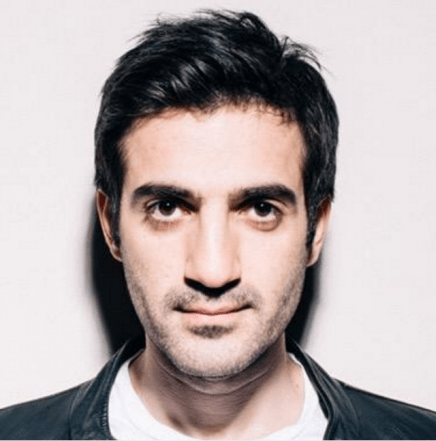
Employees petitioned to remove HQ Trivia’s CEO Rus Yusupov

HQ reimagined gaming and mobile entertainment with the launch of its 12-question trivia game in August 2017 where players all competed live in twice-daily shows with anyone who got all the answers right split a cash jackpot. The games felt urgent since you could only participate at designated times, fun to play against friends or strangers, and winning carried a significance no single-player or non-stop online game could match.

When TechCrunch wrote the first coverage of HQ Trivia in October 2017, it had just 3500 concurrent players. But by January it had climbed to the #3 game and #6 overall app in the App Store, and grown to 2.38 million players by March. Quickly, copycats from China and Facebook entered the market. But they all lacked HQ’s secret weapon — its plucky host comedian Scott Rogowsky. Affectionately awarded nicknames like Quiz Daddy, Quiz Khalifa, Host Malone, and Trap Trebek from the “HQties” who played daily, he was the de facto face of the startup.

Yet HQ had some shaky foundations. Co-founder Colin Kroll, who’d also started Vine with Yusupov and sold it to Twitter, had been fired from Twitter after 18 months for being a bad manager, Recode reported. He’d also picked up a reputation of being creepy around female employees, as well as Vine stars, TechCrunch has learned. Rapid growth and an investigation by early HQ investor Jeremy Liew that found no egregious misconduct by Kroll paved the way for a $15 million investment. The round was led by Founders Fund’s Cyan Bannister, and it valued HQ at over $100 million.
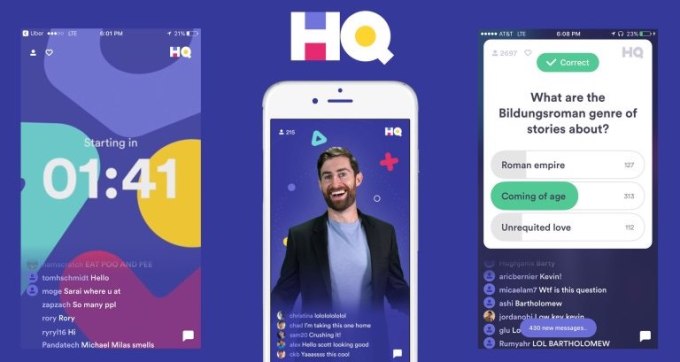
Yusupov failed to translate that cash into sustained growth and product innovation. His public behavior had already raised flags. He yelled at a Daily Beast reporter after the outlet’s Taylor Lorenz interviewed Rogowsky without Yusupov’s approval, threatening to fire the host. “You’re putting Scott’s job in jeopardy. Is that what you want? . . .  Please read me your story word for word,” Yusupov said. When he learned Rogowsky had expressed his preference for salad restaurant chain Sweetgreen, Yusupov shouted “He cannot say that! We do not have a brand deal with Sweetgreen! Under no circumstances can he say that.” The next day, Yusupov falsely claimed he’d never threatened Rogowsky’s job.

With HQ’s bank account full, sources say Yusupov was extremely slow to make decisions, allowing HQ to stagnate. The novelty of playing trivia for money via phone has begun to wear off, and people increasingly ignored HQ’s push notifications to join its next game. But beyond bringing in some guest hosts and the option to buy a second chance after a wrong answer, HQ ceased to evolve. HQ fell to the #196 game on iOS and the #585 overall app as concurrent players waned.

That’s when things started to get a bit Game Of Thrones.

Pawns In A CEO War

Liew pushed for HQ to swap Kroll into the CEO spot in September 2018 while moving Yusupov to Chief Creative Officer, which was confirmed despite an HR complaint against Kroll for aggressive management. However, three sources tell TechCrunch that Yusupov pushed that HQ employee to file the complaint against Kroll. As the WSJ reported after Kroll’s death, that employee later left the startup because they felt that they’d been exploited. “There was definitely what felt like manipulation there, and that’s also why that employee resigned from the company.” one source said. Another source said that staffer “believed Rus used their unhappiness about work to use them as a pawn in his CEO war and not because Rus actually cared about resolving things.”

Cyan of Founders Fund stepped down from HQ’s board after the decision to swap out Yusupov due to her firm’s reputation of keeping founders in control, Recode’s Kurt Wagner reported. Sources say that despite Kroll’s reputation, the staff believed in him. “Colin loved HQ and was dedicated to all the employees more than Rus. Rus cares about Rus. Colin cared about the content” a source tells me. 

Three sources say that in a desperate ploy to retain power and prevent Kroll’s rise, Yusupov suggested Rogowsky, a comedian with no tech or management experience, be made CEO of HQ Trivia. He even suggested the company film a reality show about Rogowsky taking over. That idea was quickly shot down as preposterous.

“It was a very personal desperation tactic not to have Colin be CEO. It was not a professionally thought-out idea” a source tells me, though another said it was always hard to tell if Yusupov’s crazy ideas were jokes. Both Yusupov and HQ Trivia declined to respond to multiple requests for comment, but we’ll update if we hear back.

HQ Trivia co-founder Colin Kroll passed away in December

Then tragedy struck in December. Kroll, then CEO, was found dead in his apartment from a drug overdose. Employees were distraught over what would happen next. “Colin’s plan was to ship fast, and get new things out there” a source says, noting that Kroll had pushed for the release of HQ’s first new game type HQ Words modeled after Wheel Of Fortune. “He wasn’t perfect but in the time he was in charge, the ship started to turn, but when Rus took over again it was like the 9 months where we did nothing.”

Coup d’éHQ

By February 2019, HQ’s staff was fed up. Two sources confirm that 20 of the roughly 35 employees signed a letter asking the board to remove Yusupov and establish a new CEO. With HQ’s download rate continuing to sink, they feared he’d run the startup into the ground. One source suggested Yusupov might rather have seen the whole startup come crashing down with the blame placed on the product than have it come to light that he played a large hand in the fall. The tone of the letter, which was never formally delivered but sources believe the board knew of, wasn’t accusatory but a plea for transparency about the company’s future and the staff’s job security.

At a hastily convened all-hands meeting in late February, HQ investor Liew told the company his fund Lightspeed would support a search for a new CEO to replace Yusupov, and provide that new CEO with funding for 18 more months of runway. Liew told the staff he would step down from the board once that CEO was found, but the search continues and so Liew remains on HQ’s board.

Mostly everyone was on Jeremy’s side as no one wanted to work under Rus. Jeremy wasn’t trying to screw him over the way Rus would screw other people over. He just wanted to do what was right, getting behind what everyone wanted” a source said of Liew. 

Instead, HQ’s board moved forward with instituting a new executive decision-making committee composed of Yusupov, HQ’s head of production Nick Gallo, and VP of engineering Ben Sheats. Yusupov would remain interim CEO, and he continued to cling to power and there’s been little transparency about the CEO replacement process. Until a new CEO is found, HQ must subsist on its existing funds. The staff is “always worried about running out of runway” and are given vague answers when they ask leadership about how much money is left.
On March 1st, the committee emerged from a meeting and fired three employees — two who had spearheaded the petition and been vocal about Yusupov’s failings.

One who wasn’t fired was Rogowsky, despite sources saying at one point he’d tried to organize the staff to go on strike. Other employees had been cautious about standing up to Yusupov. “Everyone was terrified of retaliation. Their fears have totally been validated” a source explains. Engineers and other staffers with strong employment prospects began to drain out of the company. Those left were just trying to hold onto their jobs. Without inspiring leadership or a strategy to reverse user shrinkage, recruiting replacements would prove difficult.

Yusupov remains on the board, along with Tinder CEO Elie Seidman who Yusupov appointed to his additional common seat. Liew retains his seat until the new CEO is found and given that seat. And Kroll’s seat appears to have gone to Lightspeed partner Merci Victoria Grace. Lightspeed and Cyan of Founders Fund declined to respond to requests for comment.

[Update: Seidman tells TechCrunch that the he sees the internal struggle for the CEO role as over now that Yusupov has accepted that a new CEO will be installed. That search is moving along, and the CEO chosen will report to the board but otherwise be given full autonomy to run the company as they choose. That includes having hiring and firing power over Yusupov. Seidman rightly believes HQ has contributed important ideas to the mobile gaming ecosystem, and now it’s the startup’s responsibility to turn those ideas into a steady business.]

Losing Face

Tensions at HQ and a desire to diversify his prospects led Rogowsky to pick up a side gig hosting baseball talk show ChangeUp on the DAZN network, TMZ reported this week. He’d hoped to continue hosting HQ during its big weekend contests. But tensions with Yusupov and the CEO’s desire for the host to remain exclusively at HQ led negotiations to sour causing Rogowsky to leave the startup entirely. TechCrunch was first to report that he’s been replaced by former HQ guest host Matt Richards, who Yusupov bluntly told me Friday had polled higher than Rogowsky in a SurveyMonkey survey of HQ’s top players.

In tweets, Rogowsky revealed that that “Sadly, it won’t be possible for me to continue hosting HQ concurrently as I had hoped” noting, “I wasn’t given the courtesy of a farewell show.” Finding a way to preserve Rogowsky’s ties to HQ likely would have been best for the startup.  TechCrunch had raised the concern a year ago that unless Rogowsky was properly locked in with an adequate equity vesting schedule at HQ, he could leave. Or worse, he could be poached by Facebook, Snapchat, or YouTube to host an HQ competitor.

“Rus is a visionary but not a good leader. He is extremely manipulative in an unproductive way. He’s a dude who just cares a lot about his reputation” a source noted. “A lot of the negative sentiment amongst staff is the belief that he cares more about his reputation than the company itself.”

HQ’s next attempt to revive growth appears to be HQ Editor’s Picks, is described as “a new live show on your phone where our host shows funny viral videos and you decide on who gets paid.” Finally it seems willing to embrace the potential of interactive live video entertainment outside of trivia and puzzles. HQ Editor’s Picks will face an uphill battle, since HQ dropped out of the top 1500 iOS apps last month, according to App Annie. Sensor Tower estimates that HQ saw just 8 percent as many downloads in March 2019 as March 2018.

After the loss of its spirit animal Rogowsky, the employees’ chosen leader Kroll, the supervision of veteran investor Cyan, and its product momentum, tough questions are what remain for HQ Trivia. The company’s struggles have paralyzed its progress towards finding a new viral mechanic or game format that attracts users. While HQ Words is fun, it’s too similar to its trivia competition to change the startup’s trajectory. And all of the in-fighting could scare off any talent hoping to turn HQ around. Unfortunately, securing an extra life for the game will take a more than a $3.99 in-app purchase.
Ten steps to prepare for an exponential future

After its first attempt botched the landing, SpaceIL commits to second Beresheet lunar mission

The minds behind Israel’s SpaceIL attempted lunar landing convened today to begin planning for a second lunar mission.

In an announcement yesterday, the chairman of SpaceIL, Morris Kahn, said that the leaders of the group behind the Beresheet launch would begin meeting to find a new group of donors for another run at a lunar landing.

On Thursday the first Israeli mission to the moon ended in failure when the organization’s spacecraft Beresheet (which means Genesis in Hebrew) crashed on the lunar surface.

“This is part of my message to the younger generation: Even if you do not succeed, you get up again and try,” Kahn said in a statement.

At a cost of $200 million the Beresheet mission would have been among the cheapest lunar landings ever attempted — and the first legitimate attempt by a private organization to make it to the moon (even though the SpaceIL organization had significant backing from the Israeli government).

The project started as an attempt to claim the Google Lunar Xprize, which was announced over ten years ago and was not awarded because no team could make an attempt at a landing within the timeframe specified. But, Beresheet’s developers labored on with help from Israel Aerospace Industries — the country’s state-owned aviation business.

In part, the cost of the lunar landing was defrayed by using existing launch technologies. Beresheet started its voyage by hitching a ride on a SpaceX Falcon 9 rocket.

After spiraling out of earth’s orbit for a month and a half, the Beresheet spacecraft entered lunar orbit just over a week ago before making its attempted landing last Thursday.

The final maneuver was an engine burn that would slow the spacecraft’s descent onto the lunar surface so that it could park on the Moon’s Sea of Serenity.

The vehicle made it most of the way to the moon. It took a picture of the blue marble from about 22 kilometers above the lunar surface and — a few minutes later — was lost.

Both Peter Diamandis, the founder of XPrize, and Anousheh Ansari, the foundation’s current chief executive, spoke to TechCrunch about the landing last week.

“What I’m seeing here is an incredible ‘Who’s Who’ from science, education and government who have gathered to watch this miracle take place,” Diamandis said. “We launched this competition now 11 years ago to inspire and educate engineers, and despite the fact that it ran out of time it has achieved 100 percent of its goal. Even if it doesn’t make it onto the ground fully intact it has ignited a level of electricity and excitement that reminds me of the Ansari Xprize 15 years ago.”

Meanwhile, Ansari emphasized the potential to reinvigorate commercial interest in lunar exploration and experimentation that the landing could evoke.

“Imagine, over the last 50 years only 500 people out of seven billion have been to space — that number will be thousands soon,” she said. “We believe there’s so much more that can be done in this area of technology, a lot of real business opportunities that benefit civilization but also humanity.”

Diving into Google Cloud Next and the future of the cloud ecosystem

Extra Crunch offers members the opportunity to tune into conference calls led and moderated by the TechCrunch writers you read every day. This week, TechCrunch’s Frederic Lardinois and Ron Miller offered up their analysis on the major announcements that came out of Google’s Cloud Next conference this past week, as well as their opinions on the outlook for the company going forward.

Google Cloud announced a series of products, packages and services that it believes will improve the company’s competitive position and differentiate itself from AWS and other peers. Frederic and Ron discuss all of Google’s most promising announcements, including its product for managing hybrid clouds, its new end-to-end AI platform, as well as the company’s heightened effort to improve customer service, communication, and ease-of-use.

“They have all of these AI and machine learning technologies, they have serverless technologies, they have containerization technologies — they have this whole range of technologies.

But it’s very difficult for the average company to take these technologies and know what to do with them, or to have the staff and the expertise to be able to make good use of them. So, the more they do things like this where they package them into products and make them much more accessible to the enterprise at large, the more successful that’s likely going to be because people can see how they can use these.

…Google does have thousands of engineers, and they have very smart people, but not every company does, and that’s the whole idea of the cloud. The cloud is supposed to take this stuff, put it together in such a way that you don’t have to be Google, or you don’t have to be Facebook, you don’t have to be Amazon, and you can take the same technology and put it to use in your company”

Image via Bryce Durbin / TechCrunch

Frederic and Ron dive deeper into how the new offerings may impact Google’s market share in the cloud ecosystem and which verticals represent the best opportunity for Google to win. The two also dig into the future of open source in cloud and how they see customer use cases for cloud infrastructure evolving.

For access to the full transcription and the call audio, and for the opportunity to participate in future conference calls, become a member of Extra Crunch. Learn more and try it for free. 

Whither native app developers?

I’ve noticed something interesting lately. Five years ago, senior developers with significant iOS experience available for new work seemed approximately as easy to find as unicorns who also laid golden eggs. Even two years ago, they were awfully hard to unearth. This year, though? Maybe it’s just a random blip — but this year, like the truth, they seem to be out there. And a few things make me suspect it’s not a blip.

App Annie’s “State of Mobile 2019” refers obliquely to “mobile maturity,” i.e. the point at which the number of downloads per year flattens out in a given market. That same report shows that the US is there; the number of app downloads in the US increased a paltry 5% from 2016 to 2018 — though it’s worth noting that app revenue which flowed through the app store increased 70% in that same time.

Meanwhile, the number of apps in the iOS App Store is essentially flat over the last two years — this has been influenced by more stringent approval standards from Apple, yes, but is still noteworthy.

Meanwhile meanwhile, non-native cross-platform development platforms are growing in popularity. “We scanned Microsoft’s iOS and Android apps and discovered that 38 of them, including the likes of Word, Excel, Xbox, and many others, were recently updated to include React Native” reports AppFigures, who add “In the last year use of React Native has nearly doubled.”

I can confirm anecdotally that clients are increasingly interested in building cross-platform apps, or at least simple cross-platform apps, in React Native. I certainly don’t think this is always the right move — I wrote about this decision and its trade-offs for ExtraCrunch a couple of months ago — but It’s certainly a more viable option than Cordova/Ionic, which I’ve had nothing but multiple terrible experiences with over the years. And then there’s the slow but distinct rise of PWAs.

Is the app boom over? Are today’s app experts doomed to become the COBOL programmers of tomorrow? Not so fast. Native development tools and technologies have gotten a lot better in that time, too. (For instance, I’ve never talked to anyone who doesn’t vastly prefer Swift to Objective-C, and while Kotlin is newer, it seems to be on a similar trajectory for Android.) And we’re still seeing consistent growth in a “long tail” of new app development, which, instead of being built for mass consumer or enterprise-wide audiences, are built and iterated for very specific business needs.

But I’d still feel at least slightly uneasy about going all-in as a specialist app developer if I was early in my career. Not because the market’s going to go away … but because, barring some new transcendent technology available only on phones (maybe some AR breakthrough?) the relentless growth and ever-increasing demand of yesteryear is, in mature markets like the US, apparently gone for the foreseeable future. There’s still some growth, but it seems that’s being sopped up by the rise of non-native development.

In short, for the first time since the launch of the App Store it’s possible to at least envision a future in which the demand for native app developers begins to diminish. It’s certainly not the only possible future. This certainly isn’t the conventional wisdom — just ask any of the hordes of Android developers flocking to Google I/O in May, or WWDC in June. But it might be worth building up a backup strategy, just in case.

Tesla is raising the price of its full self-driving option

In a few weeks, Tesla buyers will have to pay more for an option that isn’t yet completely functional, but that CEO Elon Musk promises will one day deliver full autonomous driving capabilities.

Musk tweeted Saturday that the price of its full self-driving option will “increase substantially over time” beginning May 1.

Tesla vehicles are not self-driving. Musk has promised that the advanced driver assistance capabilities on Tesla vehicles will continue to improve until eventually reaching that full automation high-water mark.

Musk didn’t provide a specific figure, but in response to a question on Twitter, he said the increase would be “something like” around the $3,000+ figure. Full self-driving currently costs $5,000.

The price hike comes amid several notable changes and events, including an upcoming Investor Autonomy Day on April 22 meant to explain and showcase Tesla’s autonomous driving technology. On Thursday, Tesla announced that Autopilot, its advanced driver assistance system that offers a combination of adaptive cruise control and lane steering, is now a standard feature.

The price of vehicles with the standard Autopilot is higher (although it should be noted that this standard feature is less than the prior cost of the option).  Buyers previously had to pay $3,000 for the option and examples given by Tesla suggest a $500 savings.

Tesla also announced it would begin leasing the Model 3 vehicles.

The more robust version of Autopilot is called Full Self-Driving, or FSD, and currently costs an additional $5,000. FSD includes Summon as well as Navigate on Autopilot, an active guidance system that navigates a car from a highway on-ramp to off-ramp, including interchanges and making lane changes. Once drivers enter a destination into the navigation system, they can enable “Navigate on Autopilot” for that trip.

Tesla continues to improve Navigate on Autopilot and the broader FSD system through over-the-air software updates. The company says on its website that FSD will soon be able to recognize and respond to traffic lights and stop signs and automatically driving on city streets. 

The next major step change is a new custom chip called Hardware 3 that Tesla recently began producing. The Tesla-built piece of hardware is designed to have greater processing power than the Nvidia computer currently in Model S, X, and 3 vehicles.

Musk tweeted Saturday that Tesla will begin swapping the new custom chip into existing vehicles in a few months.

Musk has been promising full self-driving for years now. In late 2016, when Tesla started producing electric vehicles with a more robust suite of sensors, radar and cameras that would allow higher levels of automated driving, it also started taking money from customers for FSD. Musk said at the time, it would become available if and when the technical challenges were conquered and regulatory approvals were met.

Get ready for a new era of personalized entertainment

New machine learning technologies, user interfaces and automated content creation techniques are going to expand the personalization of storytelling beyond algorithmically generated news feeds and content recommendation.

The next wave will be software-generated narratives that are tailored to the tastes and sentiments of a consumer.

Concretely, it means that your digital footprint, personal preferences and context unlock alternative features in the content itself, be it a news article, live video or a hit series on your streaming service.

The title contains different experiences for different people.

From smart recommendations to smarter content

When you use Youtube, Facebook, Google, Amazon, Twitter, Netflix or Spotify, algorithms select what gets recommended to you. The current mainstream services and their user interfaces and recommendation engines have been optimized to serve you content you might be interested in.

Your data, other people’s data, content-related data and machine learning methods are used to match people and content, thus improving the relevance of content recommendations and efficiency of content distribution.

However, so far the content experience itself has mostly been similar to everyone. If the same news article, live video or TV series episode gets recommended to you and me, we both read and watch the same thing, experiencing the same content.

That’s about to change. Soon we’ll be seeing new forms of smart content, in which user interface, machine learning technologies and content itself are combined in a seamless manner to create a personalized content experience.

What is smart content?

Smart content means that content experience itself is affected by who is seeing, watching, reading or listening to content. The content itself changes based on who you are.

We are already seeing the first forerunners in this space. TikTok’s whole content experience is driven by very short videos, audiovisual content sequences if you will, ordered and woven together by algorithms. Every user sees a different, personalized, “whole” based on her viewing history and user profile.

At the same time, Netflix has recently started testing new forms of interactive content (TV series episodes, e.g. Black Mirror: Bandersnatch) in which user’s own choices affect directly the content experience, including dialogue and storyline. And more is on its way. With Love, Death & Robots series, Netflix is experimenting with episode order within a series, serving the episodes in different order for different users.

Some earlier predecessors of interactive audio-visual content include sports event streaming, in which the user can decide which particular stream she follows and how she interacts with the live content, for example rewinding the stream and spotting the key moments based on her own interest.

Simultaneously, we’re seeing how machine learning technologies can be used to create photo-like images of imaginary people, creatures and places. Current systems can recreate and alter entire videos, for example by changing the style, scenery, lighting, environment or central character’s face. Additionally, AI solutions are able to generate music in different genres.

Now, imagine, that TikTok’s individual short videos would be automatically personalized by the effects chosen by an AI system, and thus the whole video would be customized for you. Or that the choices in the Netflix’s interactive content affecting the plot twists, dialogue and even soundtrack, were made automatically by algorithms based on your profile.

Personalized smart content is coming to news as well. Automated systems, using today’s state-of-the-art NLP technologies, can generate long pieces of concise, comprehensible and even inventive textual content at scale. At present, media houses use automated content creation systems, or “robot journalists”, to create news material varying from complete articles to audio-visual clips and visualizations. Through content atomization (breaking content into small modular chunks of information) and machine learning, content production can be increased massively to support smart content creation.

Say that a news article you read or listen to is about a specific political topic that is unfamiliar to you. When comparing the same article with your friend, your version of the story might use different concepts and offer a different angle than your friend’s who’s really deep into politics. A beginner’s smart content news experience would differ from the experience of a topic enthusiast.

Content itself will become a software-like fluid and personalized experience, where your digital footprint and preferences affect not just how the content is recommended and served to you, but what the content actually contains.

Automated storytelling?

How is it possible to create smart content that contains different experiences for different people?

Content needs to be thought and treated as an iterative and configurable process rather than a ready-made static whole that is finished when it has been published in the distribution pipeline.

Importantly, the core building blocks of the content experience change: smart content consists of atomized modular elements that can be modified, updated, remixed, replaced, omitted and activated based on varying rules. In addition, content modules that have been made in the past, can be reused if applicable. Content is designed and developed more like a software.

Currently a significant amount of human effort and computing resources are used to prepare content for machine-powered content distribution and recommendation systems, varying from smart news apps to on-demand streaming services. With smart content, the content creation and its preparation for publication and distribution channels wouldn’t be separate processes. Instead, metadata and other invisible features that describe and define the content are an integral part of the content creation process from the very beginning.

Turning Donald Glover into Jay Gatsby

With smart content, the narrative or image itself becomes an integral part of an iterative feedback loop, in which the user’s actions, emotions and other signals as well as the visible and invisible features of the content itself affect the whole content consumption cycle from the content creation and recommendation to the content experience. With smart content features, a news article or a movie activates different elements of the content for different people.

It’s very likely that smart content for entertainment purposes will have different features and functions than news media content. Moreover, people expect frictionless and effortless content experience and thus smart content experience differs from games. Smart content doesn’t necessarily require direct actions from the user. If the person wants, the content personalization happens proactively and automatically, without explicit user interaction.

Creating smart content requires both human curation and machine intelligence. Humans focus on things that require creativity and deep analysis while AI systems generate, assemble and iterate the content that becomes dynamic and adaptive just like software.

Sustainable smart content

Smart content has different configurations and representations for different users, user interfaces, devices, languages and environments. The same piece of content contains elements that can be accessed through voice user interface or presented in augmented reality applications. Or the whole content expands into a fully immersive virtual reality experience.

In the same way as with the personalized user interfaces and smart devices, smart content can be used for good and bad. It can be used to enlighten and empower, as well as to trick and mislead. Thus it’s critical, that human-centered approach and sustainable values are built in the very core of smart content creation. Personalization needs to be transparent and the user needs to be able to choose if she wants the content to be personalized or not. And of course, not all content will be smart in the same way, if at all.

If used in a sustainable manner, smart content can break filter bubbles and echo chambers as it can be used to make a wide variety of information more accessible for diverse audiences. Through personalization, challenging topics can be presented to people according to their abilities and preferences, regardless of their background or level of education. For example a beginner’s version of vaccination content or digital media literacy article uses gamification elements, and the more experienced user gets directly a thorough fact-packed account of the recent developments and research results.

Smart content is also aligned with the efforts against today’s information operations such as fake news and its different forms such as “deep fakes” (http://www.niemanlab.org/2018/11/how-the-wall-street-journal-is-preparing-its-journalists-to-detect-deepfakes). If the content is like software, a legit software runs on your devices and interfaces without a problem. On the other hand, even the machine-generated realistic-looking but suspicious content, like deep fake, can be detected and filtered out based on its signature and other machine readable qualities.


Smart content is the ultimate combination of user experience design, AI technologies and storytelling.

News media should be among the first to start experimenting with smart content. When the intelligent content starts eating the world, one should be creating ones own intelligent content.

The first players that master the smart content, will be among tomorrow’s reigning digital giants. And that’s one of the main reasons why today’s tech titans are going seriously into the content game. Smart content is coming.

O2 5G network to support Millbrook CAV trials

http://bit.ly/2KwdKmw https://ift.tt/eA8V8J

Amazon May Launch Ad-Support Free Music Streaming Service: Report

Amazon is reportedly considering launching a free, ad-supported music streaming service, which will largely be meant to boost sales of Echo smart speakers. http://bit.ly/2UeNLzT

Google Sharing Data With US Forces Raises Concerns: Report

US law enforcement officials have reportedly been turning to a particular Google database called "Sensorvault" to trace location and other data of people as part of their investigations. http://bit.ly/2UX2nIj

Sources: the US State Department ordered embassies to push back against foreign influence campaigns, as officials worry anti-US views are taking root worldwide (New York Times)

New York Times : Sources: the US State Department ordered embassies to push back against foreign influence campaigns, as officials worry ...