Monday, March 11, 2019

Alexandria Ocasio-Cortez says labor should not fear automation

It’s impossible to discuss the seismic shift toward automation without a conversation about job loss. Opponent of these technologies criticize a displacement that could some day result wide scale unemployment among what is often considered “unskilled” roles. Advocates, meanwhile, tend to suggest that reports of that nature tend to be overstated. Workforces shift, as they have done for time time immemorial.

During a conversation at SXSW this week, New York congresswoman Alexandria Ocasio-Cortez offered another take entirely.

“We should not be haunted by the specter of being automated out of work,” she said in an answer reported by The Verge. “We should be excited by that. But the reason we’re not excited by it is because we live in a society where if you don’t have a job, you are left to die. And that is, at its core, our problem.”

The response to an audience member’s question is a take that doesn’t too often get repeated in broader conversations about automation. Often times industry spokespeople will discuss technology’s potential to replace jobs that are deemed “dull, dirty and dangerous” — menial tasks that many roboticists will suggest no one really wants in the first place.

Ocasio-Cortez’s answer, on the other other hand, speaks to a viewpoint more in-line with her own Democratic Socialist views. It’s a suggestion that, if harnessed correctly, such technologies could one day liberate workers from a capitalist system where being a worker is inexorably tied to one’s identity and livelihood.

The newly elected Congresswoman elaborated on her position by pointing out the benefits that automation could bring to a society.

“We should be excited about automation, because what it could potentially mean is more time educating ourselves, more time creating art, more time investing in and investigating the sciences, more time focused on invention, more time going to space, more time enjoying the world that we live in,” The Verge quoted Ocasio-Cortez as saying. “Because not all creativity needs to be bonded by wage.”

And Ocasio-Cortez cited Bill Gates’ suggestion (first floated in a presentation on Quartz) that a robot tax might be a way to make that vision real. “What [Gates is] really talking about is taxing corporations,” she reportedly said. “But it’s easier to say: ‘tax a robot.’”

Her response to the automation question has met with applause from some writers who have been notably prescient about the future.

“This [is] just such a shockingly intelligent thing for any politician to say,” novelist William Gibson said via tweet. It is, at very least, a fresh perspective on a well-trod topic and the kind of outlook that could breath some life in a vital conversation about our collective technological future.

Automation will have an unquestionably profound impact on jobs in the coming decades — we’ve already seen much of that already, for roles in places like warehouses. Every study on the subject acknowledges this, with jobs “destroyed” number in the tens of millions and above, while jobs “created” are often times a fraction of that massive number.

The congresswoman’s comments, however, suggest that, independent of those numbers, perhaps we’ve been asking the wrong the question all along.

Appen acquires Figure Eight for up to $300M, bringing two data annotation companies together

Appen just announced that it’s acquiring Figure Eight in an all-cash deal that sees Appen paying $175 million upfront, with an additional payment of up to $125 million based on Figure Eight’s performance this year.

Both companies focus on using crowdsourced labor pools to annotate data, which in turn is used to train artificial intelligence and machine learning — for example, Figure Eight (formerly known as CrowdFlower and Dolores Labs) says its technology has been for everything from mapping to stock photography to scanning receipts for expense reports.

Appen, meanwhile, is a publicly-traded company headquartered in Sydney. CEO Mark Brayan described its technology — and its “crowd” of more than 1 million remote workers — as “highly complementary” to Figure Eight, which he praised for its data annotation and self-serve capabilities.

“We know that to compete and to be able to deliver even higher volumes, we need a richer set of technologies,” Brayan said. “That’s where Figure Eight comes in. They are, in our view, the leader in the market of the platform providers.”

As for what this means for the Figure Eight team, he said, “Everybody stays in place,” and that Appen plans to continue investing in the product.

Brayan also noted that Appen previously acquired another data annotation company called Leapforce in 2017, a move that he said provided the company with greater scale.

“The Figure Eight acquisition is the next step of our evolution,” he said. “Step one was to get bigger, step two is to become much more tech forward, which is what we get with Figure Eight.”

San Francisco-based Figure Eight has raised a total of $58 million in funding, according to Crunchbase, from investors including Trinity Ventures, Industry Ventures, Canvas Ventures and Salesforce Ventures. As CrowdFlower, it launched on-stage at the TechCrunch50 conference nearly a decade ago.

“I’m extremely proud of the team,” said Figure Eight co-founder Lukas Biewald in a statement. “This is a genuine validation of everything we’ve achieved and a great platform for our teams to combine and continue to do amazing things in AI.”

Biewald (a college friend of mine), along with his co-founder Chris Van Pelt, has moved on to a new startup called Weights and Biases, but he remains involved in Figure Eight as chairman. You can watch their TC50 presentation here.

The next great debate will be about the role of tech in society and government

The future of flying

From 3500 feet up California is a glorious patchwork quilt of green and gold, textured by rippling mountains and shining water. Ahead of us we see the Carquinez Bridge and the Bay; behind us, the fingers of Lake Berryessa curl into the steep hills. Twenty minutes ago I stood barefoot in the soft grass on the bank of one of those narrow coves, many miles from any road. Twenty minutes from now I will be driving to Five Guys for lunch.

“Hey,” I think to myself, “even a flying car couldn’t do this.”

Last year I became a Valley cliché, took up pilot training, and wrote about the experience — and the decrease in pilots worldwide, and the looming pilot shortage — for TechCrunch. ICON Aircraft, the manufacturers of a radically new kind of light airplane, the amphibious ICON A5, saw that and invited me to come to their Vacaville headquarters to experience a few days of their training. (At no cost to me, I should disclose, aside from paying the TSA $110 because I am a suspicious Canadian.) I turned up fearing that since, for tedious reasons, my training has been on hiatus since last July, I’d be so rusty I could barely fly.

It turned out that wasn’t a problem at all. Maybe I wasn’t really rusty at all … or maybe I was, but the A5 is so easy to fly that it didn’t matter.

I ended last year’s piece with “I think flying seems like a very 20th-century activity in the popular imagination.” That obviously isn’t true of ultramodern commercial jets, but it is of general aviation. It’s not at all unusual to learn to fly in a “six pack” airplane whose instruments and controls have basically not changed in 50 years or more. Sometimes they are actually are 50 years old.

Even the more “modern” “glass cockpit” light aircraft have screens with weirdly complex, user-hostile dials-and-knobs controls rather than a simple touchscreen. Even the vintage-2000 Diamond aircraft with which I started my training “features” a starting procedure which involves combining the mixture and the throttle in just the right way; significant left-turning tendencies such that you sometimes have to perform high-speed differential braking just to take off in a straight line; manual fuel-tank management; etc.

Individually these things are not such a big deal. Eventually these things are not such a big deal. But learning to navigate three-dimensional space, and land safely at busy airports — especially while dealing with restricted airspaces and air traffic control — is complicated enough that anything which adds to the initial cognitive load is a big deal.

Worse yet, most individual training is by independent Certified Flight Instructors with very different attitudes, beliefs, and curriculae. Some like to start students doing landings quite early, and some save it for quite a bit later. Some like to demonstrate, some like to instruct. It’s more a master/apprentice experience than an actual school.

Flight schools are obviously more consistent, and, in retrospect, probably a better way to learn, not least because you fly a lot in a short period of time, rather than trying to schedule with a capable but overcommitted CFI and ending up flying only every couple of weeks, which significantly retards your progress. Not that I’m speaking from bitter experience or anything.

Aaaaanyway. Let us not dwell on the unfortunate past. Let us talk about ICON, because both their aircraft and their training feel like a big step forward, right down to their instrument panel. On the A5, that panel is dominated by an Angle Of Attack indicator, which describes how much bite your airplane’s wings are taking out of the air. This is is insanely useful, especially when you are landing, when AOA is critical.

This instrument doesn’t even exist on other light aircraft. In my previous planes, Diamonds and Cessnas, landing was a complicated dance of carefully watching and managing speed, power, and seat-of-the-pants feel, while also mostly looking outside, such that one arrives at the runway at just-the-right-angle, then, a few feet above ground, rounds out at just-the-right-time to the next just-the-right-angle.

In the A5, you just set your power, make sure the AOA gauge is pointing the right way, and then glide happily down, occasionally glancing down at that single instrument, before bringing it up a notch for the round-out. Sure, you still might have to make adjustments for wind or height or whatever. But it’s a lot easier. Again, the cognitive load is so much less.

Military aircraft have AOA indicators, because, well, they’re so very useful, but no other general aviation airplane comes with one. You can buy them aftermarket, but that’s not the same. Why don’t other common general-aviation aircraft have them? Once again: because most general aviation has been stuck in the bad old days.

That extends to a slew of other things, too. The A5 is built for simplicity. No mixture to mess with; no manually controlled propeller RPM to adjust mid-flight; no magnetos to check in the run-up. In fact, if you cover the AoA gauge, altimeter, and attitude indicator, the controls look a lot like a car’s. This is by design.

You don’t even need high-octane aviation fuel; it actually runs better on standard 91-octane gasoline. (Although you can use either, or both.) The two-person cockpit, designed by BMW designers, is remarkably comfortable, and the view from its canopy is unparalleled, since its 100-horsepower engine and propeller are behind you rather than on its nose.

Perhaps best of all, it is fully amphibious. Its carbon fiber hull resembles a Jet Ski with wings, and on the water it can basically behave like one too (although that’s frowned on in excess, because the spray can wear at the propeller, and if you get crazy with it you risk dipping a wing into the water.) Takeoffs and even landings on sizable bodies of water in good conditions are ridiculously easy, courtesy of that AOA gauge.

You can even lower the landing gear, wheel it down/up a ramp to/from the water, and fly it for years without ever having to land it on a runway. What’s more, the wings fold back, which takes one person 10 minutes, so that the entire airplane can easily be stored in a nine-foot-wide trailer and driven to and from the water.

That really changes one’s perspective on flying. Instead of being limited to point-to-point flights between a fixed set of runways, anywhere on any reasonably large body of water can be your destination, weather permitting, and you can gas up at any marina. (It would be especially great in Canada, which is riven by countless lakes; the A5 is still classified as an experimental airplane there, but hopefully that will change soon, because e.g. Northern Ontario is practically made for it.)

On one flight this week we landed in a broad channel of water, navigated down a little winding side cove, beached — well, “grassed” — the plane on the shore, walked around a bit, then got back in, pushed off, restarted the engine, taxied out to the open water, and flew back to Vacaville … all very casually, keeping one eye on the wind and terrain to ensure it would be easy to get in and out of course, but really no big deal.

Let’s talk about stalls, because stalls are dangerous, and tend to happen when your plane is most vulnerable, i.e. taking off or departing. They are especially dangerous (PDF) when they progress into a spin. The most aerodynamically remarkable thing about the A5 is its stall resistance. It is the first production aircraft certified as spin resistant by the FAA, courtesy of a wing which is essentially divided into two sections, one of which stalls before the other, meaning the outer wing retains authority even when the inner wing is stalling.

Honestly, having flown it, I’m not sure how you would get it into a spin even if you wanted to. I put it into a power-on stall and held it there for full 15 seconds, banking from side to side, while the warning horn blared at me … and it gained altitude. In a power-off stall it lost height, but only at circa 10 feet per second, and was still amenable to banking. An “accelerated stall,” i.e. one while banking sharply at high speeds, is a maneuver sufficiently sketchy that student pilots have it demonstrated to them but do not usually attempt it themselves. I did one in the A5 and, just like the other stalls, it was anticlimactic in the extreme.

Oh, and if you were to get into serious trouble aloft, it also comes with a Complete Aircraft Parachute — although, to be honest, that seems to exist more to reassure your passenger than because you might use it in any conceivable circumstance, other than suddenly being struck blind or suffering an in-flight stroke.

ICON’s military background (its founders and early employees were largely Marine Corps pilots) has informed its training philosophy, too. They stress humility and being quick to volunteer your mistakes. Their training materials are much more accessible than the dense standard FAA tomes, and just the existence of a consistent curriculum across trainers is a big step forward. Their training focuses on a “sport pilot” license, which is restricted compared to “private pilot” — you can only fly light aircraft (nothing bigger than the A5), by day, in good visibility, below cloud cover — but it also requires less training, and is a very viable step towards the latter.

It will by now be more than apparent to you that I loved this airplane, and also really liked ICON’s training. Having established that, though, let’s talk about some downsides and concerns.

First, it would be disingenuous to write about ICON without mentioning the cloud of tragedy which still hangs over the company. Two years ago ICON’s lead engineer and another employee were killed in a crash on Lake Berryessa. According to the NTSB, the crash was due to pilot error, apparently when mistaking a dead-end canyon for one which led into the main body of the lake while flying at low altitude over water.

Later that year they released new low-altitude guidelines … and three weeks later, one of their first customers, former Major League Baseball superstar Roy Halladay, crashed his A5 into the Gulf of Mexico while flying at low altitude, and died. That too was declared pilot error; Halladay apparently had “high concentrations of morphine and amphetamine” along with Ambien in his system at the time.

On the one hand, even expert pilots (the chief engineer in question had flown F-16s in the Air Force) can make mistakes, and obviously one should never, ever, ever do drugs and fly. On the other, one can’t help but wonder if the fact that the A5 is so easy to fly in and out of water — landing it on a lake in good conditions is objectively easier than, say, docking a powerboat in a slip on a windy day, and takeoffs are easier yet — breeds a dangerous complacency when over water. Obviously the way to combat this is with training, and I can attest that ICON’s training today has a heavy focus on humility and caution, especially at low altitude … and yet, that kind of complacency will remain a risk factor.

Second, there’s no question that none of this comes cheap. Airplanes are expensive in general but the A5’s list price of $389,000 is noticeably more than that of, say, a new Cessna 172, the world’s most popular starter / training aircraft … which carries twice as many passengers and almost twice as much weight. The A5 is very much a light aircraft; my CFI and I’s combined 410 pounds meant we could only fill the tank halfway to stay within weight/balance restrictions, although it’s also miserly enough with fuel that that wasn’t any problem. It’s a great little airplane, but there’s no question that you’re paying more money for a smaller plane.

Their intent is to lead off as the Ferrari of light aviation, and eventually build something more like — well, not a Honda, but maybe a Maserati, in terms of relative price. They burned through some goodwill by initially claiming the list price would be $189,000. Right now they’re ramping up their production facilities in Tijuana (where all the carbon fiber components are made) and Vacaville (where those components are assembled along with everything else.)
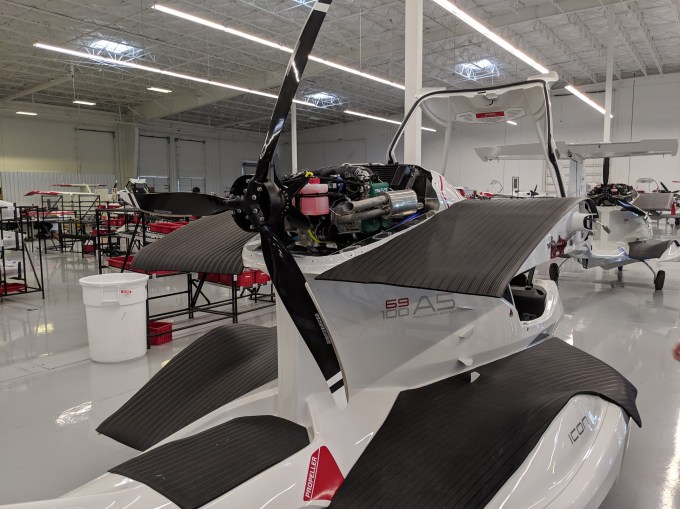
One can imagine the price diminishing as production quantities achieve economies of scale … but it’s still never going to be anything like the price of, say, a used Cessna 172, which can easily drop down into five figures.

The A5, and its easier/improved flying experience, and ICON’s more consistent training, and the simpler sport-pilot license associated with it, all do combine to make flying substantially more accessible … to the rich. It certainly won’t help the pilot shortage, though. Anyone who can afford an A5 doesn’t need to start flying professionally.

The big question is, will its advances — simpler & touchscreen cockpits, a built-in AOA gauge, spin-resistant wings, consistent training, etc. — filter down to the more affordable end of the industry, and/or into more affordable ICON aircraft? I optimistically think it will. Not anytime in the next few years, no. But much faster than we’ll get, say, affordable hex-rotor VTOL flying cars.

When people imagine flying they imagine it as a magical, dreamlike experience, and it frequently is — but at the same time, learning to fly can sometimes be more Type II fun than Type I. (I suspect that this, more than the admittedly high cost, is why a lot of student pilots peter out and never finish their certification.) Whatever the price point, the ICON people deserve kudos for building an aircraft which makes flying reliably far more the latter than the former. If that experience can scale semi-affordably — admittedly two huge ifs — then instead of facing a pilot shortage we’ll have a happy, excited, adventure-seeking glut of pilots out there, soaring from runway to runway and from lake to lake. May you try it yourself and enjoy it as much as I do.

Captain Marvel rakes in $455 million in worldwide weekend haul

Captain Marvel, the latest superhero film from Disney’s Marvel franchise, is bringing home the bacon — to the tune of a $455 million box office total for the weekend.

The movie, Marvel’s first to be headlined exclusively by a female superhero, is off to the second largest global opening of any superhero movie behind Avengers: Infinity War and the sixth best global box officer premiere of all time.

The film’s success shows (again) that when under-represented demographics get their due in solid entertainment outings, audiences will respond by opening their wallets and shelling out the cash.

Marvel’s highest grossing movie to date for the U.S. box office is Black Panther, which raked in a whopping $700 million in movie theaters across North America.

Captain Marvel’s soaring numbers come despite mixed reviews from critics (like our own Anthony Ha) who called it “a fine but underwhelming debut for Brie Larson’s superhero.”

With the new release Marvel seems to also be consistently reducing the gender gap among audiences for superhero movies. Captain Marvel ranks alongside Black Panther and Ant-Man and the Wasp for having the smallest gender divide among audiences for films in the Marvel Comics Universe franchise, with a weekend crowd that was 55% male and 45% female, as Box Office Mojo reports.

The results also could mean good things for the Disney+ streaming service, which is counting on the Marvel and LucasFilm franchises to power subscriptions (take my money already).

Plans are in the works for a series starring Tom Hiddleston as Loki (the complicated villain/anti-hero from the Thor and Avengers movies) and Marvel executives have teased that characters from the now-defunct Netflix/Marvel deal for characters based on The Defenders team (Daredevil, Jessica Jones, Luke Cage, Iron Fist — and tangentially The Punisher) may appear in some form in the Marvel Cinematic Universe down the road.

Captain Marvel, meanwhile is set to become the first movie to stream exclusively on the Disney+ service.

Josh Wood, hair colorist to the stars, gets $6.5M led by Index in its latest D2C bet

In the age of Amazon, where up to 90 percent of all consumers use it to buy goods and Amazon is accounting for a rapidly-growing percentage of a consumer’s total retail spend (along with other giants like Walmart), direct-to-consumer brands — leveraging social media alongside tech-first apps — are emerging as sometimes surprising, but often effective, competition.

In one of the latest developments, London-based celebrity hair colorist Josh Wood — who has worked with the likes of David Bowie, PJ Harvey, Florence Welch, Saoirse Ronan and Elle Macpherson, as well as with fashion designers Miuccia Prada, Donatella Versace and Marc Jacobs (and, disclaimer, me: I tried out his products before agreeing to write this story) — has raised $6.5 million led by Index Ventures, with JamJar Investments and Venrex also participating, to launch his products into cyberspace with the aim of disrupting the at-home hair color industry.

At-home hair color is a huge market that has largely been untouched in terms of innovation. Some 80 percent of women over 25 color their hair, with 75 percent of those doing it at home, working out to an industry worth $20 billion annually.

As with other direct-to-consumer brands, tech is playing a role on multiple levels at Josh Wood, from how the product is developed through to how it will match with consumers, as well as how it is marketed.

But unlike other direct-to-consumer startups, Josh Wood actually put down roots (heh) first in a very non-tech environment.

If you live in London, you might already recognise the name and logo of Josh Wood. Apart from his star list of clients (and the name check he gets in the media for that work), he has already been running his hair coloring business at some scale.

Wood’s products have been adorning a selection of London buses, in part to promote a partnership he’s had for the last year with Boots, a big UK chain of drugstores, where his coloring kits and other products are sold alongside big names like Revlon and L’Oreal.

That partnership has been a big boost for both Wood and Boots so far. Some 240,000 products were sold in the first year, contributing to the first growth spike that Boots has seen in the hair coloring category for more than a decade. (One reason also that the startup attracted the likes of Index, which has been behind other companies that have straddled the worlds of women’s consumer goods and tech, such as Farfetch and Glossier.)

The range of products — which includes hair coloring kits, root concealer products, and color-specific shampoo and conditioners — has been marketed from the start as a new take on hair coloring.

Wood has been working as a colorist himself for some 30 years, and while he has worked with some of the biggest names in women’s hair care in that time — he’d once been a global ambassador for Wella and he is currently global color creative director for Redken — he believes that there is a lot of room for improvement in home coloring.

“You get thousands of boxes of hair colors, and women are usually terrified of making the wrong choice,” he said in an interview. And that’s before you consider how prolonged dying at home can fry your hair if you don’t know what you’re doing, or using the products incorrectly.

Wood’s focus up to this point has been mainly on the product itself. Using his learnings from being a leading colorist, and knowing some of the pros and cons of working with brands that already sell mass-produced consumer goods, he has worked with chemists and other product designers on developing new ranges of shades an add-in product, called “Shade Shot Plus,” that extend the range even further and bring in highlights that are unique to each person’s hair; as well as aftercare products.

Shade Shot Plus has been a particularly notable development. Wood said that up to now the main endgame for producers of at-home hair coloring products has been to create standardised colors that will always look the same on each woman, so that it can be sold more consistently and predictably (think of those slightly macabre locks of hair that you sometimes see hanging in the aisles at drug stores showing “the color”). But the product developers couldn’t standardise how the highlights product would look. That roadblock, Wood said, turned out “to be a gift.”

In fact, standardised color runs counter to how professionals work, and what those who go to professionals want. “No two colors are the same,” he said of Shade Shot Plus “One of the big barriers at home is that women feel they have obvious ‘box color’, cookie-cutter lego hair, but this unlocks that, because the tones deposit differently on everyone’s hair.”

That product development is set to continue. With an approach reminiscent of Third Love how it has redefined shopping for bras by vastly extending the range of bra sizes, the idea will be to extend that color range even further down the line.

“This is the tip of the iceberg in terms of the ideas I’ve got,” he said. “There is a lot to learn from base color and foundation matching. This is a category that has had no innovation for decades and this is just the first iteration.”

But now, with the funding, the plan is to complement that product development with technology to help people find colors that best suit their own preferences — whether it’s for a new color that will go with a specific complexion, or to find the tint that most closely matches the color their hair used to be before it turned grey. At the same time, the aim is to deliver at-home dying in an experience that is more reminiscent of what you get if you pay much more (and spend more time) going to a trusted, professional hair colorist.

“We are pressing heavy on being able to deliver an amazing consultation online that will deliver a bespoke hair color that is very natural and covers grey,” he said. “But at our heart, I’d like to think of us as a brand that cares for the condition of your hair.”

Wood said that he is currently hiring and working with technologists to develop color-finding tools, akin to the kind you might come across in online makeup storefronts, to explore both how a woman (or man) looks, and what she or he is looking for.

This is in progress but the idea, it sounds like, will not only involve computer vision but also machine learning to tap into a bigger database of what “lookalike” complexions and people choose for colors, as well as a database created by Josh Wood itself to match those colors, based on the tinting choices that many professionals would make for those people were they sitting in a chair in a salon.

Wood said that he wanted to raise this money and expand the product as a direct-to-consumer offering because he didn’t think he’d be able to achieve this with something that is sold on a shelf — although the idea will be to complement that, too.

“The reason we are approaching this growth phase from a digital perspective is because we want to develop our business” — the market for at-home coloring is much bigger than professional, in-salon coloring — “but also have a best-in-class consultation tool. I’ve been coloring for nearly 30 years and this is the moment for me to democratize my learnings, and I couldn’t do that without digital. There is no other way to connect with so many consumers, and it’s very difficult to get that element right in a brick-and-mortar point of sale.”

I asked Wood if he would also explore the idea of subscriptions, a la Dollar Shave Club, as part of the mix as well, and his answer was actually a little refreshing and I think is a good sign for how this might develop over time.

“We are less keen on subscriptions and more keen that women feel we’re in the bathroom with them every time, monitoring how their hair color changes over time. We want something much deeper than just selling the same thing to them once a month.”

With these numbers, it’s no surprise SoftBank is investing in Latin America

This VC went long on HotelTonight and it paid off; here’s how.

Brian O’Malley has enjoyed a lot of success as a venture capitalist, thanks to bets on Bazaarvoice before its IPO, Dollar Shave Club before it was nabbed by Unilever, and a variety of other startups that were ultimately acquired or went public. It’s one reason that O’Malley, who began his venture career with Battery Ventures and stayed for nearly a decade, has been poached time and again, first joining Accel Partners for almost five years and, more recently, hopping over to Forerunner Ventures.

Interestingly, all three firms are investors in one company that O’Malley has known from nearly its outset and whose cash and stock sale for a reported $465 million to Airbnb, announced last week, he is still celebrating: HotelTonight, “The O’Malley family went long on HotelTonight,” he said in a call Thursday. “Now, we’re long Airbnb.”

For your Sunday reading, we thought you might enjoy an oral history from O’Malley about how he stumbled upon HotelTonight and remained connected to the company across its nine year history.

I’d originally met Sam [Shank HotelTonight’s CEO] way back. He had TravelPost,com, a travel blogging platform. I really liked him, but i didn’t think it was a ‘venture fundable’ company, [meaning I didn’t see] an explosive opportunity. But Sam is the kind of guy you file away in the back of your head. I knew I’d like to work with him sometime.

Then, I think it was the last week of 2010, I was at home reading up on new things and I came cross this announcement about this new thing called HotelTonight. I was looking at mobile services at the time. We [at Battery Ventures] were invested in Groupon and we saw how much customers loved this whole last-minute-deal angle. But it was hard for Groupon to [drill deep] across categories, given that merchant needs are different. The industry needed verticalized [players] and [HotelTonight] fit nicely in that sweet spot, so I did a little digging, and lo and behold, it was Sam Shank and his partner Jared [Simon] behind the company. I reached back out to Sam and said, ‘This is a great idea; I’d love to catch up with you.’

They were [running a company called] Dealbase [that aggregated and compared hotel deals] and HotelTonight was their mobile offering, so I got together with him and we set it up in a way where we wrote a [letter of intent to Dealbase’s angel investors] to spin HotelTonight out of Dealbase and make it its own company. But to do that, we wanted not just the technology but the team.

They had pretty well-known angels, so I went and talked with them, and some of them were not very excited about having the team go to this new company, so we set up this structure where Dealbase shareholders would get 50 percent of HotelTonight if they came over, and if they didn’t want to come over, we’d buy their shares. I think all of them came over eventually, though some were more curmudgeonly about it. Hopefully they appreciate it now! Then we put together a large option pool for the team and put together a syndicate, including myself at Battery, Theresia [Gouw] when she was at Accel, Kent Goldman [then of First Round Capital], and Kirsten [Green, the founder of Forerunner Ventures] was a small investor as well. And that’s what helped start the company.

At the time, I was one of the first customers, and I remember checking into one of their hotels in New York, and the hotel had never heard of HotelTonight but there on the fax machine was my booking reservation; that was the technology that was available at the time.

Then we [at Battery] led the Series A, we split it with Accel. I was already on the board from the seed round, then Theresia joined the board at the Series A.

When I left Battery [to join Accel] it was the smoothest transition. When you leave a firm, you leave behind [your companies]; your investments belong to the fund and not to you. But this was more seamless because Theresia was transitioning out of Accel [to start her own firm, Aspect Ventures] around the time that I was joining. So I think I was off the [HotelTonight] board for about a month. Then I took Theresia’s seat at Accel and [longtime Battery investor] Roger Lee went on my seat. Then at Accel, we led HotelTonight’s last round of financing.

It’s kind of serendipitous that all three firms where I’ve worked were shareholders.

[As for the outcome of the company], we’d talked about an IPO a while ago. It was growing really quickly. It’s a large business now with well over a hundred million [dollars] in [annual] revenue. It’s profitable. It has a lot of the characteristics you’d want. And they’d been approached by a variety of partners over time. But Sam and [Airbnb CEO] Brian [Chesky] have a special relationship. They’d known each other since even before HotelTonight.

And it’s great when you can clearly fill a void, and continue your mission under a bigger umbrella. Airbnb is rapidly growing a good business. It has done a great job of winning the hearts and minds of customers. But it had a gap in that it hadn’t focused on hotels and last-minute travelers, and it gets a lot of interest in those areas, so we thought the companies culturally would really complement each other, but also that the products would complement each other.

Decisions are always led by the team, and this is one where they were really excited about it, and we were super supportive of that. It’s the funny thing about all these deals, though. Yes, you can get a banker like Qatalyst [Partners] involved.  But a lot of it comes back to relationships.

Bihar Govt Recruitment 2019 – Apply Online 1676 Lecturer & Asst Professor Posts

Dept of Science & Technology, Bihar 1676 Lecturer & Asst Professor Posts. Candidates with BE, B.Tech, PG can apply online from 11-03-2019 to 31-03-2019.

RRB 2019 – Group D PET Admit Card Download

Railway Recruitment Board (RRB) has released call letter attending PET fot the post of Group D, Advt No: 02/2018.

NYKS 2019 – DYC Interview Admit Card Download

Nehru Yuva Kendra Sangathan (NYKS) released admit card for DYC Posts.

Mi A2 Price in India Slashed by Rs. 2,000, Now Starts at Rs. 11,999

Mi A2 price in India now starts at Rs. 11,999 for the 4GB RAM/ 64GB storage model, while the price of its 6GB RAM/ 128GB storage option remains as before. https://ift.tt/2u0Y2Vq

LG G8 ThinQ Price Announced, Pre-Orders to Begin Later This Week

LG G8 ThinQ price in South Korea is set at KRW 897,600 (roughly Rs. 55,300). https://ift.tt/2EP2Mmj

Captain Marvel Blasts Off With Sixth Best Opening of All-Time

Captain Marvel had the sixth largest opening weekend of all-time, grossing $455 million since its release on Friday. In India, it recorded the best opening ever for a solo superhero movie. https://ift.tt/2Uvth6O

cVIGIL App Unveiled by Election Commission Ahead of Lok Sabha Polls

Election Commission has introduced cVIGIL app at pan India level whereby citizens can record on his mobile any violation of the Model Code of Conduct (MCC) https://ift.tt/2CeantQ

Sources: amid the Iran war, Asian bankers say rising power prices and energy security are becoming a bigger consideration in data center financing decisions (Bloomberg)

Bloomberg : Sources: amid the Iran war, Asian bankers say rising power prices and energy security are becoming a bigger consideration in ...