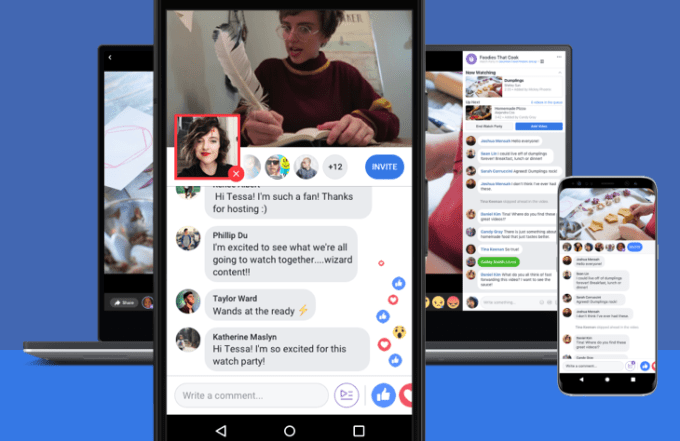
The next phase of social media is about hanging out together while apart. Rather than performing on a live stream or engaging with a video chat, Instagram may allow you to chill and watch videos together with a friend. Facebook already has Watch Party for group co-viewing, and in November we broke the news that Facebook Messenger’s code contains an unreleased “Watch Videos Together” feature. Now Instagram’s code reveals a “co-watch content” feature hidden inside Instagram Direct Messaging.
It’s unclear what users might be able to watch simultaneously, but the feature could give IGTV a much-needed boost, or just let you laugh and cringe at Instagram feed videos and Stories. But either way, co-viewing could make you see more ads, drive more attention to creators that will win Instagram their favor or just make you rack up time spent on the app without forcing you to create anything.
The Instagram co-watch code was discovered by TechCrunch’s favorite tipster and reverse-engineering specialist Jane Manchun Wong, who previously spotted the Messenger Watch Together code. Her past findings include Instagram’s video calling, music soundtracks and Time Well Spent dashboard, months before they were officially released. The code mentions that you can “cowatch content” that comes from a “Playlist” similar to the queues of videos Facebook Watch Party admins can tee up. Users could also check out “Suggested” videos from Instagram, which would give it a new way to promote creators or spawn a zeitgeist moment around a video. It’s not certain whether users will be able to appear picture-in-picture while watching so friends can see their reactions, but that would surely be more fun.
Instagram declined to comment on the findings, which is typical of the company when a feature has been prototyped internally but hasn’t begun externally testing with users. At this stage, products can still get scrapped or take many months or even more than a year to launch. But given Facebook’s philosophical intention to demote mindless viewing and promote active conversation around videos, Instagram co-watching is a sensible direction.
Facebook launched Watch Party to this end back in July, and by November, 12 million had been started from Groups and they generated 8X more comments than non-synced or Live videos. That proves co-watching can make video feel less isolating. That’s important as startups like Houseparty group video chatrooms and Squad screenshare messaging try to nip at Insta’s heels.
It’s also another sign that following the departure of the Instagram founders, Facebook has been standardizing features across its apps, eroding their distinct identities. Mark Zuckerberg plans to unify the backend of Facebook Messenger, WhatsApp, and Instagram to allow cross-app messaging. But Instagram has always been Facebook’s content-first app, so while Watch Party might have been built for Facebook Groups, Instagram could be where it hits its stride.
Speaking of the Instagram founders Kevin Systrom and Mike Krieger, this article’s author Josh Constine will be interviewing them on Monday 3/11 at SXSW. Come see them at 2 pm in the Austin Convention Center’s Ballroom D to hear about their thoughts on the creator economy, why they left Facebook and what they’ll do next. Check out the rest of TechCrunch’s SXSW panels here, and RSVP for our party on Sunday.
After indicating that it was exploring its options for fighting the potentially deadly rise of anti-vaccination content on its platform last month, Facebook is making a plan of attack.
Facebook’s strategy in the effort is to both minimize the spread of vaccination misinformation and to point users away from inaccurate anti-vaccination propaganda and toward “authoritative information,” i.e. info corroborated by the health and scientific establishment.
To achieve a reduction in the spread of anti-vax propaganda, Facebook will downrank groups and pages that spread this kind of content across both News Feed and its search function. Facebook will also reject ads promoting anti-vaccination misinformation. Repeat offenders attempting to promote this content through ads may see their accounts disabled. On Instagram, Facebook “won’t show or recommend content that contains misinformation about vaccinations on Instagram Explore or hashtag pages,” effectively burying that content from public-facing spaces. Facebook noted that it would also remove anti-vax adjacent ad targeting descriptors including the term “vaccine controversies.”
Facebook’s role in the rise of anti-vaccination or “anti-vax” conspiracy theories came into the spotlight last month. In light of reporting pointing to the responsibility of Facebook and YouTube in spreading this particularly dangerous form of misinformation, prominent California Rep. Adam Schiff wrote to the two companies demanding “additional information on the steps that you currently take to provide medically accurate information on vaccinations to your users.”
Last month, Bloomberg reported that Facebook was “exploring additional measures to best combat the problem,” including “reducing or removing this type of content from recommendations, including Groups You Should Join, and demoting it in search results, while also ensuring that higher quality and more authoritative information is available.”
Like other dangerous forms of online disinformation, the prevalence of anti-vax content has destructive real-world implications. The U.S. is currently experiencing an outbreak of measles, an entirely preventable infectious disease that is threatening the health of children and vulnerable populations and creating broad school closures in places like Clark County, Wash.
When Facebook directs its attention toward reducing the public spread of a particular strain of conspiracy theory or otherwise pernicious content, it tends to do a pretty thorough job. The problem of course is that such efforts from Facebook and other major tech platforms remain reactionary rather than proactive, meaning that Facebook’s next major outbreak of harmful, even deadly algorithmically fueled disinformation is likely just around the corner.
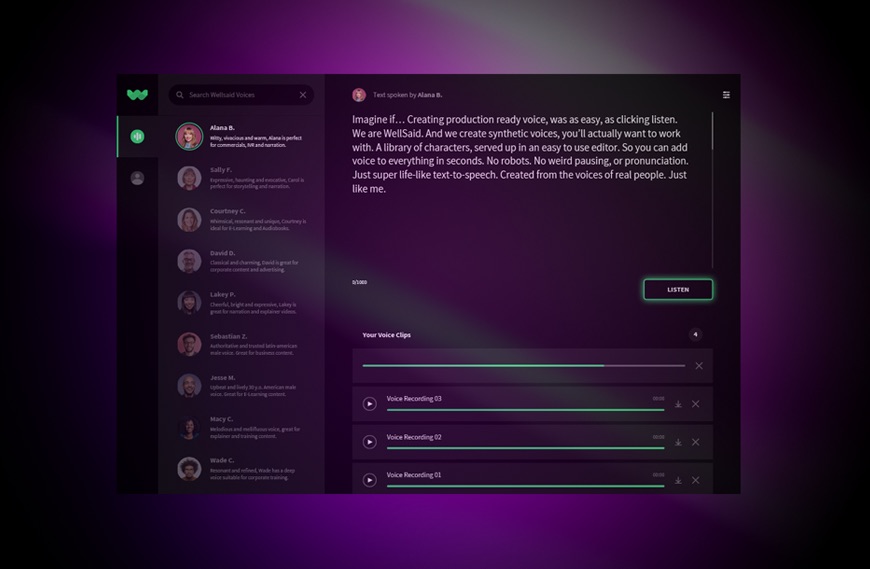
Many things are better said than read, but the best voice tech out there seems to be reserved for virtual assistants, not screen readers or automatically generated audiobooks. WellSaid wants to enable any creator to use quality synthetic speech instead of a human voice — perhaps even a synthetic version of themselves.
There’s been a series of major advances in voice synthesis over the last couple of years as neural network technology improves on the old highly manual approach. But Google, Apple and Amazon seem unwilling to make their great voice tech available for anything but chirps from your phone or home hub.
As soon as I heard about WaveNet, and later Tacotron, I tried to contact the team at Google to ask when they’d get to work producing natural-sounding audiobooks for everything on Google Books, or as a part of AMP, or make it an accessibility service, and so on. Never heard back. I considered this a lost opportunity, as there are many out there who need such a service.
So I was pleased to hear that WellSaid is taking on this market, after a fashion, anyway. The company is the first to launch from the Allen Institute for AI (AI2) incubator program announced back in 2017. They do take their time!
I talked with the co-founders CEO Matt Hocking and CTO Michael Petrochuk, who explained why they went about creating a whole new system for voice synthesis. The basic problem, they said, is that existing systems not only rely on a lot of human annotation to sound right, but they “sound right” the exact same way every time. You can’t just feed it a few hours of audio and hope it figures out how to inflect questions or pause between list items — much of this stuff has to be spelled out for them. The end result, however, is highly efficient.
“Their goal is to make a small model for cheap [i.e. computationally] that pronounces things the same way every time. It’s this one perfect voice,” said Petrochuk. “We took research like Tacotron and pushed it even further — but we’re not trying to control speech and enforce this arbitrary structure on it.”
“When you think about the human voice, what makes it natural, kind of, is the inconsistencies,” said Hocking.
And where better to find inconsistencies than in humans? The team worked with a handful of voice actors to record dozens of hours of audio to feed to the system. There’s no need to annotate the text with “speech markup language” to designate parts of sentences and so on, Petrochuk said: “We discovered how to train off of raw audiobook data, without having to do anything on top of that.”
So WellSaid’s model will often pronounce the same word differently, not because a carefully manicured manual model of language suggested it do so, but because the person whose vocal fingerprint it is imitating did so.
And how does that work, exactly? That question seems to dip into WellSaid’s secret sauce. Their model, like any deep learning system, is taking innumerable inputs into account and producing an output, but it is larger and more far-reaching than other voice synthesis systems. Things like cadence and pronunciation aren’t specified by its overseers but extracted from the audio and modeled in real time. Sounds a bit like magic, but that’s often the case when it comes to bleeding-edge AI research.
It runs on a CPU in real time, not on a GPU cluster somewhere, so it can be done offline as well. This is a feat in itself, as many voice synthesis algorithms are quite resource-heavy.
What matters is that the voice produced can speak any text in a very natural-sounding way. Here’s the first bit of an article — alas, not one of mine, which would have employed more mellifluous circumlocutions — read by Google’s WaveNet, then by two of WellSaid’s voices.
The latter two are definitely more natural sounding than the first. On some phrases the voices may be nearly indistinguishable from their originals, but in most cases I feel sure I could pick out the synthetic voice in a few words.
That it’s even close, however, is an accomplishment. And I can certainly say that if I was going to have an article read to my by one of these voices, it would be WellSaid’s. Naturally it can also be tweaked and iterated, or effects applied to further manipulate the sound, as with any voice performance. You didn’t think those interviews you hear on NPR are unedited, did you?
The goal at first is to find the creatives whose work would be improved or eased by adding this tool to their toolbox.
“There are a lot of people who have this need,” explained Hocking. “A video producer who doesn’t have the budget to hire a voice actor; someone with a large volume of content that has to be iterated on rapidly; if English is a second language, this opens up a lot of doors; and some people just don’t have a voice for radio.”
It would be nice to be able to add voice with a click rather than just have block text and royalty-free music over a social ad (think the admen):
I asked about the reception among voice actors, who of course are essentially being asked to train their own replacements. They said that the actors were actually positive about it, thinking of it as something like stock photography for voice; get a premade product for cheap, and if you like it, pay the creator for the real thing. Although they didn’t want to prematurely lock themselves into future business models, they did acknowledge that revenue share with voice actors was a possibility. Payment for virtual representations is something of a new and evolving field.
A closed beta launches today, which you can sign up for at the company’s site. They’re going to be launching with five voices to start, with more voices and options to come as WellSaid’s place in the market becomes clear. Part of that process will almost certainly be inclusion in tools used by the blind or otherwise disabled, as I have been hoping for years.
Sounds familiar
And what comes after that? Making synthetic versions of users’ voices, of course. No brainer! But the two founders cautioned that’s a ways off for several reasons, even though it’s very much a possibility.
“Right now we’re using about 20 hours of data per person, but we see a future where we can get it down to one or two hours while maintaining a premium lifelike quality to the voice,” said Petrochuk.
“And we can build off existing data sets, like where someone has a back catalog of content,” added Hocking.
The trouble is that the content may not be exactly right for training the deep learning model, which advanced as it is can no doubt be finicky. There are dials and knobs to tweak, of course, but they said that fine-tuning a voice is more a matter of adding corrective speech, perhaps having the voice actor reading a specific script that props up the sounds or cadences that need a boost.
They compared it with directing such an actor rather than adjusting code. You don’t, after all, tell an actor to increase the pauses after commas by 8 percent or 15 milliseconds, whichever is longer. It’s more efficient to demonstrate for them: “say it like this.”
Even so, getting the quality just right with limited and imperfect training data is a challenge that will take some serious work if and when the team decides to take it on.
But as some of you may have noticed, there are also some parallels to the unsavory world of “deepfakes.” Download a dozen podcasts or speeches and you’ve got enough material to make a passable replica of someone’s voice, perhaps a public figure. This of course has a worrying synergy with the existing ability to fake video and other imagery.
This is not news to Hocking and Petrochuk. If you work in AI, this kind of thing is sort of inevitable.
“This is a super important question and we’ve considered it a lot,” said Petrochuk. “We come from AI2, where the motto is ‘AI for the common good.’ That’s something we really subscribe to, and that differentiates us from our competitors who made Barack Obama voices before they even had an MVP [minimum viable product]. We’re going to watch closely to make sure this isn’t being used negatively, and we’re not launching with the ability to make a custom voice, because that would let anyone create a voice from anyone.”
Active monitoring is just about all anyone with a potentially troubling AI technology can be expected to do — though they are looking at mitigation techniques that could help identify synthetic voices.
With the ongoing emphasis on multimedia presentation of content and advertising rather than written, WellSaid seems poised to make an early play in a growing market. As the product evolves and improves, it’s easy to picture it moving into new, more constrained spaces, like time-shifting apps (instant podcast with five voices to choose from!) and even taking over territory currently claimed by voice assistants. Sounds good to me.
Is it happening? Is it not happening? After years of back and forth, it looks like the new tax on tech giants in France is about to become a law. Big tech companies that generate significant revenue in France will be taxed on their revenue generated in France.
Economy Minister Bruno Le Maire has been lobbying for a new tax so that tech giants would stop optimizing their European corporate structure to lower their effective tax rate. Originally, Le Maire wanted to convince other European countries to get on board.
But you need a unanimous vote when it comes to tax reforms in Europe. And Le Maire couldn’t convince everyone.
Le Maire still wanted to do something. So here we are, with a new tax on tech companies that generate more than €750 million in revenue globally and €25 million in France.
If you’re operating a marketplace (Amazon’s marketplace, Uber, Airbnb…) or an advertising business (Facebook, Google, Criteo…), you will have to pay 3 percent of your French revenue in taxes. The government says that it isn’t against American companies, as European and Asian companies are also about to get taxed.
It’s a weird taxation mode,l as it is based on revenue and not profit. It’ll also require some work from the taxation administration, as French revenue means that it involves all transactions with somebody with a French mailing address or a French IP address. France expects to generate €400 million in revenue with this new tax in 2019.
I’ve been talking about this new tax with people in the French tech ecosystem and they think it’s a publicity stunt more than anything else. The OECD has been working on a way to properly tax tech companies with a standardized set of rules.
It could still take a couple of years, but it would be based on profit and it would clarify the situation across dozens of countries. It would replace today’s new tax.
Don’t get me wrong. Taxing tech giants is important and tech companies have been fined for tax avoidance for too many years. But this feels a bit rushed.
As the streaming world continues to grow, startups are looking to take advantage of the opportunity and grab a slice of the pie, and indeed create new revenue models around it entirely.
Camelot allows viewers to place bounties on their favorite streamers, putting a monetary value on the things they want to see on stream. This could include in-game challenges like “win with no armor,” as well as stream bounties like “Play Apex” or “add a heartbeat monitor to the stream.”
When a viewer posts a bounty, other viewers can join in and contribute to the overall value, and the streamer can then choose whether or not to go through with it from an admin dashboard.
Because internet platforms can often be used for evil alongside good, cofounder and CEO Jesse Zhang has thought through ways to minimize inappropriate requests.
There is an option for streamers to see and approve the bounty before it’s ever made public to ensure that they avoid inappropriate propositions. Bounties are also paid for up front by viewers, and either returned if the creator declines the bounty or pushed through when the streamer completes the task, raising the barrier to entry for nefarious users.
Camelot generates revenue by taking a five percent stake in every bounty completed.
The platform isn’t just for Twitch streamers — YouTubers can also get in on the mix using Camelot and making asynchronous videos around each bounty. Not only does it offer a new way to generate revenue, but it also offers content creators the chance to get new insights on what their viewers want to see and what they value.
Cofounder and CEO Jesse Zhang believes there is opportunity to expand to streamers and YouTube content creators outside of the gaming sphere in the future.
For now, however, Camelot is working to bring on more content creators. Thus far, streamers and viewers have already come up with some interesting use cases for the product. One streamer’s audience bought his dog some treats, and one viewer of Sa1na paid $100 to play against the streamer himself.
Camelot declined to share how much funding it has received thus far, but did say that lead investors include Y Combinator, the Philadelphia 76ers, Soma Capital, and Plaid cofounders William Hockey and Zach Perret.
Venture investors are pouring billions of dollars into feeding their hunger for food and agriculture startups. Whether that trend line is due to enthusiasm for the sector or just broader heavy investing in the VC space is much less clear.
According to a recent report published by AgFunder – a VC and investing marketplace focused on the agriculture and food sectors – the “AgriFood” space is booming. Using data from Crunchbase and several other data partners, the organization published its “2018 AgriFood Tech Investing Report” this morning, finding that investment in AgriFood companies increased 43% year-over-year, reaching $16.9 billion in 2018.
AgFunder classifies AgriFood tech as “the small but growing segment of the startup and venture capital universe that’s aiming to improve or disrupt the global food and agriculture industry.” Their definition is intentionally broad, encompassing everything from crop and livestock biotech, property management systems, and payments, to biomaterials and meat alternatives, all the way up to tech platforms for restaurants, grocers, deliveries and at-home cooks.
While some of the AgriFood tech categories – such as delivery or restaurant software – have long been popular destinations for venture capital, we’re now seeing a more diverse array of startups innovating across the entire food supply chain. According to the report, expansion in AgriFood is fairly consistent across upstream (agricultural and farming) subsectors to downstream (more consumer-facing) subsectors, with each group growing roughly 44% and 42% year-over-year respectively.
The data also shows growth occurring across almost all deal stages. AgriFood saw huge increases in the average deal size and total investment for late-stage companies in particular, as venture-backed startups have grown to global scale. And penetrating and attracting capital from international markets seems more feasible than ever. AgriFood investing, which traditionally has been largely US-centric, is rapidly becoming a global phenomenon, with more than half of total funding – and some of the largest rounds – now coming from companies and investors outside the US.
The Daily Crunch is TechCrunch’s roundup of our biggest and most important stories. If you’d like to get this delivered to your inbox every day at around 9am Pacific, you can subscribe here.
In a long post published yesterday, the Facebook CEO laid out his vision for making Facebook’s products more privacy-friendly. But can Facebook reform its 15-year legacy as devourer of all things private with a single sweeping manifesto?
Taylor Hatmaker has a simple answer: Heck no, of course it can’t. (Except she says it less politely.)
At the center of the suit is the company’s claim that Section 889 in the National Defense Authorization Act — which contains restrictions that prevent federal agencies from procuring Huawei equipment or services — is unconstitutional.
“Rewarded Products” will allow non-paying app users to contribute to an app’s revenue stream by sacrificing their time, but not their money. The first product will be rewarded video, where users can opt to watch a video ad in exchange for in-game currency, virtual goods or other benefits.
The V3 Supercharger, which was unveiled Wednesday, supports a peak rate of up to 250 kilowatts on the long-range version of the Model 3. At this rate, the V3 can add up to 75 miles of range in five minutes, Tesla said.
Bird Platform sells the vehicles to entrepreneurs at cost and then takes a 20 percent cut from the ride revenue. The program is launching in New Zealand, Canada and Latin America in the coming weeks.
Starting this week, Pixel 3 owners in 43 U.S. states will be able to use the company’s AI technology to book appointments at any restaurants that use booking services that partner with the Reserve with Google Program but don’t have an online system to complete the booking.