Tuesday, March 5, 2019

Precursor Ventures just raised a second fund to zero in on pre-seed-stage startups

Precursor Ventures, a 3.5-year-old, seed-stage investment firm in San Francisco, just closed its second fund with $31 million in capital commitments, roughly double what it raised for its debut effort in 2017.

Somewhat amazingly, it has 75 portfolio companies to show from that first fund, and many more that it has been quietly funding with the second. Not only does it show how far smaller pools of capital can go, but Precursor is run by a single general partner, longtime VC Charles Hudson, formerly of Uncork Capital. He has help from senior associate Sydney Thomson and, more newly, an analyst, Ayanna Kerrison, but it’s still lot to manage.

How does he do it, and how can he identify breakout companies when he’s moving as quickly as he does? We talked with him earlier today to get an update on the firm, which is focused in part on funding women and other underserved minorities but is more broadly seeking out burgeoning marketplaces and people “who have fundamental insights that are likely to be true for five to seven years,” no matter whether or not they have founded a company previously, says Hudson.

More from our chat below.

TC: Like a lot of fund managers, the money for your first fund came mostly from family offices. This time, you say it’s more institutional money. But isn’t it challenging for big institutional investors to write smaller checks for a fund of Precursor’s size?

CH: It is still hard. We definitely have a more concentrated [investor] base. But I think people who last time around didn’t necessarily believe in pre-seed deals, who thought that it felt like adverse selection and involved too many companies and too little ownership, have changed their thinking. Now, most realize that seed investing is a continuum, as [fellow investor] Hunter Walk likes to say. They see the value of being the first money into a startup.

TC: For your first fund, you were writing initial checks of $150,000, then raising special purpose vehicles to support some of your breakout companies. Were you using AngelList syndicates to do this? 

CH: Yes, we write a small check and if we’re fortunate, we get pro rata allocation and we’ll use SPVs, some on AngelList, some [not involving AngelList]. We did 14 SPVs altogether for fund one and they’ve been a great way for us to maintain relationships with companies beyond even their Series A round.

TC: You’re often funding people who’ve never started a company before. From where is your deal flow coming?

CH: We were the first investor in the [subscription-based sports website] The Athletic because I was introduced to the founders through a founder who I knew from Uncork. Juniper Square [which makes investment management software] I met through AngelList folks and some other people who I know. Carrot Fertility [which enables employers to offer fertility benefits] I think I met through [Evernote founder turned investor] Phil Libin.

We also have almost 300 founders in our portfolio across companies we’ve backed, and they do a tremendous job of referring people. And we try to be a good partner to seed-stage firms so that when they see startups that [are too early for them] they’ll send the founders our way.

There’s a small sliver of entrepreneurs who can walk into an Uncork or Freestyle or First Round with little more than an idea and raise money. Those people totally exist. It’s a small fraction of the population, though.  I think the majority of founders we meet are coming out of another company or experience, they aren’t super famous yet, but they’re totally qualified and have a good idea and need $500,000 to $1 million to make enough progress for the bigger seed funds to pay attention, and someone has to fill the gap.

TC: You aren’t the only fund backing these types of startups. In fact, most of your deals are co-investments. But you’re maybe better known in this world. Does that help in terms of securing a meaningful ownership stake? Do you have a specific target when you’re writing a check?

CH: My view is that you want enough ownership that the model works. We could probably be more punitive if we wanted — the air is pretty thin in pre-seed — but with a $30 million fund, ownership of 5 percent is plenty. We’re sensitive to the dynamics of seed funding, wherein seed investors want [a bigger ownership percentage]; if we’re taking 10 percent and they’re taking another 25 percent, that’s already well above the ownership level that a founder should [be left with].

TC: What was the math that you pitched to your investors?

CH:  Basically, I didn’t want us to be a fund where we need multibillion-dollar outcomes. Getting to a billion-dollar valuation is a big accomplishment. I think we’ve gotten numb to it, but it’s still a really hard thing to do. If you get [at an exit at that level], it should return your fund, or multiples of it. For us, though, if we have a company that sells for $500 million and we own 3 percent of it, we’re fine.

Our enemy is dilution. If our 5 percent stake ends up being where we exit, or it goes to 3 percent, we’re okay. If it goes to 1 percent, it’s unlikely that that exit is going to be material. [Working in our favor], we like capital efficient businesses [versus] the companies getting written up for raising large amounts of money [and often diluting earlier investors in the process].

TC: At the outset of Precursor, you’d said that backing women and minorities was going to be among your priorities. How would you score the firm on this front so far?

CH: We’ve made a lot of investments already and we’re doing better on gender dynamics than in fund one. Across the entire population of our second fund, 56 percent of portfolio companies have a female founder on the team and 51 percent of the CEOs are female. As for people of color, 17 percent our founders are either black or Latinx and if you add Asian founders into the mix, that percentage goes way higher.

TC: Do you feel like progress is being made, in terms of underserved populations being better able to access capital?

CH: I’m probably more concerned than I’ve ever been. I think that increased awareness about the issues that particularly black women face has not translated into them receiving more money. In talking with black female founders, I don’t get the feeling that their experience is improving, even while there are more of them, and they are stronger founders with more traction than we saw before.

TC: What are you looking for, exactly, in a founding team?

CH: I don’t care that much about traction. That’s not an important input in our model. Most companies are between five and 12 months away from a public launch, where their product can be evaluated and assessed. So the founders’ insights have to be sufficiently durable that their ideas will be true in a year and where a million dollars can get them from a lack of evidence to an indication that they’re on to something.

TC: Are you funding people who come out of industry and so know what their industries’ pain points are?

CH: Sometimes, or sometimes they’ve encountered a problem in their life that needs to be solved and is adjacent to the work they do.

TC: And how do you keep tabs on all of these companies?

CH: We probably spend the most amount of time internally on our own systems and processes that we use to keep track of portfolio companies, though at this stage, there’s no substitute for spending time with them, so half of my day each day is spent with companies that we’ve already backed.

TC: Do they also give you monthly or quarterly updates?

CH: We work out a cadence, whether it’s monthly meetings in person or over video or via something written. We don’t prescribe the form, but we say, ‘It’s worthwhile for you to report once a month so, so you can get our input.’

I find the founders who share the most information get more value out of us. Some don’t, though, and there’s only so much we’re going to impose on them.

TC: What about conflicts of interest? Given how nascent these startups are and how fast you are writing checks, are you dealing with startups that potentially compete with one another?

CH: We say no to a lot of interesting opportunities because I don’t [want to be in that position].

VW’s futuristic all-electric dune buggy embraces its 1960s’ roots

Volkswagen has added another member to its ever-expanding I.D. line of concept electric vehicles that’s meant to showcase the automaker’s electric future. This time it’s the I.D. Buggy, an all-electric dune buggy with some 1960s California subculture flair.

The I.D. Buggy, which made its global debut Monday at the 89th Geneva International Motor Show, is meant to show the versatility of the automaker’s modular electric drive toolkit chassis, or MEB. The MEB, which was introduced in 2016, is a flexible modular system — really a matrix of common parts — for producing electric vehicles that VW says make it more efficient and cost-effective.

For instance, the two-seater buggy can be converted to a 2+2-seater and an additional electric motor can be added to the front axle in order to make four-wheel drive possible, the company said. The modular design allows for the composite upper body to be detached from the MEB chassis, which VW argues will open up a “world of possibilities for third-party manufacturers, as the original Meyers Manx kit did for the first buggies.” The Meyers Manx kit was the creation of California engineer, boat builder and surfer Bruce Meyers who modified the original Volkswagen Beetle to make it suitable for desert racing. 

The I.D. Buggy is equipped with a a 62kWh lithium-ion battery and a 201-horsepower electric motor in the rear to give it an expected range of 155 miles on the WLTP cycle, the company said. There are no doors or a roof in the two-seater, which VW says gives drivers the “purest experience of classic beach cruising.”

The vehicle has three-dimensional oval LED headlights and taillights and an LED VW logo. The automaker also touts the buggy’s body that seems to “float above the chassis,” an effect achieved by how its painted.

Volkswagen has been showing off its I.D. line of concept electric vehicles for several years now.  And some of them are even going into production. There is the electric all-wheel drive microbus called I.D. Buzz, a futuristic take on the family camper van that VW introduced as a concept in 2017, the I.D. Vizzion self-driving sedan concept, and of course, the I.D. Crozz SUV concept that was first shown at the North American International Auto Show  last year.

The I.D. Crozz and I.D. Buzz are going into production. It’s not clear if the I.D. Buggy will ever be anything more than concept.

Earlier this year, VW announced plans to spend $800 million to expand a U.S. factory in Chattanooga, Tenn., that will produce the automaker’s next generation of electric vehicles.

VW’s Chattanooga expansion is just a piece of the automaker’s broader plan to move away from diesel in the wake of the emissions cheating scandal that erupted in 2015. The company is also building a European facility in Zwickau, Germany, set to begin EV production in 2019 and adding EV-production at facilities in Anting and Foshan, in China, in 2020, and in the German cities of Emden and Hanover by 2022.

The Tennessee factory (along with the other new facilities) will produce EVs using Volkswagen’s MEB chassis. Volkswagen of America says it will offer the first EV based on the MEB platform to customers in 2020. Electric vehicle production at the Tennessee site will begin in 2022.

Netflix defends its impact on the movie business ahead of Oscars debate

Netflix did pretty well at this year’s Academy Awards, but it’s also facing pushback from some big names in the movie business.

“Roma” took home more high-profile Oscars (Best Director, Best Foreign Language Film and Best Cinematography) than any Netflix or streaming original before it. But it lost out to “Green Book” for Best Picture, a race where its association with Netflix may have hurt its chances — though it faced other obstacles, like the fact that the Academy has never given Best Picture to a foreign language film.

Now director Steven Spielberg is reportedly preparing to speak out against Netflix at the next meeting of the Academy’s Board of Governors.

It’s not entirely clear what Spielberg is proposing — the story in Variety said it was “unclear what specific rule changes he would advocate for,” while a more recent Hollywood Reporter piece suggests that he’s suggesting that movies be required to play exclusively in theaters for at least four weeks to be eligible for an Oscar.

Whatever the specifics of his plan, Spielberg has been open about his feelings on Netflix and awards before, arguing in an interview last year that Netflix original films were “TV movies” that should be up for Emmys, not Oscars.

The news has, perhaps inevitably, led to debate about Netflix’s impact on the movie business — for some, it’s time to trot out the “old man yells at cloud” meme, which in turn has prompted others to criticize the streaming company’s lackluster selection of movies (particularly older films), plus its resistance to putting its movies in theaters before they go live on Netflix.

Clearly, the discussion has gone beyond the Oscars themselves, tapping into broader anxiety about the threat that Netflix and streaming poses to the theatrical model. It’s the same anxiety that prompted the Cannes Film Festival to announce a rule that prevented Netflix films from competing (a rule the festival may be reconsidering), and that led the major theater chains to refuse to show “Roma,” even after it was nominated for 10 Oscars.

The debate has gotten Netflix’s attention too, with a tweet yesterday declaring, “We love cinema.” It goes on to argue that the service brings movies to people who can’t afford or don’t have access to movie theaters, gives everyone access to movies at the same time and gives filmmakers “more ways to share art.”

“Netflix, good or bad for the movies?” is an argument that isn’t going away anytime soon, and it’s far beyond the scope of this article to settle it.

I will say this, though: I’m glad Netflix financed “Roma,” but I’m also glad Netflix backed down from its initial, hard-line stance on theatrical releases — if only because I’ve seen “Roma” on the big screen, and that’s how it deserves to be watched.

I’m certainly glad that Netflix has helped movies like “Roma,” “The Ballad of Buster Scruggs,” “To All The Boys I’ve Loved Before,” “The Meyerowitz Stories” and “Okja” get made. But if a little Spielbergian pressure means that the company gets more serious about releasing its movies in theaters, even better.

Failed meal-kit service Munchery owes $6M to gift card holders, vendors

Several weeks after a sudden shutdown left customers and vendors in the lurch, meal-kit service Munchery has filed for bankruptcy. In the Chapter 11 filing, Munchery chief executive officer James Beriker cites increased competition, over-funding, aggressive expansion efforts and Blue Apron’s failed IPO as reasons for its demise.

Munchery owes $3 million in unfulfilled customer gift cards and another $3 million to its vendors, suppliers and various counterparties, the filing reveals. The company’s remaining debt includes $5.3 million in senior secured debt and convertible debt of approximately $23 million. Munchery says its scrounged up $5 million from a buyer of its equipment, machinery and San Francisco headquarters.

The business had raised more than $100 million in venture capital funding, reaching a valuation of $300 million in 2015 before ceasing operations on January 22 and laying off 257 employees in the process. Munchery was backed by Menlo Ventures, Sherpa Capital, e.Ventures, Cota Capital and others.

The company, which failed to notify its vendors it was going out of business, has been scrutinized for failing to pay those vendors in the wake of its shutdown. To make matters worse, emails viewed by TechCrunch show Munchery continued aggressively marketing its gift cards in emails sent to customers in December, weeks before a final email to those very same customers announced it was ceasing operations, effectively immediately.

An email advertising Munchery gift cards sent to a customer weeks before the startup went out of business.

The latest court filings shed light on Beriker’s decision-making process in those final months, touching on Munchery’s frequent pivots, the company’s 2017 layoffs, its plans to scale sales of Munchery products in Amazon Go stores and failed attempts at a sale. Beriker is the sole remaining Munchery board member. He has not responded to several requests for comment from TechCrunch.

In the third quarter of 2018, Munchery, at the recommendation of its board, hired an investment bank to find a buyer for the startup, to no avail. Beriker suggests the lack of a buyer, coupled with industry trends like larger-than-necessary venture capital rounds and inflated valuations, were cause for the startup’s failure to deliver.

“The company expanded too aggressively in its early years,” the filing states. “The access to significant amounts of capital from leading Silicon Valley venture capital firms at high valuations and low-cost debt from banks and venture debt firms, combined with the perception that the on-demand food delivery market was expanding quickly and would be dominated by one or two brands– as Uber had dominated the ridesharing market– drove the company to aggressively invest in its business ahead of having a well-established and scalable business model.”

Increased competition from well-funded competitors drove the startup off course, too, and the epic failure that was Blue Apron’s IPO, which had a “material negative impact on access to financing for startups in the online food delivery business,” was just the cherry on top, according to Beriker’s statements.

Munchery’s vendors, who were not notified or paid following Munchery’s announcement, have provided outspoken criticism to the company and venture capital’s lack of accountability in the weeks following Munchery’s shutdown. Lenore Estrada of Three Babes Bakeshop, among several vendors owed thousands of dollars in unpaid invoices, orchestrated a protest outside of Munchery investor Sherpa Capital’s offices in January. She said she has spoken with Beriker and founding Munchery CTO Conrad Chu in an attempt to pick up the pieces of the failed startup puzzle.

“None of us who are owed money are going to get anything,” Estrada told TechCrunch earlier today. “But [Beriker], after fucking it all up, is still getting paid.”

Beriker, indeed, is still earning a salary of $18,750 per month, one-half of his pre-bankruptcy salary, as well as a “success fee based on the net proceeds recovered from the sale of the company’s assets up to a maximum of $250,000,” the filing states.

View the full bankruptcy filing here:

The lonely death of Jibo, the social robot

We knew this moment was coming — we just never expected it to arrive so soon. Jibo owners all over are reporting a final death rattle from their beloved home robot. The last message finds Jibo announcing the imminent shutdown of it servers, noting that its interactions will soon be limited — likely meaning anything that requires an internet connection.

“I want to say I’ve really enjoyed our time together,” Jibo announces in a monotone that belies the gravity of the situation. “Thank you very, very much for having me around.”

The message comes to a close as Jibo dances to a jaunty number through invisible robot tears. For Jibo, it seems, this is a party, not a funeral. Though some owners on the company’s Facebook account are less than thrilled with how things ended. That is, sadly, the plight of the early adopter.

The company behind Jibo came to an unceremonious end late last year, in spite of a successful Kickstarter campaign and a healthy round of VC. I’ve said it before — if hardware is hard, then robotics are next to impossible. Jibo, ultimately, was too beautiful for this world, it seems, leading the startup to lay off most of its workforce over the summer, selling its IP later that year.

For robotics fans, it’s easy to find echoes of the sad, lonesome death of Sony’s original Aibo, which met a similar fate at the hands of shutdown servers. There’s a cautionary tale in all of this, of course. The plight of the early adopter is exacerbated when the customer is asked to make an emotional investment in a product, as is the case with a robotic pet or anthropomorphized home assistant.

Perhaps tis better to have loved and had one’s servers shut down than never to have loved at all. Until then, enjoy this one final dance.

This handy Twitter video downloader bot is now seeing 7,500 requests a day

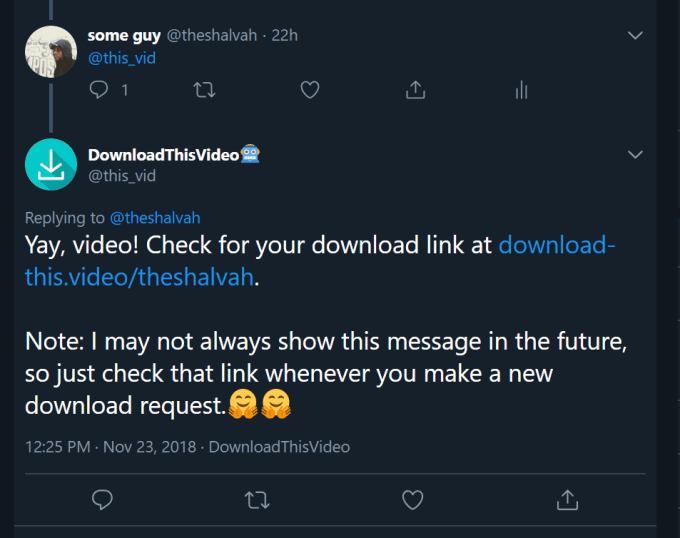
Not all the bots on Twitter are spammers or democracy hackers. You may recall seeing requests to the Thread Reader app bot to “unroll” a long thread into readable copy, for example, and in more recent days you may have spotted Twitter users tagging a newer bot, @this_vid, on tweets with a video file attached. The handy bot (aka DownloadThisVideo) offers a way to download both videos and GIFs from Twitter’s site for easier offline viewing.

The idea for @this_vid comes from Shalvah Adebayo, a backend developer born and raised in Nigeria, and currently living in Lagos. Shalvah says he got into development back in 2013, during his final year of secondary school (high school).

“There was a kid in a lower class that people talked about in awe — ‘he knows programming!,'” explains Shalvah. “I had no idea what it was then,” he continues. “I watched a command-line quiz application he’d made, and I was impressed. I’d won a laptop in a competition a few months back, so the next day, I walked into the only computer shop I knew and asked them for ‘Programming videos.’ They gave me something on C++. I watched those at home that day and went back the next day to buy the actual software (the IDE). That was how I started writing C++,” he says.

Since then, Shalvah moved from C++ to Android development, then web development. He went to university and then quit, and began working in the tech industry. Today, Shalvah works full-time as a remote software engineer for an engineering consultancy and product design company in South Africa called Deimos Cloud.

He builds apps in his spare time as side projects, and has previously open-sourced other bots like @RemindMe_OfThis, which lets you set reminders by tweets, and TwitterThrowback, which is like Twitter’s version of Facebook’s “On This Day” feature.

However, the Twitter video downloader bot has become one of his more popular creations, and is now seeing around 7,500 user requests per day, and as many as 9,500 at peak times.

Shalvah explains he got the idea because it was a personal pain point. Internet access where he lives can be spotty, and the Twitter app’s video experience was not ideal. He said he preferred to download the videos to watch them offline, but couldn’t find any easy way to do so.

“I knew of a couple of sites and apps that did that, but I don’t like installing apps, and I didn’t like the friction involved in using a site,” the developer says. “Plus, I wanted an asynchronous process, where you could just say ‘hey, I want to download this’ and continue browsing Twitter and come back later to pick up your download.”

Plus, Shalvah says he saw a lot of other Twitter users asking how they can get the video posted in nearly every popular thread where someone had tweeted a video.

The bot, @this_vid, has been up and running since May 2018. After sending it out first to his own followers, Shalvah then began to point people to it whenever he saw them asking on a thread how to get a particular video that was shared. This led to its increasing popularity around Twitter.

“I think it really solved a problem for a lot of people, and that was what made it so popular. So there were quite a lot of people, both friends and strangers, that tweeted about it to their followers, and it just kind of grew organically,” he says.

There are some videos that @this_vid can’t download, because the poster — often a sports organization (e.g. The NFL ) — has restricted it from downloads. But in most cases, all you need to do is mention @this_vid in a reply to the original tweet, and you’ll receive a link with the video download in a few minutes.

The bot works by querying the Twitter API for the tweet data, and then retrieves the media URL along with a few other fallbacks.

Because Twitter is rate-limited, allowing the bot only 300 tweets every three hours, Shalvah made the download link for each user easy to remember at: download-this.video/Twitter_username. That way you can get to your downloads even when the bot can’t reply.

The bot itself is free to use, open source and supported through Patreon donations.

There’s some concern that people could download videos they don’t have the rights to through a bot like this, or publish them elsewhere and take credit. Shalvah says he doesn’t believe the bot is in violation of Twitter’s copyright policy, developer terms or rules.

So far, most people seem to be using the bot for personal use. But Twitter hasn’t always been kind to third-party developers, so it remains to be seen how long @this_vid will last.

Shalvah says he intends to keep @this_vid free and will continue to develop it.

Andreessen Horowitz hires its 15th general partner

Andreessen Horowitz, a venture capital fund behind the likes of Facebook, Instagram and Groupon, has tapped David George as its newest general partner and its first top dealmaker focused on late-stage deals. George joins from General Atlantic, where he’d backed consumer internet, enterprise software and fintech startups as a principal since 2012.

“Andreessen has always been a multi-stage investment firm, but really the opportunity here is for [me] to be the first focused late-stage investor there and to work with the early-stage team and complement their experience,” George told TechCrunch.

A16z’s newest general partner David George

At a16z, George will invest across industries, offering up his knowledge of late-stage economics, valuations and underwriting to a16z’s large team of investors. George is the firm’s 15th general partner and at least the fourth high-level addition to the team in the last year, including Katie Haun, who joined in June to lead a16z’s cryptocurrency investment effort. Angela Strange and Connie Chan, additionally, were promoted to GP last summer.

The firm’s swelling team is amongst the largest of any VC firm. Most partnerships consist of one to three top dealmakers and a few partners or principals. A16z breaks the mold with its ever-expanding team of GPs. Managing director Scott Kupor says this is part of the firm’s strategy of attacking every industry head-on.

“This is a market where entrepreneurs have lots of choices and they are making choices on the expertise of the individual partner,” Kupor told TechCrunch. “The purpose of having more GPs is about having the appropriate domain expertise and coverage so we can be in front of the most opportunities out there.”

With that in mind, a16z has no plans to slow down on hiring.

“We want to make sure we have the right coverage of all the domains we are focused on,” Kupor added.

A16z is currently investing out of its fifth flagship venture fund, which closed on $1.5 billion in 2016. The firm has raised two bio funds, deploying capital to early-stage startups at the intersection of computer science and life sciences, as well as a $300 million crypto fund and a cultural leadership fund, which counts Sean “Diddy” Combs, Shonda Rhimes, Jada Pinkett Smith and others as limited partners.

What critics get wrong about the ‘American AI Initiative’

Docs: Israeli AI chip startup Hailo is pursuing an urgent IPO via a SPAC merger at a valuation of less than $500M; it was last valued at $1.2B in 2024 (Meir Orbach/CTech)

Meir Orbach / CTech : Docs: Israeli AI chip startup Hailo is pursuing an urgent IPO via a SPAC merger at a valuation of less than $500M; ...