Staff Selection Commission (SSC) has released result & marks for the post of Library & Information Asst.
Thursday, January 31, 2019

NHM Manipur Recruitment 2019 – 229 Staff Nurse, ANM, MO & Other Posts
National Health Mission (NHM), Manipur recruits 229 Staff Nurse, ANM, MO & Other Posts. Candidates with 10+2, Diploma, Degree, PG can apply from 04 to 16-02-2019.
AIIMS Recruitment 2019 – Apply Online for 1491 Nursing Officer, Cashier & Other Posts
All India Institute of Medical Sciences (AIIMS), New Delhi recruits 1372 Nursing Officer Posts. Eligible candidates may apply Online from 31--01-2019 to 07--02-2019.
ONGC Recruitment 2019 – Apply Online for 908 Asst Technician, Asst & Other Posts
Oil & Natural Gas Corporation Limited (ONGC) recruits 737 Asst Technician & Jr Asst Technician Posts. Candidates with 10th, 12th Class, Diploma, B.Sc can apply online from 31-01-2019 to 20-02-2019.
HAL Recruitment 2019 – Apply Online for 77 Asst & Operator Posts
Hindustan Aeronautics Ltd (HAL) recruits 77 Asst & operator Posts. Candidates with Diploma, PG can apply online from 30-01-2019 to 13-02-2019.
BSNL Recruitment 2019 – Apply Online for 198 JTO Post Details
Bharat Sanchar Nigam Limited (BSNL) recruits 198 JTO (Civil & Electrical) Posts. Candidates with BE/ B.Tech (Civil/ Electrical) can apply online from 11-02-2019 to 12-03-2019.
Wednesday, January 30, 2019
It’s time to pay serious attention to TikTok
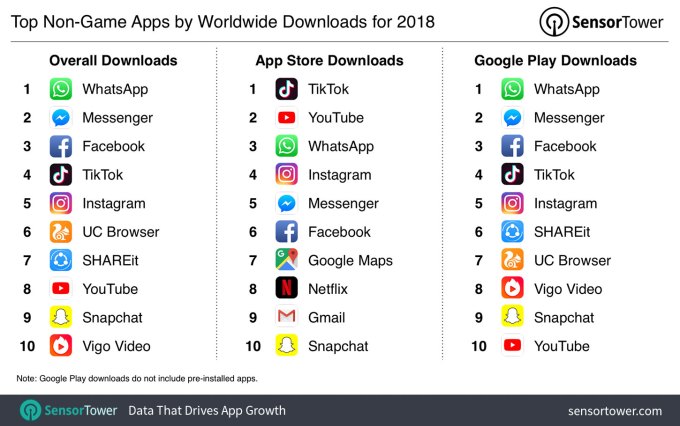
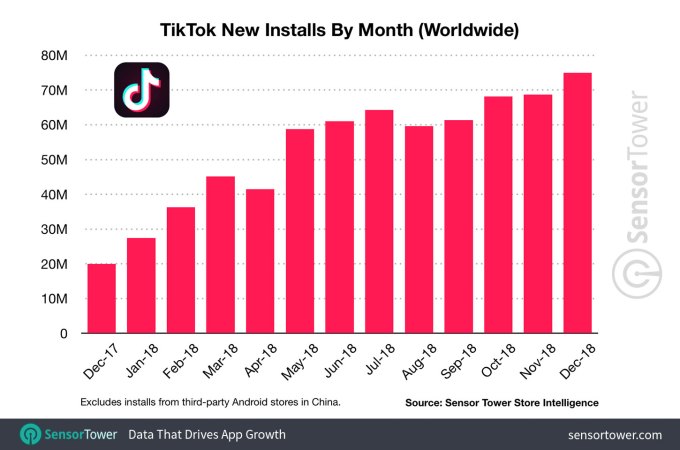
If you haven’t been paying attention to TikTok, you haven’t been paying attention. The short-form video app hailing from Beijing’s ByteDance just had its biggest month ever with the addition of 75 million new users in December — a 275 percent increase from the 20 million it added in December 2017, according a recent report from Sensor Tower.
Despite its rapid rise, there are still plenty of people — often, older people — who aren’t quite sure what TikTok is.
TikTok is often referred to as a “lip-syncing” app, which makes it sound like it’s some online karaoke experience. But a closer comparison would be Vine, Twitter’s still sorely missed short-form video app whose content lives on as YouTube compilations.
While it’s true that TikTok is home to some standard lip-syncing, it’s actually better known for its act-out memes backed by music and other sound clips, which get endlessly reproduced and remixed among its young users.
Its tunes are varied — pop, rap, R&B, electro and DJ tracks serve as backing for its 15-second video clips. But the sounds may also be snagged from YouTube music videos (see: I Baked You A Pie above), SoundCloud or from pop culture — like weird soundbites from Peppa Pig or Riverdale — or just original creations.
These memes-as-videos reference things familiar to Gen Z, like gaming culture (see below). They come in the form of standalone videos, reactions, duets, mirrors/clones and more.
The app has been growing steadily since it acquired its U.S.-based rival Musical.ly in November 2017 for north of $800 million, then merged the two apps’ user bases last August.
This gave TikTok the means to grow in Western markets, where it has attracted the interest of U.S. celebrities like Jimmy Fallon and Tony Hawk, for example, along with YouTubers on the hunt for the next new thing.
But unlike Vine (RIP), YouTube or Instagram, TikTok doesn’t yet feel dominated by micro-celebs, though they certainly exist.
Instead, its main feed often surfaces everyday users — aka, amateurs — doing something cute, funny or clever, with a tacit acknowledgement that “yes, this is an internet joke” underlying much of the content.
Okay, okay.
Sometimes these videos are described as “cringey.”
But that’s because those of us trying to talk about TikTok are old(er) people who grew up on the big ol’ mean internet.
Cringey, frankly, is an unfair label, as it dismisses TikTok’s success in setting a tone for its community. Here, users will often post and share unapologetically wholesome content, and receive less mocking than elsewhere on the web — largely because everyone else on TikTok posts similar “cringey” content, too.
You might not know this, however, if your only exposure to TikTok comes from YouTube’s TikTok Cringe Compilations. But spend a day in the (oddly addictive) TikTok feed, and you’ll find a whole world of video that doesn’t exist anywhere else on the web — including on YouTube. Videos that are weird, sure — but also fun to watch.
It’s a stark comparison to the existing social media platforms.
Users today are engaged in the culture wars on Twitter (ban the Nazis! protect free speech!), while YouTubers are gaming the algorithm with hateful, exploitive, dangerous and otherwise questionable content that freaks out advertisers. And Facebook is, well, contributing to war crimes and the toppling of democracy.
Meanwhile, TikTok presents an alternative version of online sharing. Simple, goofy, irreverent — and frankly, it’s a much needed reset.
For example, some of the popular TikTok memes have included videos of kids proclaiming what a great mom they have, as they drag her into frame, or they remind people to pick up litter and conserve water. They might give themselves silly, but self-affirming makeovers where, afterwards, they cite themselves not as “cute” but rather “drop. dead. gorgeous.”
They might spend hours setting up gummy bears as Adele concert-goers, learning how to do a shuffle dance up a set of stairs or in a dance battle their dad. Or they may showcase some special talent — drawing, painting, gymnastics, dance or skateboarding, perhaps. They do science experiments, make jokes or use special effects for a little video magic.
They shout out “hit or miss!” in public places and wait to see who answers. (Look it up.)
Sometimes it’s dumb, Sometimes it’s clever. But it’s addictive.
Of course, it is still the internet. And TikTok isn’t perfect.
The app has also been the subject of troubling reports about its “dark” side, which is reportedly filled with child predators and teens bullying and harassing one another. It’s not clear, however, that TikTok’s affliction with these matters is any worse than any other large, social, public-by-default app of its size.
And unlike some apps, concerned parents — or the users themselves — can set a TikTok account to private, turn off commenting, hide the account from search, disable downloads, disallow reactions and duets and restrict an account from receiving messages.
It is concerning, however, that under-13 kids are setting up social media accounts without parental consent. (But, uh, have you seen Fortnite and Roblox? This is what kids do. At least the TikTok main feed isn’t worrisome, we’ve found.)
The bigger issue, though — and one that could ultimately prove damaging to TikTok — is whether it will be able to keep up with content filtering and takedown requests, or handle its security and privacy protection issues as it scales up.
Content and community aren’t the only things contributing to TikTok’s growth.
While Vine may have introduced the concept of short-form video, TikTok made video editing incredibly simple. You don’t need to be a video expert to put together clips with a range of effects. It’s the Instagram for the mobile video age — in a way that Instagram itself won’t be able to reproduce, having already aligned its community with influencers and advertisers.
TikTok’s sizable user base, meanwhile, is due not only to its growth in Western markets, but because of its traction in emerging markets like China and India.
This allowed TikTok to rank No. 4 worldwide across iOS and Android, combined, according to App Annie’s data on the most-downloaded apps of 2018. On iOS, TikTok was the No. 1 most-downloaded app of the year, mainly thanks to China.
At times last year, TikTok even ranked higher than Facebook, Instagram, Snapchat and YouTube.
Both App Annie and Sensor Tower agree that TikTok scored the No. 3 position for most installs among all apps worldwide in 2018.
Now, TikTok is growing in India, says Sensor Tower.
The country accounted for 27 percent of new installs between December 2017 and December 2018, and last month was the source for 32.3 million of TikTok’s 75 million total new downloads — a 25x increase from last year.
Some of this growth comes from ad spend, according to a report from Apptopia, which examined the app’s widened use of ad networks. (It’s also driving people bonkers with its YouTube ads).
The revenue is starting to arrive, as well.
Worldwide, users spent $6 million tipping their favorite live streamers, a 253 percent year-over-year jump from December 2017’s total of $1.7 million, Sensor Tower estimates. But live streaming is not the default activity on TikTok — it added the feature after shutting down Musical.ly’s live streaming app, Live.ly.

Above: full-screen ad in TikTok when app is first launched; spotted today
Above: an ad appearing earlier this month
TikTok is also starting to test in-app advertising, and is being eyed by agencies as a result. When you launch TikTok, you may see a full-page splash screen ad of some kind — though the company has not officially launched ad products.

But the brands are starting to take notice. This week, for example, TikTok collaborated with SportsManias, an officially licensed NFL Players Association partner, for the introduction of NFL-themed AR animated stickers in time for the Super Bowl. The move feels like a test for how well branded content will perform within the TikTok universe, but the company says it’s “not an ad deal.”
The company also declined to say how many are today using TikTok.
However, parent company ByteDance had publicly stated last year that it had 500 million monthly active users when it announced the app’s rebranding post-merger. It has yet to release new numbers for its global user base.
That said, ByteDance just shared updated stats for China only, on all versions of the TikTok app (including the non-Google Play Android version). It says that TikTok now has 500 million monthly active users in China alone.
Sensor Tower today estimates TikTok has grown to nearly 800 million lifetime installs, not counting Android in China.
Factoring in those Android in China installs, it’s fair to say this app has topped 1 billion downloads.
Here comes the new new internet, folks. It’s big, dominated by emerging markets, mobile, video, meme-ified, and goes viral both online and off.
So if you haven’t been paying attention to TikTok, you may want to get started.


Knotch raises $25M to help marketers collect data about their content
Knotch announced yesterday that it has raised $25 million in Series B funding.
The round was led by New Enterprise Associates, with NEA’s Hilarie Koplow-McAdams joining the Knotch board of directors. Rob Norman, the former chief digital officer of ad giant GroupM is also joining the board.
“Brands have a desire to understand the effectiveness of their digital content across all channels, a gap that hadn’t been filled before Knotch,” Koplow-McAdams said in a statement. “Our conviction around the Knotch platform and team is driven by their impressive traction and comprehensive product offerings. We’re thrilled to partner with Knotch as they continue their growth trajectory, providing transformative marketing intelligence at scale.”
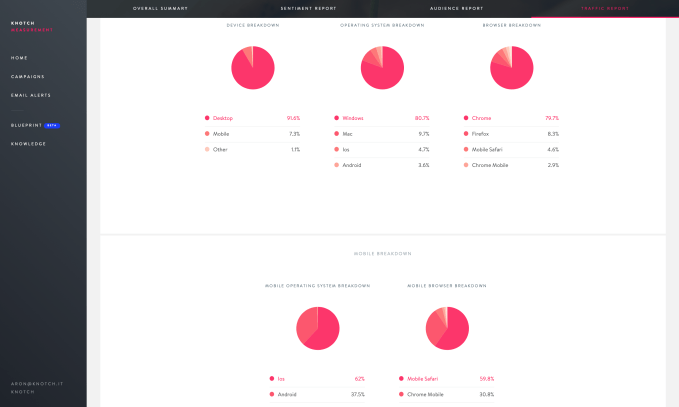
When we first wrote about Knotch back in 2012, it was a consumer product where people could share their opinions using a color scale. It might seem like a stretch go from that to a marketing and data company, but in fact Knotch still collects data using its color-based feedback system — now, it’s using that system to ask consumers about their response to sponsored content.
In addition, Knotch offers a competitive intelligence product, as well as Blueprint, which helps marketers find the best publishers for their sponsored content.
“As [brands are building] their own content hubs and recognizing content as a really key piece of their marketing stack, as they’re turning to this space, there’s not a lot of great options for them to turn to and say, ‘Here’s a way to know in advance which creative themes and topics and formats [are going to resonate].’ Here’s how we optimize this content, here’s a way to benchmark what you’re doing,” founder and CEO Anda Gansca told me.
And it sounds like Gansca’s vision goes beyond sponsored content.
“In this convoluted landscape, you need a partner that is going to be your Switzerland of data, who’s aligned with you, collecting transparent digital performance data across paid and own channels,” she said.
Knotch has now raised a total of $34 million. Customers include JP Morgan Chase, AT&T, Ally Bank, Ford, Calvin Klein and Salesforce.


Argo AI acquires permit to test autonomous vehicles in California
Argo AI, the self-driving car startup that burst onto the scene in 2017 with $1 billion in backing from Ford, has obtained a permit to test its autonomous vehicles in California.
The permit, issued by the California Department of Motor Vehicles, is for one vehicle and two drivers.
Unlike other self-driving car companies, California isn’t the first, or even third, market where Argo AI is testing its tech.
The company, founded by former Google self-driving project veteran Bryan Salesky and Uber Advanced Technologies Group’s former engineering lead Peter Rander, has been busy in its short life, including acquiring LiDAR company Princeton Lightwave.
Argo AI does much of its testing in Pittsburgh, where it’s based. The company is also testing its autonomous vehicle technology in Miami, Detroit and soon Washington, D.C. as part of its relationship with Ford. Argo AI has had vehicles on DC’s streets for months now, mapping roads in the first step toward testing in autonomous mode. Ford said last year that the self-driving vehicles would begin testing on public roads in the first quarter of 2019.
Argo AI is an independent company, although Ford is a major backer and has seats on its board. Ford is also Argo AI’s only customer — at least for the moment. Argo AI is developing the virtual driver system and high-definition maps designed for Ford’s self-driving vehicles. Ford has said it plans to launch a self-driving taxi and delivery service in 2021.
It’s not clear if Argo AI’s plans to test in California are part of its relationship with Ford, are related to a new customer or are part of its testing program. TechCrunch will update the story when it learns more.


Apple’s global active install base of iPhones surpassed 900 million this quarter
It’s not surprising that Apple has a massive active install base of iPhones across the globe, but we now finally have an exact number to put behind it. During its Q1 earnings call, CFO Luca Maestri shared the install base for the first time.
“Our global active install base of iPhone continues to grow and has reached an all-time high at the end of December,” Maestri said. “We are disclosing that number now for the first time; it has surpassed 900 million devices.”
Apple has previously detailed the total active install base of its products. They updated the number today to 1.4 billion devices worldwide at the end of December 2018, up from 1.3 billion at the end of January 2018. It’s interesting that Apple has decided to break out iPhone device numbers even as it shies away from releasing unit sales in its earning calls from this point moving forward.
Maestri detailed that Apple would continue to offer updates on the iPhone install base and total install base on a “periodic basis.”
Apple seems to be seeking bright spots wherever they can find them; the Q1 2019 earnings didn’t deliver great news for the company despite beating already reduced market expectations. iPhone revenues were down 15 percent.


Facebook, Google and Twitter told to do more to fight fake news ahead of European elections
A first batch of monthly progress reports from tech giants and advertising companies on what they’re doing to help fight online disinformation have been published by the European Commission.
Platforms including Facebook, Google and Twitter signed up to a voluntary EU code of practice on the issue last year.
The first reports cover measures taken by platforms up to December 31, 2018.
The implementation reports are intended to detail progress towards the goal of putting the squeeze on disinformation — such as by proactively identifying and removing fake accounts — but the European Commission has today called for tech firms to intensify their efforts, warning that more needs to be done in the run up to the 2019 European Parliament elections, which take place in May.
The Commission announced a multi-pronged action plan on disinformation two months ago, urging greater co-ordination on the issue between EU Member States and pushing for efforts to raise awareness and encourage critical thinking among the region’s people.
But it also heaped pressure on tech companies, especially, warning it wanted to see rapid action and progress.
A month on and it sounds less than impressed with tech giants’ ‘progress’ on the issue.
Mozilla also signed up to the voluntary Code of Practice, and all the signatories committed to take broad-brush action to try to combat disinformation.
Although, as we reported at the time, the code suffered from a failure to nail down terms and requirements — suggesting not only that measuring progress would be tricky but that progress itself might prove an elusive and slippery animal.
The first response certainly looks to be a mixed bag. Which is perhaps expected given the overarching difficulty of attacking a complex and multi-faceted problem like disinformation quickly.
Though there’s also little doubt that opaque platforms used to getting their own way with data and content are going to be dragged kicking and screaming towards greater transparency. Hence it suits their purpose to be able to produce multi-page chronicles of ‘steps taken’, which allows them to project an aura of action — while continuing to indulge in their preferred foot-drag.
The Guardian reports especially critical comments made by the Commission vis-a-vis Facebook’s response, for example — with Julian King saying at today’s press conference that the company still hasn’t given independent researchers access to its data.
“We need to do something about that,” he added.
Here’s the Commission’s brief rundown of what’s been done by tech firms but with emphasis firmly placed on what’s yet to be done:
- Facebook has taken or is taking measures towards the implementation of all of the commitments but now needs to provide greater clarity on how the social network will deploy its consumer empowerment tools and boost cooperation with fact-checkers and the research community across the whole EU.
- Google has taken steps to implement all its commitments, in particular those designed to improve the scrutiny of ad placements, transparency of political advertisement and providing users with information, tools and support to empower them in their online experience. However some tools are only available in a small number of Member States. The Commission also calls on the online search engine to support research actions on a wider scale.
- Twitter has prioritised actions against malicious actors, closing fake or suspicious accounts and automated systems/bots. Still, more information is needed on how this will restrict persistent purveyors of disinformation from promoting their tweets.
- Mozilla is about to launch an upgraded version of its browser to block cross-site tracking by default but the online browser should be more concrete on how this will limit the information revealed about users’ browsing activities, which could potentially be used for disinformation campaigns.
Commenting in a statement, Mariya Gabriel, commissioner for digital economy and society, said: “Today’s reports rightly focus on urgent actions, such as taking down fake accounts. It is a good start. Now I expect the signatories to intensify their monitoring and reporting and increase their cooperation with fact-checkers and research community. We need to ensure our citizens’ access to quality and objective information allowing them to make informed choices.”
Strip out the diplomatic fillip and the message boils down to: Must do better, fast.
All of which explains why Facebook got out ahead of the Commission’s publication of the reports by putting its fresh-in-post European politician turned head of global comms, Nick Clegg, on a podium in Brussels yesterday — in an attempt to control the PR message about what it’s doing (or rather not doing, as the EC sees it) to boot fake activity into touch.
Clegg (re)announced more controls around the placement of political ads, and said Facebook would set up new human-staffed operations centers — in Dublin and Singapore — to monitor how localised political news is distributed on its network.
Although the centers won’t launch until March. So, again, not something Facebook has done.
The staged press event with Clegg making his maiden public speech for his new employer may have backfired a bit because he managed to be incredibly boring. Although making a hot button political issue as tedious as possible is probably a key Facebook strategy.
Anything to drain public outrage to make the real policymakers go away.
(The Commission’s brandished stick remains that if it doesn’t see enough voluntary progress from platforms, via the Code, is to say it could move towards regulating to tackle disinformation.)
Advertising groups are also signed up to the voluntary code. And the World Federation of Advertisers (WFA), European Association of Communication Agencies and Interactive Advertising Bureau Europe have also submitted reports today.
In its report, the WFA writes that the issue of disinformation has been incorporated into its Global Media Charter, which it says identifies “key issues within the digital advertising ecosystem”, as its members see it. It adds that the charter makes the following two obligation statements:
We [advertisers] understand that advertising can fuel and sustain sites which misuse and infringe upon Intellectual Property (IP) laws. Equally advertising revenue may be used to sustain sites responsible for ‘fake news’ content or ‘disinformation’. Advertisers commit to avoiding (and support their partners in the avoidance of) the funding of actors seeking to influence division or seeking to inflict reputational harm on business or society and politics at large through content that appears false and/or misleading.
While the Code of Practice doesn’t contain a great deal of quantifiable substance, some have read its tea-leaves as a sign that signatories are committing to bot detection and identification — by promising to “establish clear marking systems and rules for bots to ensure their activities cannot be confused with human interactions”.
But while Twitter has previously suggested it’s working on a system for badging bots on its platform (i.e. to help distinguish them from human users) nothing of the kind has yet seen the light of day as an actual Twitter feature. (The company is busy experimenting with other kinds of stuff.) So it looks like it also needs to provide more info on that front.
We reached out to the tech companies for comment on the Commission’s response to their implementation reports.
Google emailed us the following statement, attributed to Lie Junius, its director of public policy:
Supporting elections in Europe and around the world is hugely important to us. We’ll continue to work in partnership with the EU through its Code of Practice on Disinformation, including by publishing regular reports about our work to prevent abuse, as well as with governments, law enforcement, others in our industry and the NGO community to strengthen protections around elections, protect users, and help combat disinformation.
A Twitter spokesperson also told us:
Disinformation is a societal problem and therefore requires a societal response. We continue to work closely with the European Commission to play our part in tackling it. We’ve formed a global partnership with UNESCO on media literacy, updated our fake accounts policy, and invested in better tools to proactively detect malicious activity. We’ve also provided users with more granular choices when reporting platform manipulation, including flagging a potentially fake account.
At the time of writing Facebook had not responded to a request for comment.


Apple is rethinking international iPhone pricing as revenues slip
When Apple lowered guidance on earnings earlier this month, it cited markets like China as a major factor in its disappointing numbers. Sure enough, when earnings hit today, things didn’t look great, as iPhone revenues dipped 15 percent year over year for the quarter.
In an interview with Reuters earlier today, Tim Cook noted that the company is reassessing how it sells handsets outside of the U.S. Apple has traditionally relied on the U.S. dollar to set the price, which has led to steeper costs internationally.
“When you look at foreign currencies and then particularly those markets that weakened over the last year those (iPhone price) increases were obviously more,” the CEO said. “And so as we’ve gotten into January and assessed the macroeconomic condition in some of those markets we’ve decided to go back to more commensurate with what our local prices were a year ago in hopes of helping the sales in those areas.”
There are, of course, a lot of factors at play here. For one thing, global smartphone numbers have been on the decline for the first time since analysts began recording such figures. Handsets have gotten pretty good across the board and afforded fewer killer reasons to upgrade every two or so years.
Economic factors are also at play in a major way. That certainly goes for China, where the country’s slowed growth has led to fewer large purchases. A looming trade war between the U.S. and China has had an impact as well, with tariffs and other factors, as companies like Huawei have managed to buck the trend in their home country.


Subscribe to:
Comments (Atom)
Medvi, glorified by the NYT as a two-employee startup with $1B+ in revenue, is a warning about how AI can be misused for shady business and marketing practices (Gary Marcus/Marcus on AI)
Gary Marcus / Marcus on AI : Medvi, glorified by the NYT as a two-employee startup with $1B+ in revenue, is a warning about how AI can be...

-
The first project we remember working on together was drawing scenes from the picture books that our mom brought with her when she immigrate...
-
Sohee Kim / Bloomberg : South Korean authorities are investigating a data leak at e-commerce giant Coupang that exposed ~33.7M accounts; ...

