Saturday, December 1, 2018

There’s definitely reason to worry about Brexit, says Accel’s London team

Longtime Accel partners Philippe Botteri, Sonali De Rycker, Luciana Lixandru and Harry Nelis took the stage at Disrupt Berlin earlier today, and unlike many London-based investors, who have downplayed how much Brexit could hurt their local economy, the team was frank about their sundry concerns over what happens if the U.K. leaves the European Union as is currently scheduled to happen, beginning March 29, 2019.

Though they reiterated that no one can know for certain what Brexit’s impact might be, Botteri raised a handful of things that have the firm worried, beginning with “immigration and hiring talent and the movement of talent,” which could be meaningfully hampered by Brexit. “Even companies that don’t move their headquarters to London will often at some point begin to build a team,” he noted, questioning whether that will continue to happen.

There’s also the nontrivial issue of what happens to fintech companies, which have been thriving in London as a gateway between the U.S. and Europe and that have easily operated across all of Europe. Asked Botteri, “What about that?” post Brexit.

Others of the teams’ concerns center on data resiliency and subsidies. Regarding the first, Botteri noted that “more and more” of Accel’s portfolio companies are “dependent on the use and leverage of data, and obviously,” he continued, “where the data is stored is very critical. You have laws in the EU. If the U.K. is out [that bloc], then does it mean that every company will need to have a separate data center in the U.K. or manage data differently?” As for subsidies, Botteri observed that U.K. startups have received meaningful R&D support from the European Union, and well as the U.K., and wondered aloud how a split will impact startups.

Botteri then offered on a personal note that, “It’s not just startups. I’m not a U.K. citizen. I’d love to know at some point what’s going to happen to my visa,” he said with an uncomfortable laugh.

The partners didn’t talk about Brexit alone. Instead, among other topics covered in the discussion were the downstream effects of having a player like SoftBank’s Vision Fund in the market, and whether the secondary market is picking up in Europe as many regional companies — like their U.S. counterparts — linger ever longer as privately held companies.

Of SoftBank and the $100 billion that it’s currently plugging into startups around the world, Nelis initially answered generally, saying that it’s a “great trend for there to be more money for the European ecosystem. More money means more opportunities for great companies to be funded.”

He later added that he does think SoftBank’s appearance on the investing scene “changes the dynamic in the market. SoftBank is later-stage oriented and competing with other later-stage funds, so [what’s happening] is these [later-stage] funds are [trying to reach startups] a little bit earlier. So there’s this chain effect, where everyone needs to go earlier [stage] in order to accommodate this big amount of money.”

As for the biggest backer of SoftBank Vision Fund, Crown Prince Mohammad Bin Salman, who has been tied by U.S. officials to the brutal murder of Saudi journalist Jamal Khashoggi, the association is not prompting questions from founders regarding who, exactly is funding venture capital firms. Not yet, said De Rycker.

In part, she suggested, founders don’t have the time to give it as much thought as they perhaps should.

“The world right now is in such a race, it’s moving so fast . . . that I fear to say that for some of these questions, it matters at the core expense of some of these questions around where is the money coming from and what it means for your direction and who you are accountable to.” If a startup can “go forward without asking too many questions right now, why wouldn’t you, especially if you can get a lot of capital at a very high price?”

Before the foursome exited the stage, the partners touched on the secondary market, saying that though there is one, it’s not quite as evolved as in the U.S., where secondaries have become a routine way for venture capitalist to exit all or part of their investments.

“Primarily in Europe,” said Nelis, “secondaries are used to providing liquidity to founders. We’re very long-term investors, where we’re involved eight, nine, 10 years with our companies,” with Accel’s main objective being to “build big, valuable businesses, and to exit these companies when the founders do.”

If founders take a “little bit of money off the table” so they can “go and build a big company, rather than sell it halfway through the process,” he added, “that’s a good thing.”

Asked how soon is too soon to do that, the firm declined to comment directly. Instead, Botteri said that it hasn’t noticed any changes on this front over the last five years.

Asana raises $50M, Airbnb gets a new CFO and a 2019 IPO preview

Hello and welcome back to Equity, TechCrunch’s venture capital-focused podcast, where we unpack the numbers behind the headlines.

This week as TechCrunch Disrupt Berlin came to life, Kate Clark and I snagged some mics and dug through the biggest news of the week (a $50 million check), and talked through who may go public next year and what those IPOs might look like.

Our usual fare, if you will. (If you are missing Danny and Connie, fear not, they will be back next week.)

This week we hit two news items and one roundup. Here’s the skinny:

  • Asana raises $50 millionYep, Asana went back to the funding well this week for its Series E, despite having raised a $75 million Series D earlier this year. The company’s funding pace might seem aggressive, but we’re hearing that many startups are looking to tack on extra cash. Why? Because the market might change, and so the savvy are stacking chips in case the cashier closes. Oh, and the company dropped a number of relative growth metrics that were, I have to say, impressive.
  • Airbnb gets a new CFO. After its old CFO took off, Airbnb’s eventual IPO was on hold. You can’t go public without a CFO. But now it has one! And that means that the company can eventually sell shares on a public exchange, whenever it deigns to sell equity to the hoi polloi. But put your checkbook down, as it’s far from clear precisely when Airbnb will pull the trigger and give us an S-1.
  • Speaking of which, let’s talk decacorn IPOs. Not my best segue, but it’ll do. There are a number of private tech companies worth $10 billion or more (10x unicorns, or, ahem, decacorns) that will probably try to go public next year. You can read about it here, but the gist is that Uber, Lyft, Pinterest and Airbnb need to go public, and there’s reason to believe that they are going to do it next year.

All that and we managed to mispronounce “EBITDA” a few times.

That’s Equity for this week. Have a listen and we’ll be back in just seven days!

Equity drops every Friday at 6:00 am PT, so subscribe to us on Apple PodcastsOvercast, Pocket Casts, Downcast and all the casts.

Shuttle business Via could add scooters to its lineup

Via, a shuttle-based carpooling service and platform that partners with cities in the U.S. and Europe, could soon add scooters to its business.

Via CEO and co-founder Daniel Ramot said onstage at TechCrunch Disrupt Berlin that the company is experimenting with the idea of adding scooters as a complement to its shuttle business.

“We’re also adding scooters mostly, again, for our partner cities, where they’re going to provide a holistic transportation solution as a public transit offering to the residents,” Ramot said.

Via’s consumer-facing shuttles are in Chicago, Washington, D.C. and New York. The company also partners with cities and transportation authorities, giving clients access to their platform to deploy their own shuttles. For instance, Austin’s Capital Metropolitan Transportation Authority uses the Via platform to power the city’s Pickup service. Via’s platform is also used by Arriva Bus UK, a Deutsche Bahn Company, for a first and last-mile service connecting commuters to a high-speed train station in Kent, U.K.

Via hasn’t launched scooters yet. But Ramot told TechCrunch backstage that Via is looking at launching scooters in Sacramento and is already in talks with city officials. The approach would be to add scooters in cities where it already has a presence. Scooters wouldn’t be launched without its core shuttle business or platform, Ramot said.

Via is still very much focused on building out its shuttle platform. By the end of next year, Via wants to be in about 300 cities powering the public transit system, Ramot said.

Sweetgreen is opening up order-ahead locations inside WeWork

Salad startup Sweetgreen is expanding on a pilot program with WeWork that provides free delivery to WeWork members. Though, it’s more accurate to describe it as an order-ahead service that lets you pick up your food from your WeWork of choice.

Geared toward WeWork employees and members, Sweetgreen at WeWork outposts are going live in seven cities in the country. Across those seven cities, which include New York, Los Angeles, San Francisco, Chicago, Washington, D.C., Philadelphia and Boston, Sweetgreen at WeWork has plans to cover 50 WeWork locations.

“WeWork and sweetgreen share a vision for creating community and being more conscious global citizens, fostering discussion and recognition of the way our actions impact ourselves, our communities, and the world around us,” WeWork president and CFO Artie Minson said in a press release. “Together, we are bringing sweetgreen’s offerings directly to thousands of WeWork members and employees while leveraging WeWork’s platform to support sweetgreen’s continued scale. While Outposts presents an exciting new opportunity, it only represents the beginning of this long-term, strategic partnership by our two mission-driven companies.”

At these locations, WeWork members and employees can place an order via Sweetgreen’s web or mobile platform, and then select their specific WeWork as the pickup location. From there, Sweetgreen delivers to that location at a select time.

This announcement comes shortly after Sweetgreen officially became a unicorn following a $200 million Series H round led by Fidelity. That round brought Sweetgreen’s total amount of funding to $365 million.

With the additional $200 million in funding, Sweetgreen is setting its eyes on other food categories and looking to expand its delivery offerings. Sweetgreen is also looking at using blockchain technology to create more transparency in the supply chain.

Apple Music is coming to the Amazon Echo

Starting mid-December, Amazon Echo devices will be able to stream songs from Apple Music. A bit of a surprise, perhaps, given that Apple’s been a competitor in the space since launching the HomePod back in 2017.

Amazon’s had its own music service for some time, as well, but the company appears to have given up on the dream of being a serious competitor in the space — for now, at least. Instead, Echo smart speakers offer native support for a decent cross-section of streaming services, including Pandora, Spotify, iHeartRadio and TuneIn.

The new skill lets users play specifics songs, genres, playlists and the Beats 1 station through the smart speakers. Adding Apple Music will help the popular smart home products tap into a rapidly growing service.

The company cracked 50 million subscribers earlier this year. That’s still well behind the 83 million paid subscribers Spotify announced back in July, but this addition should help give Amazon an added advantage against Google’s Home devices, particularly here in the States, where the bulk of Apple Music subscribers reside.

For Apple’s part, the offering brings Music to much more accessible hardware. The HomePod currently runs $349 — several times the price of the entry-level Echo Dot. The new skill arrives on Echo devices the week of December 17.

Facebook quietly hired Republican strategy firm Targeted Victory

Facebook is still reeling from the revelation that it hired an opposition research firm with close ties to the Republican party, but its relationship with Definers Public Affairs isn’t the company’s only recent contract work with deeply GOP-linked strategy firms. While that work alone isn’t cause for controversy, Facebook’s work with Republican groups does call into question the ongoing narrative that Facebook operates with an anti-conservative bias.

According to sources familiar with the project, Facebook also contracted with Targeted Victory, described as “the GOP’s go-to technology consultant firm.” Targeted Victory worked with Facebook on the company’s Community Boost roadshow, a tour of U.S. cities meant to stimulate small business interest in Facebook as a business and ad platform. The ongoing Community Boost initiative, announced in late 2017, kicked off earlier this year with stops in cities like and Topeka, Kansas and Albuquerque, New Mexico.

Facebook also worked with Targeted Victory on the company’s ad transparency efforts. Over the last year, Facebook has attempted to ward off regulation from Congress over ad disclosure, even putting forth some self-regulatory efforts to appease legislators. Specifically, it has dedicated considerable lobbying resources to slow any progress from the Honest Ads Act, a piece of legislature that would force the company to make retain copies of election ads, disclose spending and more. Targeted Victory, a digital strategy and marketing firm, is not a registered lobbyist for Facebook on any work relating to ad transparency. 

Targeted Victory

On his company biography page, Targeted Victory founder and CEO Zac Moffatt describes his experience helping companies “enhance their brand and get their message out in the current political and media environment,” mentioning Facebook, FedEx and Gillette as corporate clients. The bio page appears to be one of the only public mentions of his work with Facebook and the company was not mentioned alongside Gillette and FedEx on his Linkedin page.

TechCrunch reached out to Facebook to ask if it also contracted with equivalent left-leaning groups or other political firms it was willing to disclose because information about the many firms a company like Facebook contracts with is generally not openly available. The company declined to comment on its political contract work and on the nature of its work with Targeted Victory.

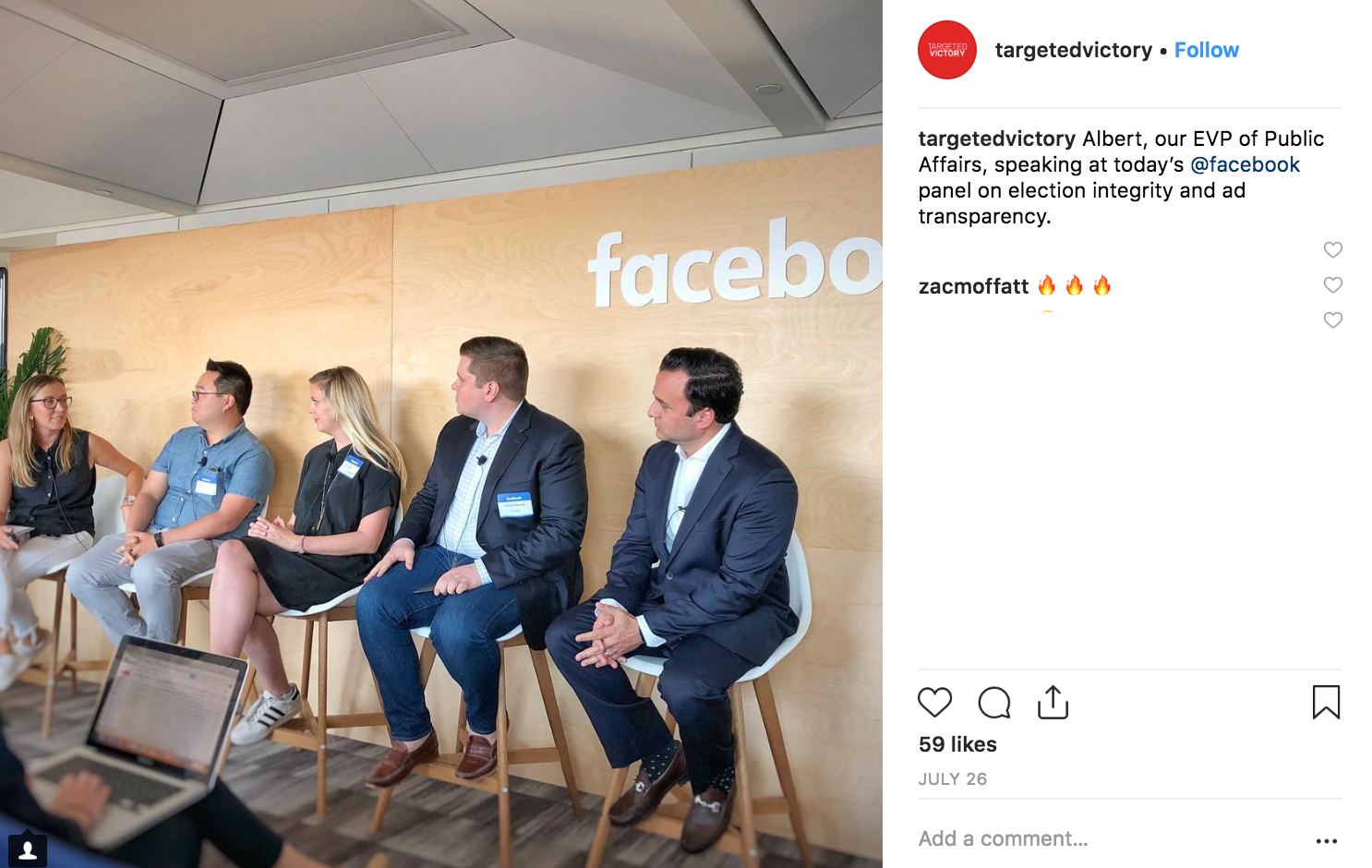
In July and September of this year, Facebook hosted members of Targeted Victory for panels on election integrity and ad transparency, as well as best practices for election season. It’s unclear if Facebook disclosed its financial relationship to the company at the time.

Facebook panel

In March of 2017, a blog post by Targeted Victory mentioned that a new investment would “strengthen [Targeted Victory’s] already unmatched relationships with top teams at Facebook, Google, Twitter and Snapchat” indicating that the company had an established rapport with Facebook and other major tech companies at the time. TechCrunch contacted Targeted Victory about the nature of its work for this story but did not receive a reply.

Like Definers, Targeted Victory was founded by digital team members from Mitt Romney’s 2012 presidential campaign who formed their own companies in the election’s aftermath. As TechCrunch previously reported, Facebook’s communications team has a number of ties to Romney’s campaign. The company’s contract work with Definers arose out of those connections, particularly through Andrea Saul, Facebook’s Director of Policy Communications . Though the depth of Facebook’s work with Targeted Victory is not yet known, TechCrunch will continue to report what it learns. 

Prior to Targeted Victory, Moffatt served as the digital director on the Romney campaign, founding his company after the campaign dissolved. Before working on the campaign, Moffatt worked for the Republican National Committee. 

While the extent of Targeted Victory’s work with Facebook is not clear, Moffatt’s firm provides a range of potentially relevant services. On its website, Targeted Victory advertises “public affairs, advertising, media planning, fundraising and reputation management.” The company also offers services in online political advertising and voter targeting as dual areas of expertise. 

Moffatt’s opposition of regulation efforts targeting online political advertising is well known. In an interview with Axios last year, Moffatt criticized congressional interest in regulating political ads. “No government regulator, and very few members of the media, understand how these mediums are being leveraged by campaigns,” Moffatt said, dismissing potential regulation for tech platforms as “a knee-jerk reaction.”

Late last year, Moffatt suggested that Facebook’s efforts to self regulate could boost the social giant’s profits. Specifically, that Facebook’s decision to ask political groups to publish the ads they buy could generate even more interest in ad buys as firms see what their rivals are up to and ratchet up their spending.

Facebook’s visible political money

The world’s largest social network might be regarded as a just another liberal Silicon Valley stronghold by critics on the right, but Facebook’s financial disclosures and contract work tell a fairly different story. Facebook’s lobbying and federal political contributions in recent years depict a company with financial heft doled out to both the left and the right. Facebook’s federal lobbyists and political donations are registered in searchable public databases, but, as with any company, that data only reveals the surface layer of political relationships.

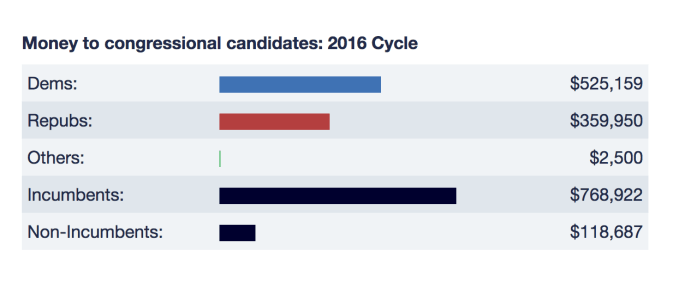
Facebook 2016 congressional contributions via OpenSecrets.org

Over the last three years, Facebook’s registered lobbying expenditures were mostly spent on large, uncontroversial bipartisan firms, a few smaller groups with specific partisan ties and a smattering of other issue-specific specialists. For example, Facebook brought on a Democratic former Senate chief of staff for lobbying related to “data security, online privacy, and elections integrity” and a firm called Capitol Tax Partners to lobby around tax reform.

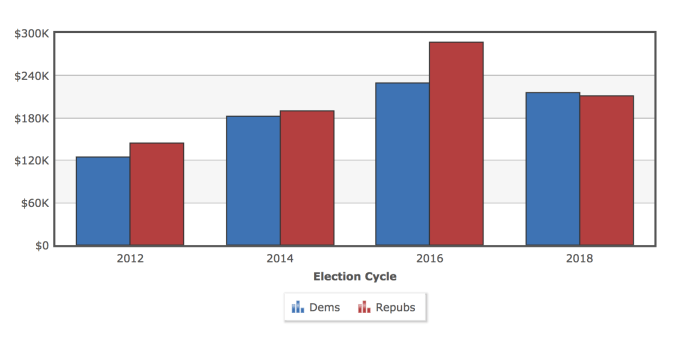
Facebook PAC Contribution Summary via OpenSecrets.org

Historically, Facebook’s donations to Democratic candidates outweigh those to Republicans, though the numbers approached parity in the 2012 and 2014 election cycles. On the other hand, Facebook’s PAC, established in 2011, favored Republican candidates in three of the last four national election cycles, tipping Democratic by a margin of 1% in 2018. In 2016 Facebook’s PAC gave 44% of contributions to Democrats and 55% to Republican candidates.

At Facebook, Vice President of Global Public Policy Joel Kaplan “oversees all corporate political activity, including lobbying activities and political contributions.” A prominent Republican, Kaplan also oversees Facebook’s state level contributions, collected here, with the help of members of the company’s Public Policy, Legal and Communications departments. Kaplan made headlines in September when he sat in support of Brett Kavanaugh, the Supreme Court nominee accused of sexual violence and later confirmed. Following the confirmation, Kaplan and his wife hosted a party for Kavanaugh.

Making amends with conservatives

It’s not clear when Facebook’s relationship with Targeted Victory began and whether Facebook has ramped up relationships with conservative consultants in recent years or held them steady.

In May 2016, Moffatt attended a high profile meeting with Mark Zuckerberg, Sheryl Sandberg and 15 other prominent conservatives. Facebook ostensibly organized the meeting to mend fences with Republicans who were criticizing the social giant for a perceived bias against conservatives.

“I know many conservatives don’t trust that our platform surfaces content without a political bias,” Mark Zuckerberg said in a Facebook post following the meeting. “I wanted to hear their concerns personally and have an open conversation about how we can build trust.”

After the meeting, Moffatt remarked that anyone who didn’t see Facebook’s bias against conservative voices, part of a broader perceived trend in left-leaning Silicon Valley, “is completely missing the larger picture.”

In spite of the Facebook’s apparent financial ties to some of the GOP’s most closely held strategic groups, its Republican-helmed D.C. office and its contributions to candidates on both the left and right, criticisms that Facebook operates with a left-leaning bias remain a familiar chorus.

For his part, Moffatt was cautiously optimistic following the 2016 meeting with Sandberg and Zuckerberg, noting that “he would actually commend Facebook for being the only one of the major tech groups in Silicon Valley that’s willing to have conversations like this.”

Know anything about this story and have something to add? Email taylor.hatmaker@techcrunch.com. Secure contact for files and sensitive info: Signal 510.545.3125 or thatmaker@protonmail.com.

UrbanClap, India’s largest home services startup, raises $50M

UrbanClap, a four-year-old startup that offers home services across India, has closed a $50 million Series D round for expansion.

The round was led by Steadview Capital, a hedge fund with more than $1 billion under management, and existing investor Vy Capital. It takes UrbanClap to $110 million raised to date, according to data from Crunchbase.

Via its platform, UrbanClap matches service people, such as cleaners, repair staff or beauticians, with customers across 10 cities in India. Co-founder and CEO Abhiraj Bhal told TechCrunch that the business supports 15,000 “micro-franchisees” with around 450,000 transactions taking place each month.

“Micro-franchisees” is an interesting term — I’ve not heard it used much, even in the buzzword-heavy world of tech startups — but Bhal explained his vision to enable service workers to earn more and enjoy greater control of their work and, consequently, overall life.

For example, he said, the typical salary for an offline service worker might be in the region of 10-15,000 INR (up to $215) while, for those operating independently, their flow of work would be tied to a middleman, store or word of mouth networks. UrbanClap offers a more direct model, with workers keeping 80 percent of the cost of their jobs. That, Bhal said, means workers can earn multiples more and manage their own working hours.

“The UrbanClap model really allows them to become service entrepreneurs,” he said. “Their earnings will shoot up two or three-fold, and it isn’t uncommon to see it rise as much as 8X — it’s a life-changing experience.”

Beyond helping workers with their job, UrbanClap also provides training, credit, basic banking and more. Bhal said that around 20-25 percent of applicants are accepted into the platform, that’s a decision based on in-person meetings, background and criminal checks, as well as a “skills” test. Workers are encouraged to work exclusively — though it isn’t a requirement — and they wear UrbanClap outfits and represent the brand with customers.

While there is encouragement, there is also a level of monitoring. If a worker’s average review for their last 30/50 jobs (dependent on vertical) drops below 4.0, the system stops sending them work. There is an opportunity to appeal, retrain and return to the platform, except in cases of poor attitude, misconduct and other serious misdemeanors, Bhal said. He declined to provide numbers for dropouts but said that the retention rate is “healthy.”

UrbanClap founders (left to right) Abhiraj Bhal, Raghav Chandra and Varun Khaitan started the business in 2014

UrbanClap expanded to Dubai, the capital of the UAE, six months ago, so it would be logical to think this new capital will go toward further expansions. No so, according to Bhal. The company is instead going after tier-two cities in India and working to deepen its position in its existing locations. In short, there’s no additional overseas plan at this point.

“In many ways, we think about the Dubai move as an extension of India [Dubai has a strong presence of Indian and South Asia nationals] rather than an international expansion — a little like a U.S. company going into Canada,” Bhal explained. “We believe we have enough headroom to grow in India and Dubai; these are fairly unpenetrated markets.”

Elaborating on that thinking, Bhal said that online is just a small component of all local service jobs in India.

“We need to get to double digital penetration of the offline market,” he said. “We think we could grow 10, 20 or 100 times from where we are right now.”

The company isn’t profitable yet and Bhal isn’t sharing revenue details, other than the fairly hazy detail that revenue is growing 3X per year. Rival Housejoy, which includes Amazon among its shareholders, went through some fairly well-publicized issues this year resulting in layoffs and, according to reports, efforts to sell the business.

Bhal didn’t comment directly on those reports, but he did say that if the company did do an acquisition, it would be focused on “adjacent spaces we aren’t in yet” as opposed to a direct competitor for growth.

He was somewhat more forthcoming on the future exit plan for UrbanClap, which did allow some secondary sales within this Series D round. Bhal said he fully intends to take the company public but he said that there’s no firm plan on when, or indeed where, that might happen.

“Eventually we will look to go public,” he said. “But we’re a few years away from that — we need to earn the right, which means being a scalable and profitable company.”

UK accountancy regulator FRC says auditors can't blame AI for audit failures, after it published what it called the world's first guidance on auditor AI usage (Ellesheva Kissin/Financial Times)

Ellesheva Kissin / Financial Times : UK accountancy regulator FRC says auditors can't blame AI for audit failures, after it published...